Gemstones of Zhejiang: Changhua Chicken-Blood Stone, Qingtian Stone, & Zhuji Pearls | Gems of China Series
In this edition of our Gemstones of China series, we travel to East China to uncover the hidden geological treasures of Zhejiang Province.
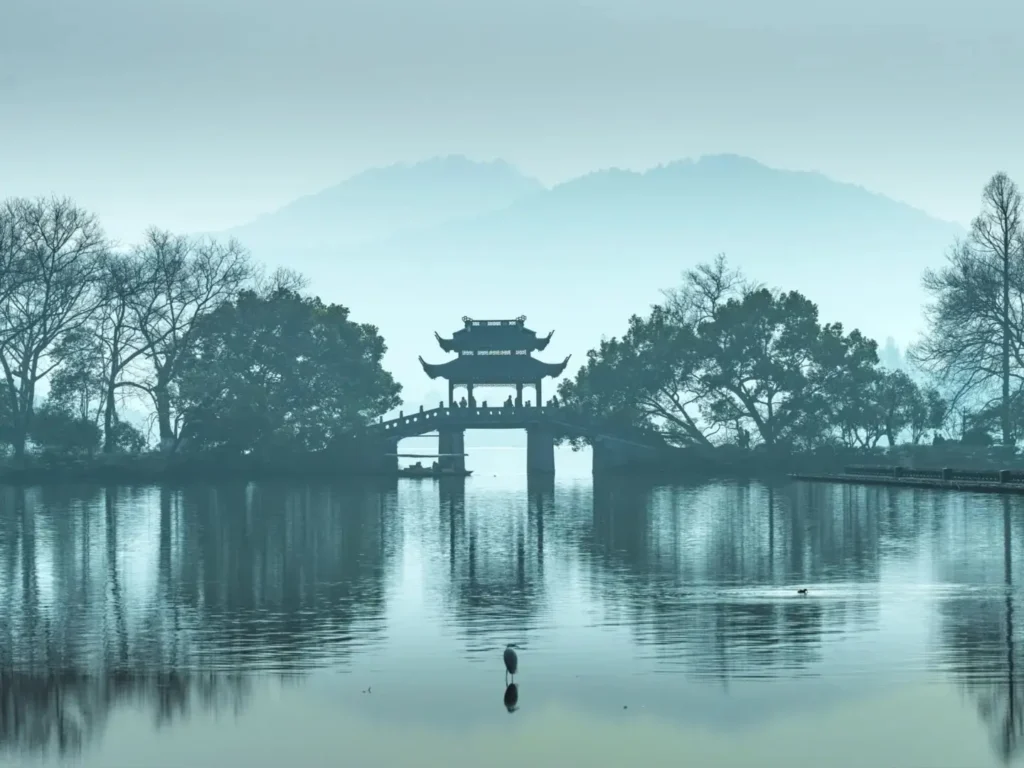
Zhejiang is a true wonderland. If you love breathtaking scenery, you will find West Lake in Hangzhou, the ancient water town of Wuzhen in Jiaxing, and the misty, ethereal peaks of Lishui. Food lovers can indulge in Ningbo sticky rice balls, Jiaxing savory zongzi, Shaoxing stinky tofu, and world-famous Jinhua ham. For culture enthusiasts, the region offers exquisite Hangzhou silk, traditional West Lake oil-paper umbrellas, and historic Nijin lacquerware.
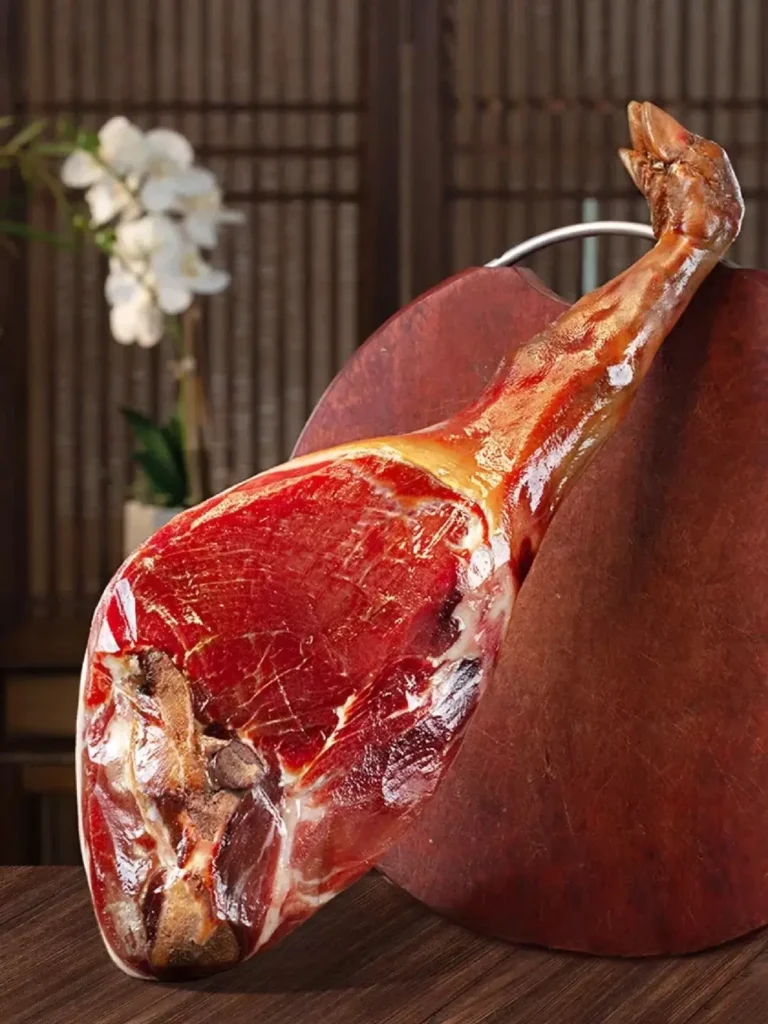
Zhejiang seamlessly blends a thriving modern economy with deep cultural roots, offering everything one could want in a beautiful lifestyle. Though relatively small in geographic size, this province boasts incredible mineral wealth. Geologists have discovered 93 different types of minerals here across 2,343 recorded mining sites.
Today, we are taking you on a journey to explore three of the most iconic Zhejiang gemstones: the legendary Changhua chicken-blood stone, the 6,000-year-old Qingtian stone, and the world-renowned Zhuji pearls.
Changhua Chicken-Blood Stone: The Vivid Crimson Gem
China is known for four famous seal stones: Changhua Chicken Blood Stone, Balin Chicken Blood Stone, Qingtian Stone, and Shoushan Stone. Among them, the Changhua chicken-blood stone reigns supreme. Prized for its vibrant color, unique patterns, and striking beauty, collectors affectionately call it the “Queen of Seal Stones.”
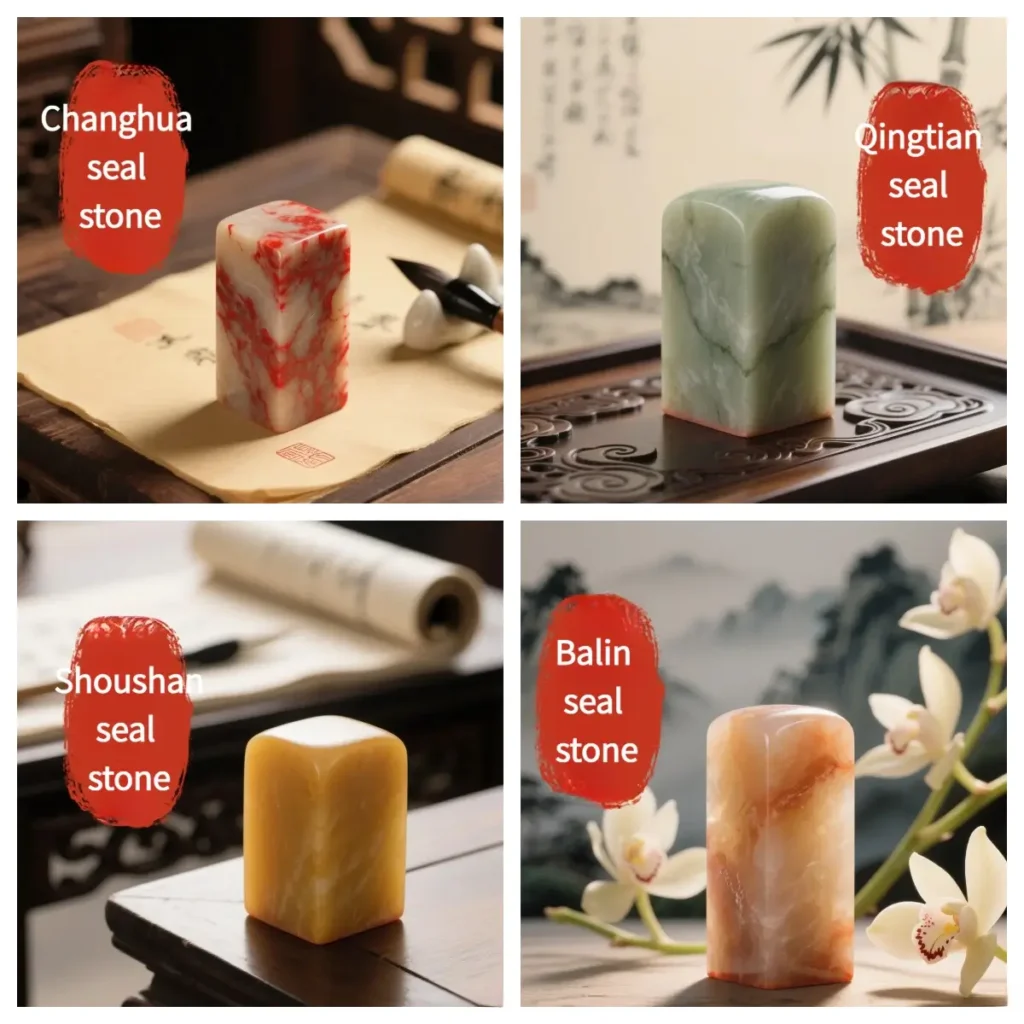
First discovered in Changhua County, Zhejiang Province, this precious gemstone gets its dramatic name from its bright, blood-red hue. It remains a rare treasure unique to China.
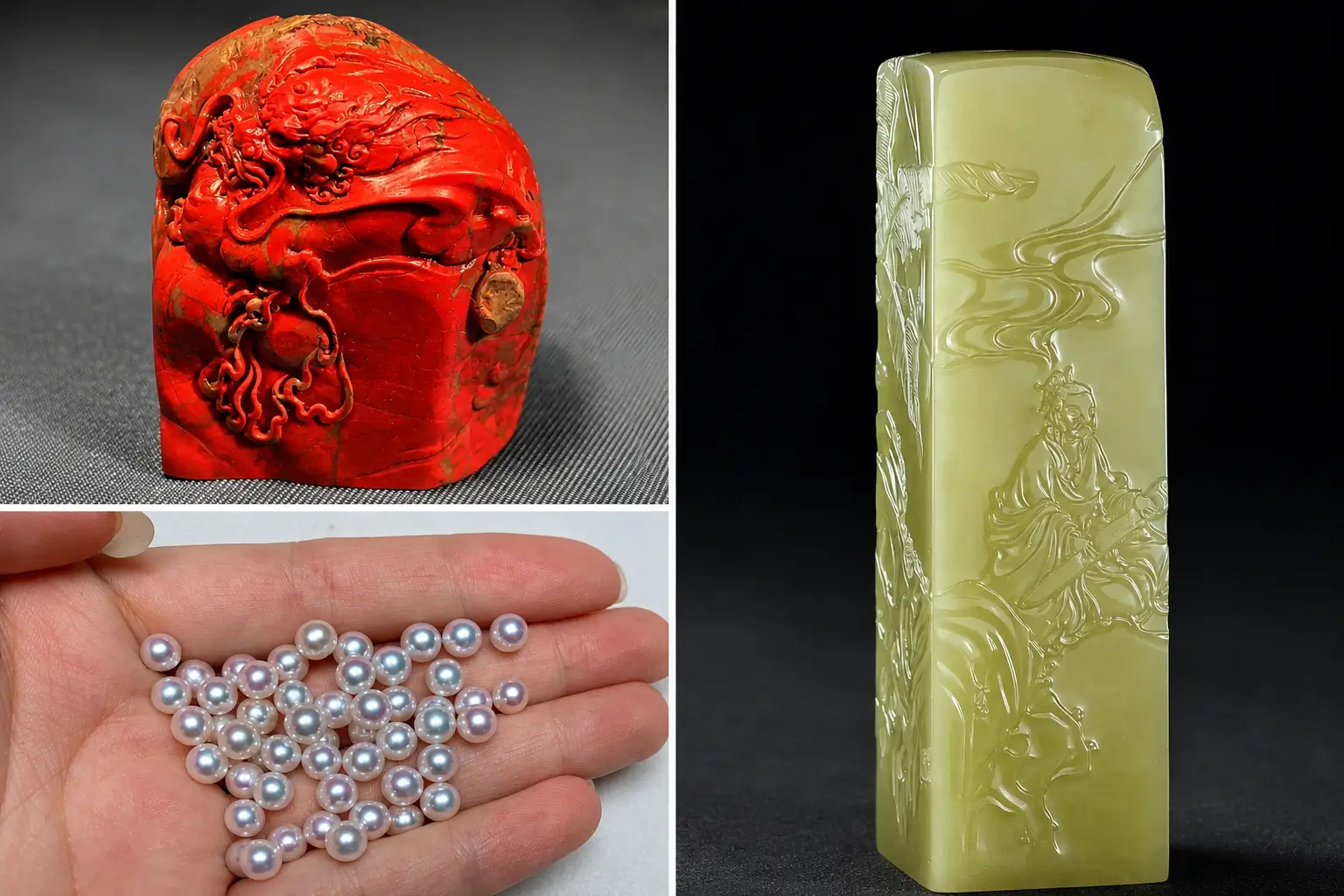
Unlike other seal stones, chicken-blood stone consists of two distinct elements: the “blood” and the “ground” (the matrix). The “ground” refers to the non-red background mineral matrix. It consists primarily of dickite, along with varying amounts of kaolinite, alunite, halloysite, and quartz. The brilliant “blood” section gets its fiery red color from rich cinnabar inclusions that naturally stain the host rock.
How Cinnabar Created This Striking Crimson Gem
Around 75 million years ago, violent volcanic eruptions reshaped the Changhua region in Zhejiang. Over millennia, the volcanic rocks underwent intense alteration, transforming into minerals like dickite and kaolinite. This process created the foundational Changhua stone.
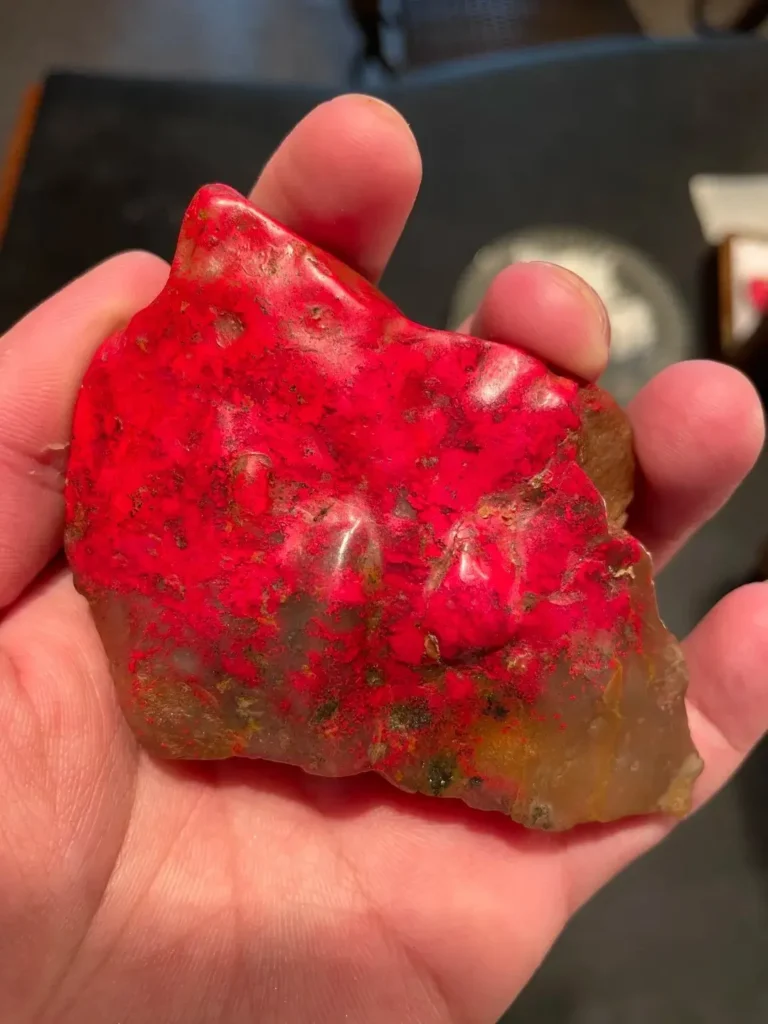
However, the geological magic did not stop there. Hydrothermal solutions rich in mercury sulfide (liquid cinnabar) continuously permeated and eroded these rocks deep within the Earth’s crust. Over millions of years, this red solution slowly saturated the matrix, leaving behind the brilliant, blood-red veins we see today.
Grading and Varieties of Changhua Chicken-Blood Stone
Changhua chicken-blood stone is world-renowned for its vivid, fiery crimson hue. In the gem market, the purity, intensity, and volume of the “blood” directly determine the stone’s quality and value. Based on the color depth, distribution patterns, and positioning of these cinnabar inclusions, connoisseurs classify the stone into several legendary varieties:
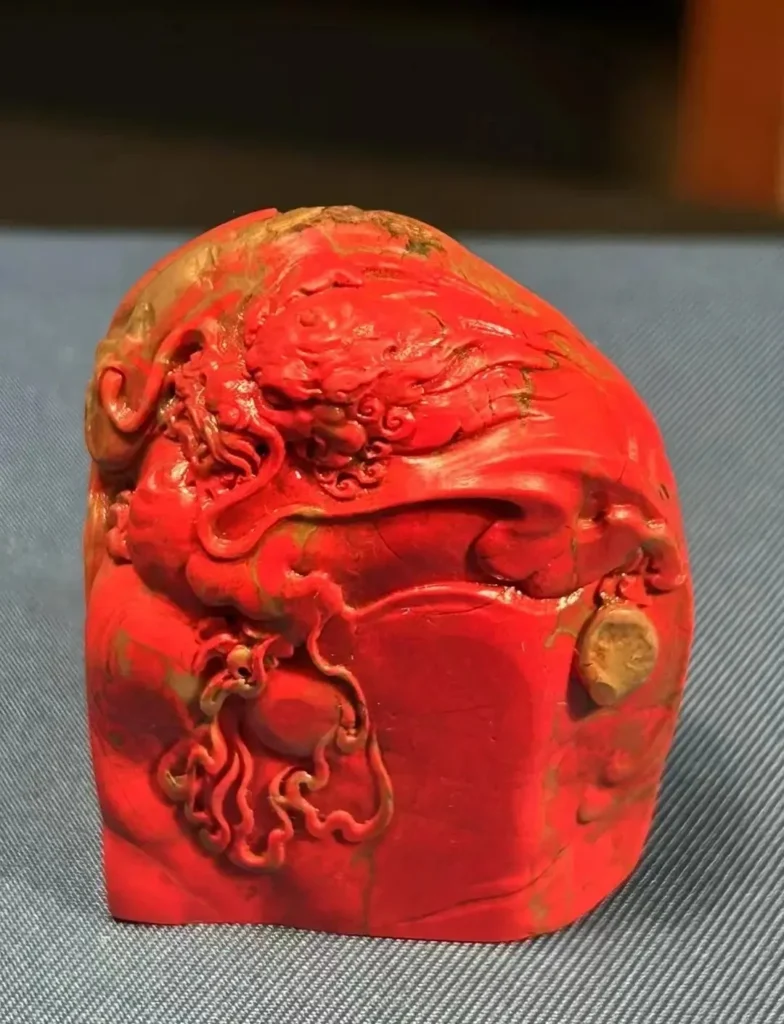
- Da Hong Pao (The Great Red Robe): This is the ultimate investment grade. The cinnabar content exceeds 70%, cloaking the stone in a vibrant, uniform bright red or vermilion. To the naked eye, it appears almost entirely saturated with “blood.”
- Hong Mao Zi (The Red Hat): This variety features a striking contrast, where the cinnabar content exceeds 30%. The vibrant red “blood” concentrates perfectly at the top, while the base transitions into a translucent, jelly-like stone matrix (Dong stone). The red section accounts for roughly one-third of the finished piece.
- Liu-Guan-Zhang (The Three Brothers): Named after legendary heroes from the Romance of the Three Kingdoms, this tricolor stone features a clean black, yellow, or white matrix paired with brilliant red patches. The white represents Liu Bei, the black embodies Zhang Fei, and the crimson signifies the red-faced Guan Yu—symbolizing their historic oath of brotherhood.
The Rich History and Modern Value of Changhua Chicken-Blood Stone
Artisans began mining Changhua chicken-blood stone over a thousand years ago, drawn by its irreplaceable crimson hue. During the Ming and Qing dynasties, the stone’s prestige reached its peak. The Qianlong Emperor fell in love with its fiery color, declaring it a national treasure and making it a staple of the imperial court.
“Changhua County produces seal stones with crimson dots like cinnabar, and mottled purples akin to tortoiseshell. They are precious objects of fine play, yet top-quality pieces have recently become exceedingly rare to find.” — The General Gazetteer of Zhejiang, Qianlong Period (18th Century)
The Qianlong Emperor owned several imperial seals carved from chicken-blood stone. One of his most exquisite treasures, inscribed with “Qianlong Chenhan” (The Emperor’s Autograph), features only sparse, thread-like veins of red scattered throughout. However, the stone boasts an exceedingly warm, unctuous texture. The intricately carved landscape on the seal comes alive with remarkable spirit, making it one of the finest and most magnificent masterpieces among all of Qianlong’s imperial seals.
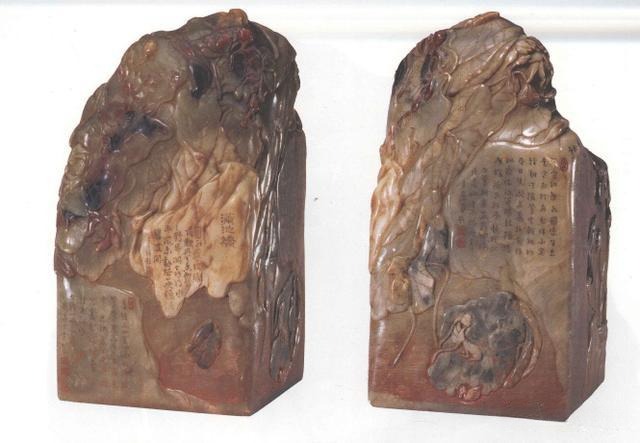
Beyond imperial seals, chicken-blood stone served as a definitive status symbol in Qing dynasty court hierarchy. First-rank officials wore hats topped with a chicken-blood stone bead (Plume Button), marking their elite social standing.
In modern history, the stone found a new role as a prestigious diplomatic gift. In the 1970s, China gifted a pair of square Changhua chicken-blood stone seals to the Japanese Prime Minister to mark the normalization of diplomatic relations. Decades later, in 2019, the opening of the official Changhua Chicken-Blood Stone Museum brought renewed global attention to this unique material, drawing gem enthusiasts from all over the world.
Navigating Today’s Market: Scarcity and Authenticity
After a millennium of active mining, natural reserves of fine Changhua chicken-blood stone are nearly exhausted. As a result, market prices have skyrocketed. This extreme scarcity has unfortunately led to a rise in sophisticated counterfeits and treated stones, making the modern market difficult for casual buyers to navigate.
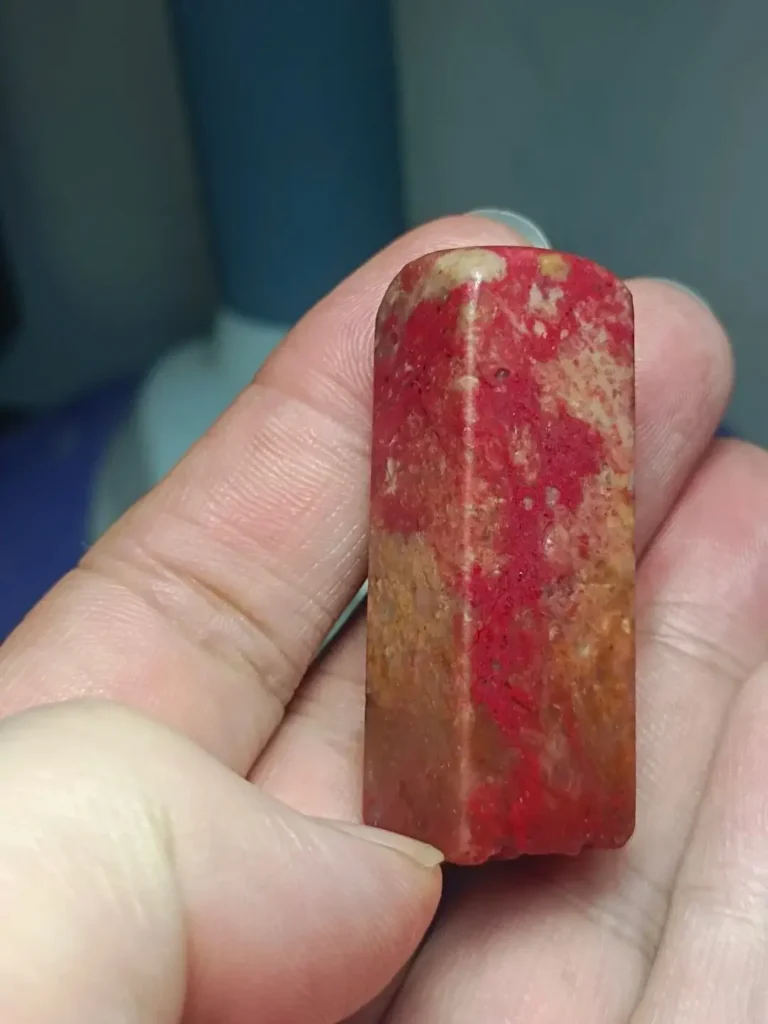
If you are looking to invest in an authentic piece of this historical gemstone, remember the golden rules of gem collecting: take your time, examine the material under magnification, consult trusted gemologists, and never buy on impulse.
Qingtian Stone: A 6,000-Year Legacy
Having explored the fiery Changhua chicken-blood stone, we now turn to another legendary Chinese seal stone from Zhejiang: Qingtian stone. Mineralogically classified as pyrophyllite, this exceptional material derives its name from its historical source in Qingtian County.
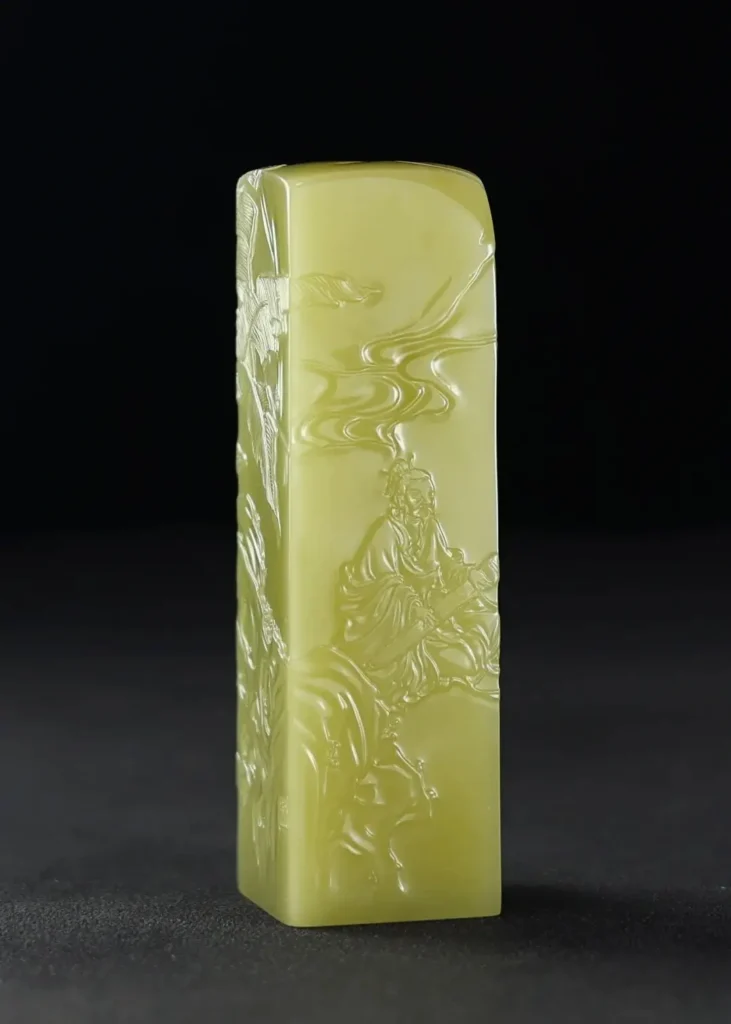
Renowned for its pure composition, compact fine-grained structure, and remarkable thermal stability, Qingtian stone possesses a signature silky, jade-like texture. These distinctive physical properties make it an unparalleled medium for fine lapidary art and seal carving, earning it a revered place among Chinese literati and artists for centuries.
The celebrated Song Dynasty poet Lu You once mused: “Though stones cannot speak, they are the most endearing companions.” Later, during the Ming Dynasty, the master calligrapher and seal artist Wen Peng championed the material, noting: “Thus, the name ‘jelly stone’ (Dong stone) was born unto the world, and its stunning beauty spread to every corner of the land.”
The Vibrant Palette of Qingtian Stone
Qingtian stone boasts an incredibly rich color palette. In exceptional specimens, a single stone can exhibit a breathtaking mosaic of hues, seamlessly blending shades of green, white, yellow, red, brown, purple, blue, and black.
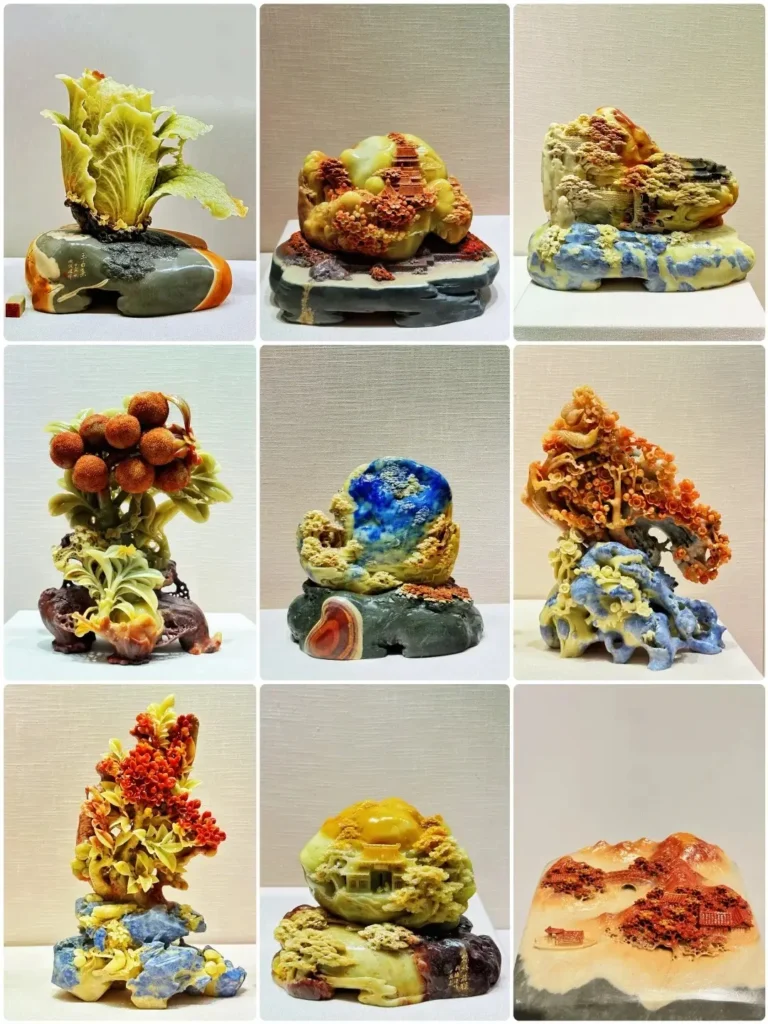
This vast chromatic diversity allows connoisseurs to classify Qingtian stone into over a hundred distinct varieties based on its dominant colors:
- The Greens (Celadon & Teal): This group includes legendary varieties like Dengguang Dong (Lanternlight Jelly), Fengmen Qing (Fengmen Green), Lanhua Qing (Orchid Green), and Zhuye Qing (Bamboo Leaf Green).
- The Yellows: Highly prized varieties include Huangjin Yao (Golden Radiance), Yu Dong (Fish-Gel Jelly), Caihua Qingtian (Cauliflower Yellow), and Huangguo (Yellow Fruit).
- The Whites: This category features clean, milky tones like Baiguo (Ginkgo White) and the coveted Zhuyou Dong (Lard Jelly).
- The Browns: Notable selections include the deep, warm tones of Jiangyou Dong (Soy-Sauce Jelly).
- The Reds: Brilliant types such as Zhusha Qingtian (Cinnabar Qingtian) and Honghua Qingtian (Red Flower Qingtian).
While its color spectrum is vast, the true spirit of Qingtian stone lies in its elegant, understated serenity. The understated, green-hued varieties—particularly Dengguang Dong, Fengmen Qing, and Zhuye Qing—remain the ultimate benchmark and defining masterpieces of this historical material.
The Ancient Art of Qingtian Stone Carving
With a Mohs hardness of just 2 to 2.5, Qingtian stone offers the perfect balance of softness and durability, making it an exceptional medium for intricate carving. Its lapidary history spans six millennia, dating back to the Neolithic Songze Culture, where archaeologists unearthed ancient Qingtian stone jade-like ornaments (Huang).
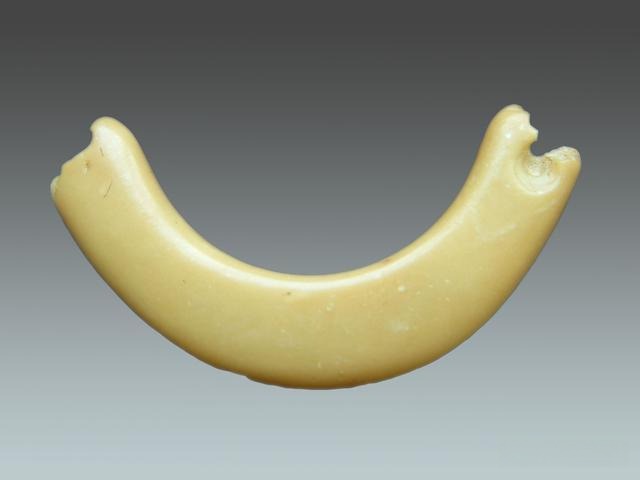
During the Six Dynasties period, large-scale mining began as artisans crafted Qingtian stone objects primarily for funerary art. By the Yuan and Ming dynasties, master carvers elevated their craft to imperial standards, making these carvings prized royal tributes. During this pivotal era, Qingtian stone seals officially replaced traditional gold, jade, and bronze as the preferred medium for scholars and rulers alike.
By the Qing Dynasty, artisans pioneered advanced multi-layered openwork carving, pushing the craft to its absolute peak. To showcase this heritage, Qingtian stone carving stepped onto the global stage, debuting at the 1889 Paris Exposition, followed by the 1904 St. Louis World’s Fair. Its crowning international achievement came at the 1915 Panama-Pacific International Exposition in San Francisco, capturing the world’s attention and cementing its global reputation.
A Living Heritage Facing Modern Scarcity
Over centuries of refinement, Qingtian stone carving evolved a distinct artistic style. Master carvers let the natural form, color, and texture of each raw specimen dictate their design, employing diverse techniques like delicate openwork and intricate relief. Today, this versatile material appears in everything from elegant scholar’s studio objects to monumental stone tablets and statues.
In 2006, China recognized this cultural treasure by opening the Qingtian Stone Carving Museum and listing the craft on the nation’s inaugural National Intangible Cultural Heritage register. The Chinese government has frequently selected top-tier Qingtian carvings as prestigious diplomatic gifts for visiting foreign heads of state. Today, prestigious museums worldwide safeguard over a hundred premium masterpieces, while domestic museums house thousands more.
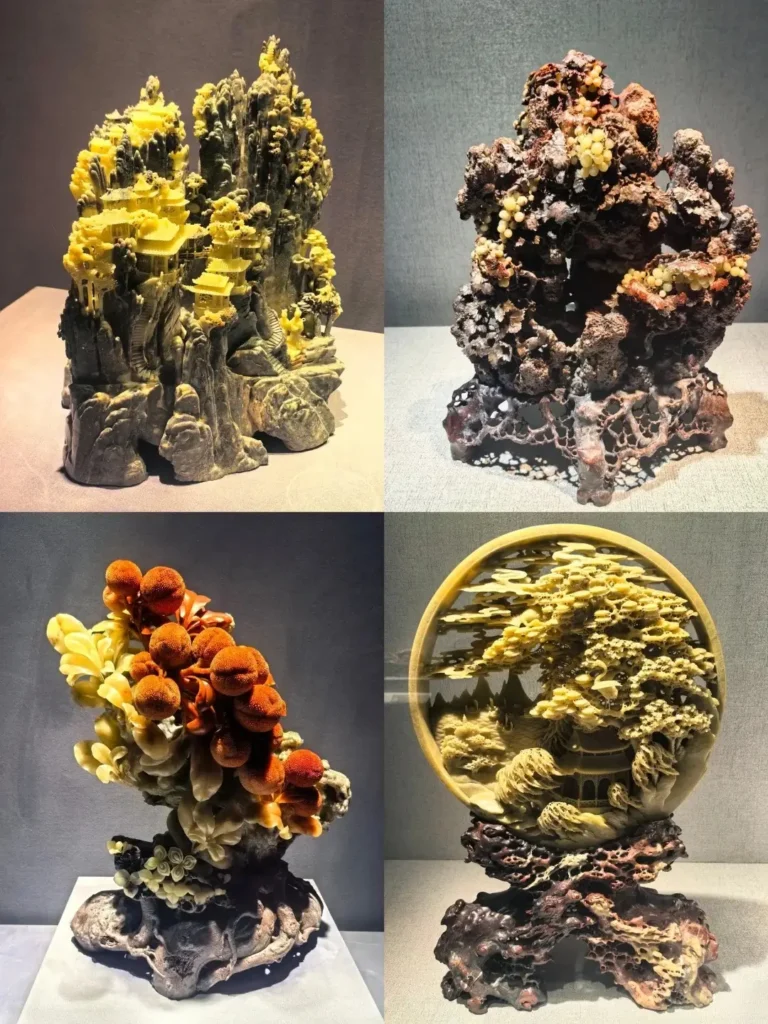
However, this soaring global recognition triggered decades of aggressive, unregulated mining. Since the 1970s, reserves of high-grade, investment-quality Qingtian stone have sharply declined, leaving historic mining sites heavily depleted. As authentic raw material faces severe exhaustion, the market value of fine Qingtian stone art continues to appreciate exponentially.
Zhuji Pearls: From Local Harvest to Global Phenomenon
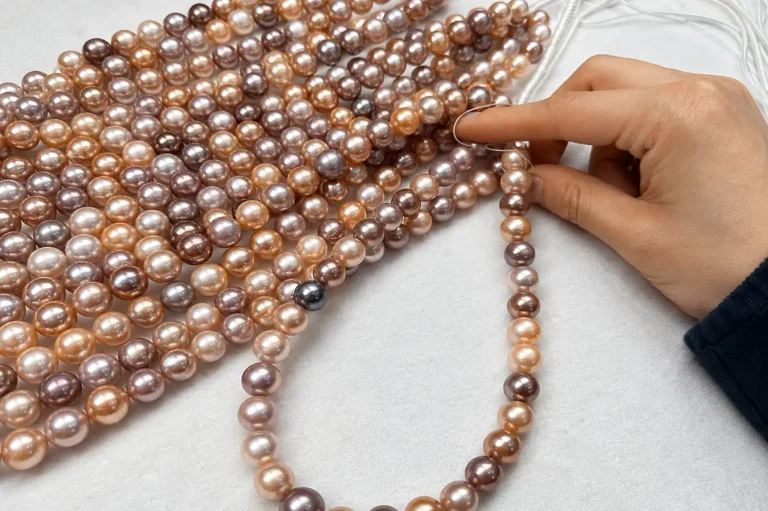
The jewelry industry operates on a well-known maxim: “The world’s pearls come from China, and China’s pearls come from Zhuji.” Today, China reigns as the undisputed global leader in freshwater pearl production, supplying over 95% of the world’s total harvest.
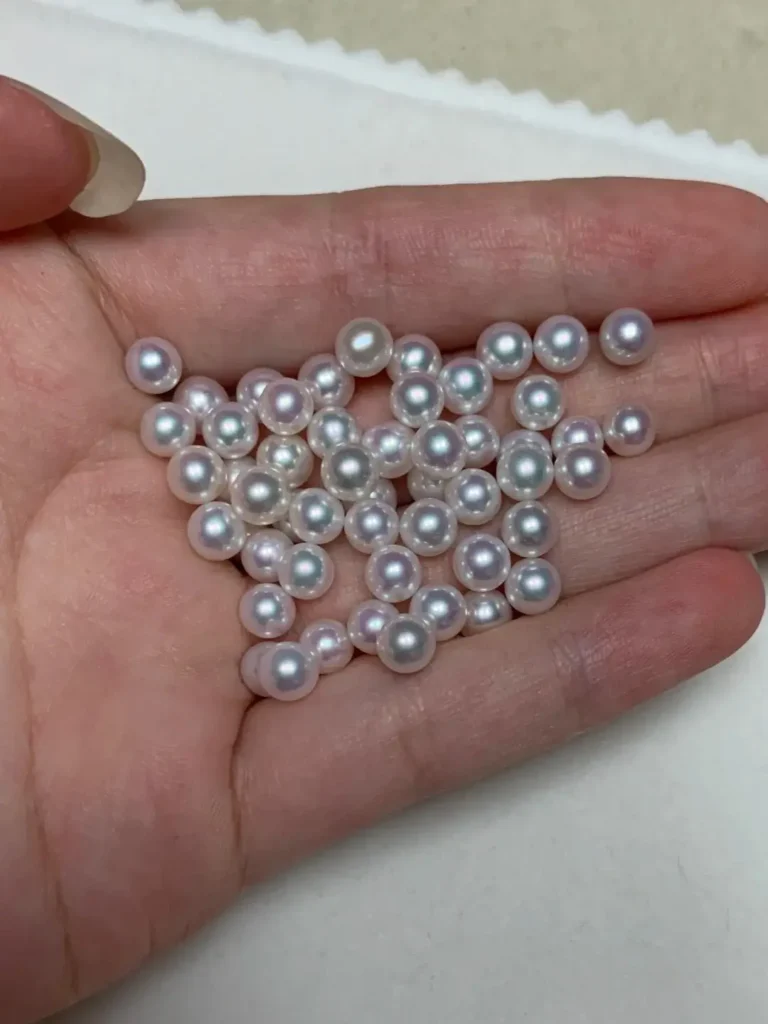
At the absolute heart of this industry lies Zhuji, a city in Zhejiang Province that serves as China’s largest hub for pearl cultivation, processing, and trade. The Chinese government officially recognizes Zhuji as the nation’s premier specialized market for pearls and pearl jewelry. Producing roughly 80% of China’s total freshwater supply, this powerhouse has rightfully earned its titles as the “Hometown of Chinese Pearls” and the “Global Pearl Capital.”
Legends and Landscapes: The Origins of Zhuji Pearls
The historical tie between Zhuji and freshwater pearls stretches back to the Spring and Autumn period, when Zhuji served as the ancient capital of the Yue Kingdom. This storied land is the birthplace of Xi Shi, one of ancient China’s legendary Four Beauties. For centuries, locals have shared a beautiful lore about her origin: while washing silk by a stream, her mother experienced a mystical pearl encounter, became pregnant after a radiant beam of light shot toward her body, and later gave birth to Xi Shi.
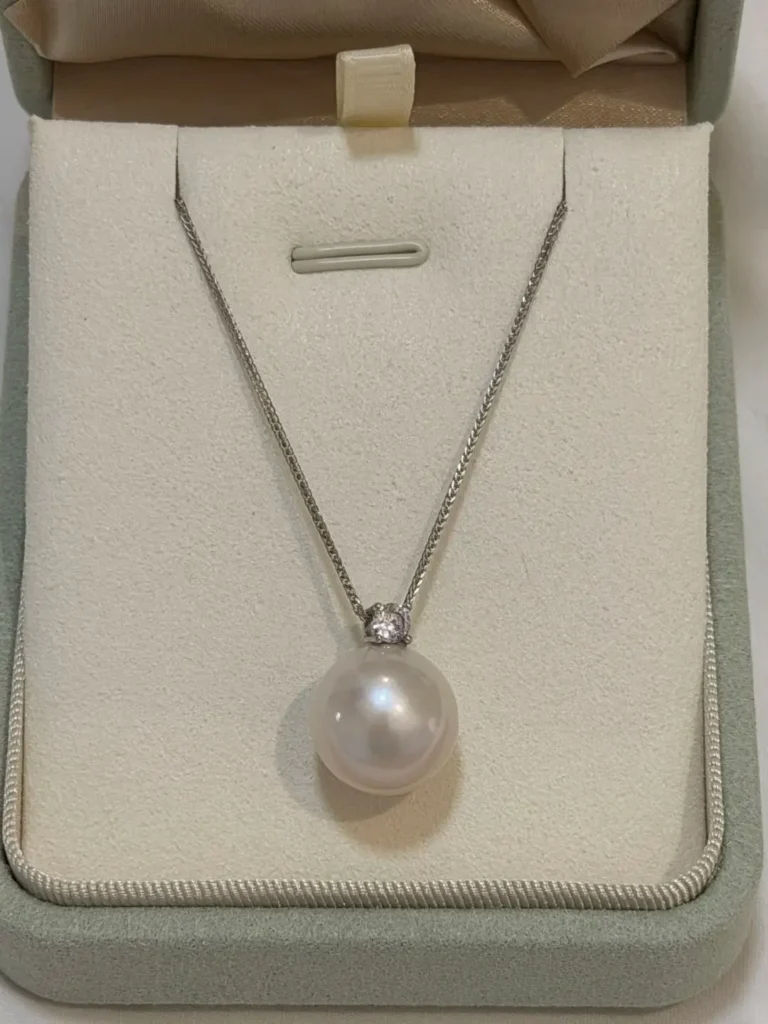
According to this beloved legend, the goddess Chang’e owned a massive, brilliant pearl in her celestial Moon Palace, which she loved to cradle and admire. One day, she went out and left the treasure under the care of the Five-Colored Golden Rooster. As soon as Chang’e left, the rooster grew mischievous and began tossing the pearl back and forth. Suddenly, the pearl slipped and plummeted down to the mortal realm.
The Golden Rooster rushed down in hot pursuit, but the pearl landed safely in a stream in Zhuji. Captivated by the breathtaking local scenery, the pearl decided it never wanted to return to the cold Moon Palace.
Seeing the rooster closing in, the pearl reacted quickly. It leaped up and flew straight into the mouth of a woman washing clothes by the riverbank. Unable to find the treasure, the defeated rooster gave up and returned to the heavens to face his punishment. Sixteen months later, the heavenly pearl transformed into a baby girl and entered the world—the beautiful Xi Shi.
The Natural Sanctuary for Pearl Cultivation
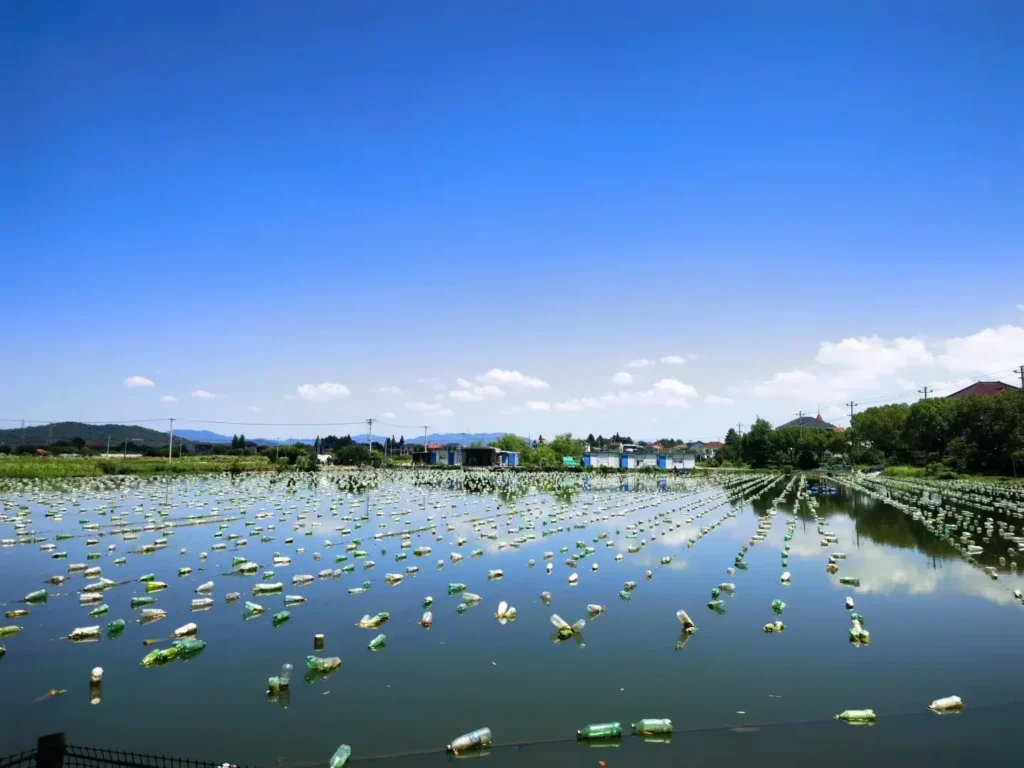
While legends add romantic charm, the true secret behind Zhuji’s rise as a global hub lies in its flawless geography. Nestled in northern Zhejiang, the region features a unique hilly topography fed by a humid subtropical monsoon climate. This environment ensures abundant rainfall and constant water circulation through its vast network of lakes. These clean, nutrient-rich, naturally filtered waters create the absolute perfect habitat for freshwater mussels to thrive and produce high-luster pearls.
The Rise and Evolution of a Pearl Empire
Beyond natural gifts, proactive government support catalyzed the industry’s growth. Zhuji successfully built a fully integrated, streamlined supply chain. This comprehensive network covers every stage of production, from initial mussel breeding and precise nucleus implantation to careful cultivation management and final product processing.
By 2000, Zhuji’s pearl farms expanded to 67,000 hectares, yielding over 300 tons annually. This massive output accounted for a quarter of China’s total production, firmly establishing the pearl trade as a cornerstone of the local economy.
However, this rapid scaling brought significant challenges. Environmental pollution, fluctuating pearl quality, fragmented industrialization, and outdated marketing strategies eventually threatened to stall the industry’s progress.
To bridge the gap with the international market, Zhuji launched a biennial Pearl Festival, drawing global buyers and tourists. In 2001, the city developed a specialized industrial park and leveraged e-commerce to modernized sales. By 2004, construction began on the massive International Jewelry City.
The world took notice. In 2013, Zhuji pearls served as official diplomatic gifts for visiting foreign heads of state, skyrocketing their global reputation. By 2019, in Shanxiahu Town alone, freshwater cultivation spanned over 13,000 hectares, supporting more than 3,000 dedicated farmers and a workforce of 15,000 professionals. Today, this robust trade remains the defining economic pillar of the region.
Explore More in Our Chinese Gems Series
At Jewea, our mission is to uncover the hidden geological wonders across China. Before we dove into the Gemstones of Zhejiang, we explored several other regions famous for their rare and storied treasures.
Take a look back at our previous journeys:
East China
- Jiangxi: Gemstones of Jiangxi: Yingtan Yellow Wax Stone, Wannian Pearls, and Zhang River Agate | Chinese Gems Series
- Shandong: Gemstones of Shandong: Changle Sapphire, Diamond & Taishan Jade | Gems of China Series
- Anhui: Gemstones of Anhui: Huoshan Quartzite Jade, Huangshan Wax Stone & Turquoise | Gems of China Series
- Jiangsu: Gemstones of Jiangsu: Crystal, Yuhua Stone, & Taihu Stone | Gems of China Series
- Taiwan: Gemstones of Taiwan: Red Coral, Blue Chalcedony, Taiwan Nephrite & Seven-Color Jade | Gems of China Series
- Fujian: Gemstones of Fujian: Sapphire, Zircon, Garnet, and Shoushan Stone | Gems of China Series