Chinese Seal Stones: The Four Famous Stones of China
Chinese seal stones occupy a unique place in gemology, lapidary art, and Chinese cultural heritage. Unlike gemstones mainly used for jewelry, these fine-grained ornamental stones have long served as treasured materials for seal carving, sculpture, and traditional scholar’s objects.
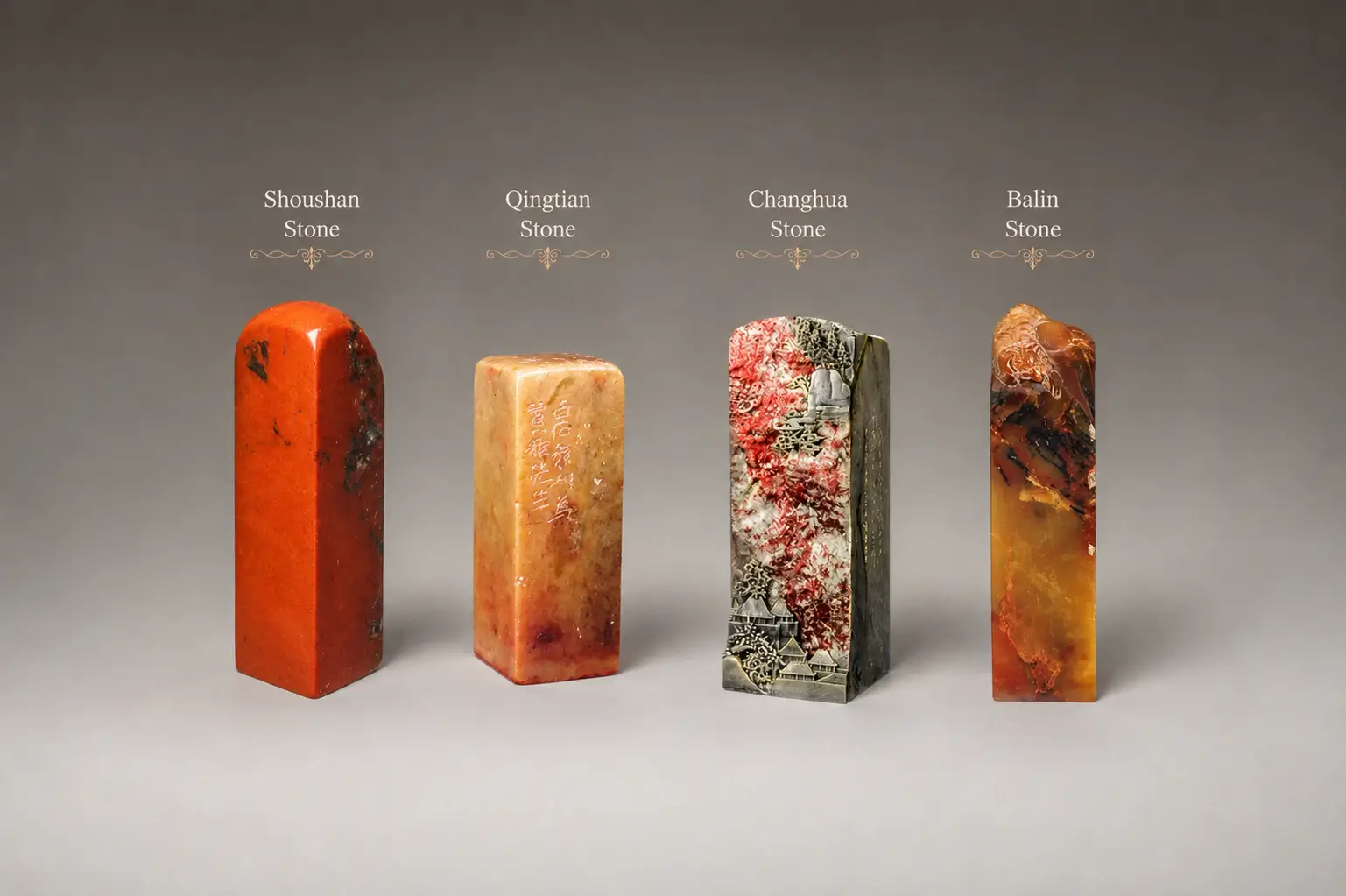
Among China’s many seal stone varieties, Shoushan Stone, Changhua Stone, Qingtian Stone, and Balin Stone represent the Four Famous Chinese Seal Stones. Their smooth texture, natural colors, and ideal carving qualities have inspired emperors, master artisans, and collectors for generations.
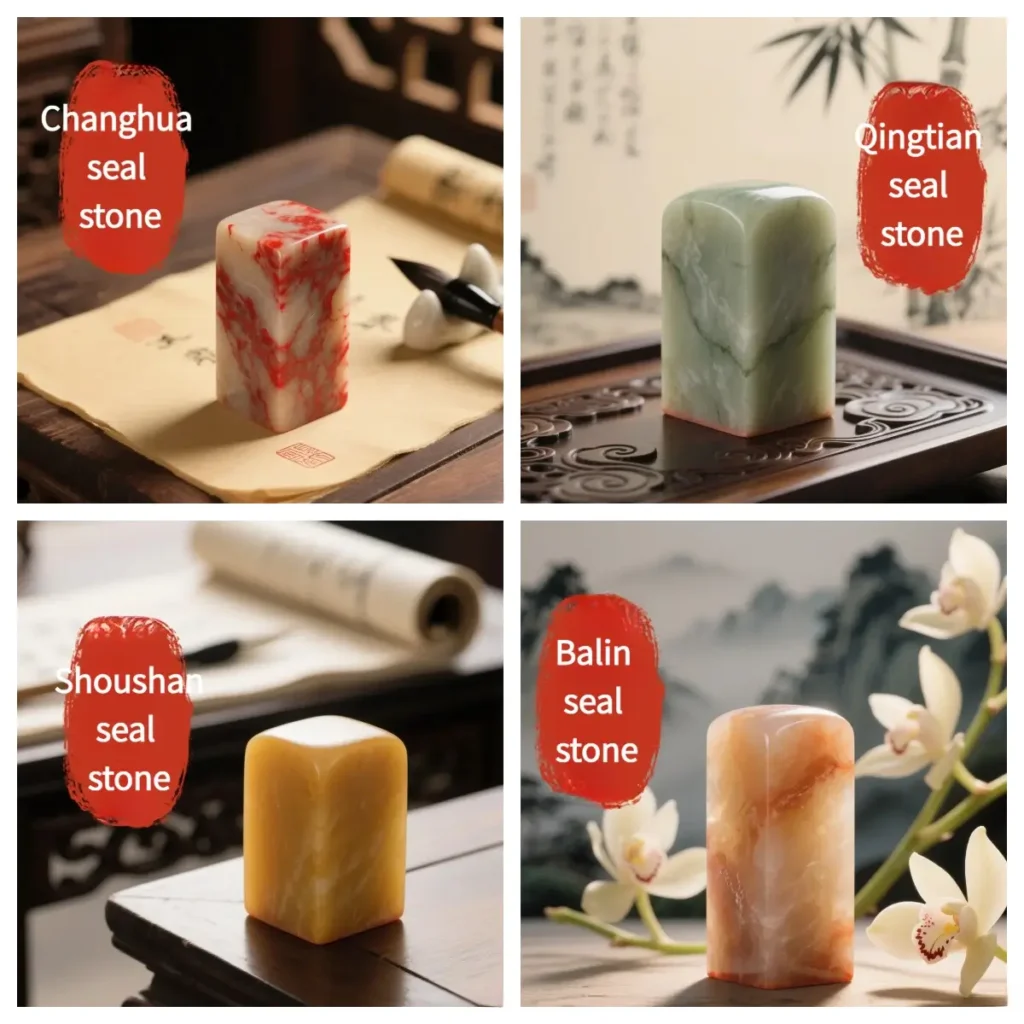
In this guide, we explore their geological origins, mineral compositions, famous varieties—including Tianhuang Stone and Chinese Chicken Blood Stone—and the cultural legacy behind China’s most celebrated seal stones.
What Are Chinese Seal Stones?
Chinese seal stones, also known as seal carving stones, are ornamental stones traditionally used for carving seals. Artists prize them for their fine texture, rich colors, and relatively soft composition, which allows them to create delicate and detailed carvings. For centuries, artisans have transformed these stones into seals, sculptures, and other forms of traditional stone art.
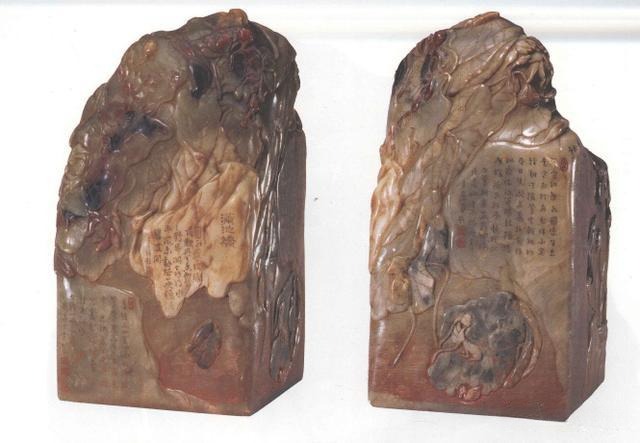
Many people associate Chinese seal stones with calligraphy, painting, and collecting. However, their artistic value goes far beyond seal making. Carvers also use these unique stones to create a wide range of sculptures and decorative works, making them an important part of China’s traditional stone carving heritage.
Most Chinese seal stones form within pyrophyllite-altered zones of acidic igneous rocks. They mainly consist of clay minerals such as kaolinite, pyrophyllite, mica, and illite. Among the many varieties, the Four Famous Seal Stones of China are the most renowned:
- Shoushan Stone from Fujian, especially the Tianhuang Stone.
- Qingtian Stone from Zhejiang, including the prized Fengmenqing variety.
- Changhua Stone from Zhejiang, best known for Changhua Chicken Blood Stone.
- Balin Stone from Inner Mongolia, including the famous Balin Chicken Blood Stone.
Among all Chinese seal stones, Tianhuang Stone and Chicken Blood Stone rank among the most valuable varieties. Their rarity, distinctive appearance, and historical importance have made them highly prized in auctions and among collectors worldwide.
Shoushan Stone
In our Fujian gemstones article, we introduced Shoushan Stone, a renowned Chinese ornamental stone named after Shoushan Mountain in Fuzhou, Fujian Province. As one of the Four Famous Chinese Seal Stones, it has a history of more than 1,500 years. Archaeological discoveries have found Shoushan Stone arrowheads at ancient Stone Age sites.
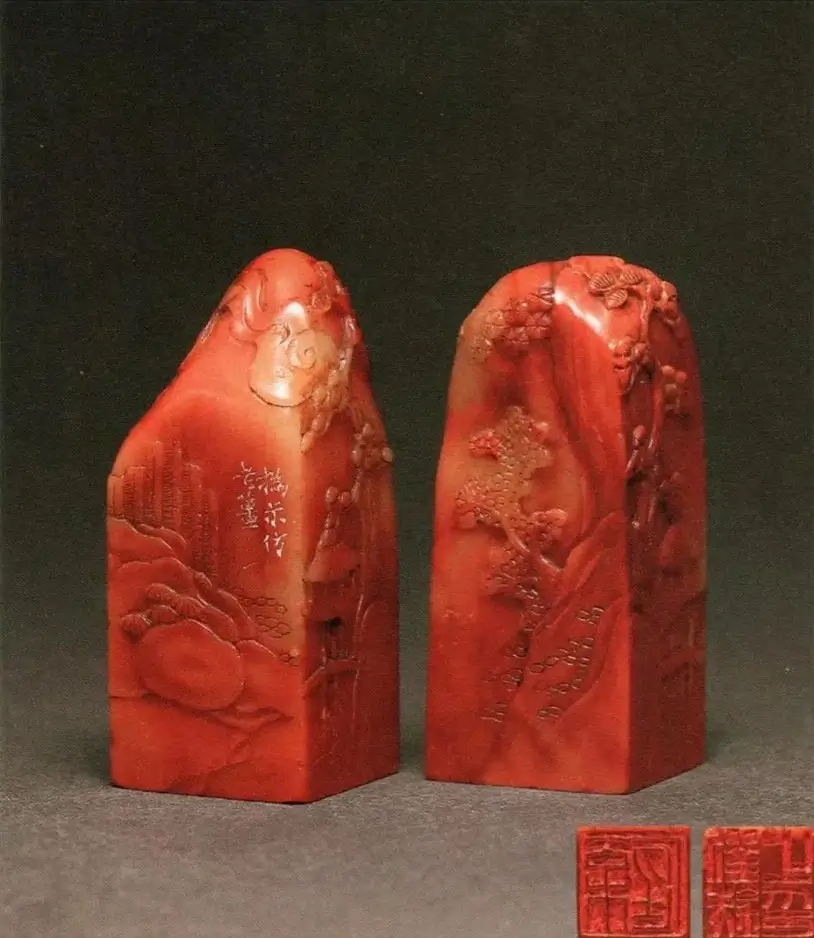
Composed mainly of minerals such as kaolinite, dickite, nacrite, pyrophyllite, and illite, Shoushan Stone is prized for its smooth, waxy texture and broad range of colors, including white, red, yellow, green, purple, and black. Among these varieties, yellow Shoushan Stone is the most valuable, especially the legendary Tianhuang Stone.
Geologically, Shoushan Stone is classified into primary deposits (mountain and water stones extracted directly from mineral veins) and secondary deposits (alluvial field stones shaped by natural weathering and water erosion over time).
Shoushan Stone includes numerous varieties, which are generally grouped into three main categories:
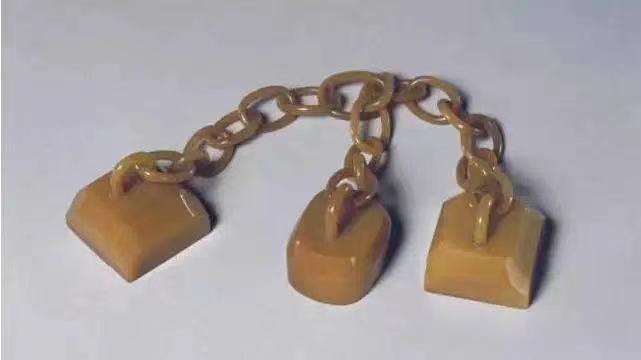
- Tian Keng Stone: Among Tian Keng varieties, the yellow type known as the renowned Tianhuang Stone is considered the most precious. Highly translucent or nearly transparent specimens are called Tianhuang Dong (Tianhuang Frozen Stone), a rare variety prized for its exceptional clarity and jelly-like appearance. Throughout Chinese history, Tianhuang has been honored as the “King of Seal Stones” and the “Emperor of Stones.” Its most celebrated historical treasure—the Qianlong Emperor’s Tianhuang Triple-Chain Seal—is preserved today as a Grade-1 National Cultural Relic of China.
- Shui Keng Stone (Kengtou Stone): Semi-transparent with a strong luster. Among non-Tianhuang varieties, Kengtou Dong (Kengtou Frozen Stone) is considered the most precious.
- Shan Keng Stone: This category includes dozens of varieties, classified according to their specific origin, texture, transparency, and color.
Related Reading: Furong Stone Explained: Rose Quartz vs Shoushan Stone — Two Gems, One Name
Changhua Stone
In our Zhejiang gemstones article, we introduced Changhua Stone, named after Changhua Town in Lin’an, Zhejiang Province.
Changhua Stone comes in a wide range of colors and varieties, including White Changhua, Black Changhua, and Patterned Changhua. Among its many varieties, Changhua Chicken Blood Stone (also known as Changhua Bloodstone) stands out as the most famous and is known as the “Queen of Seal Stones.”
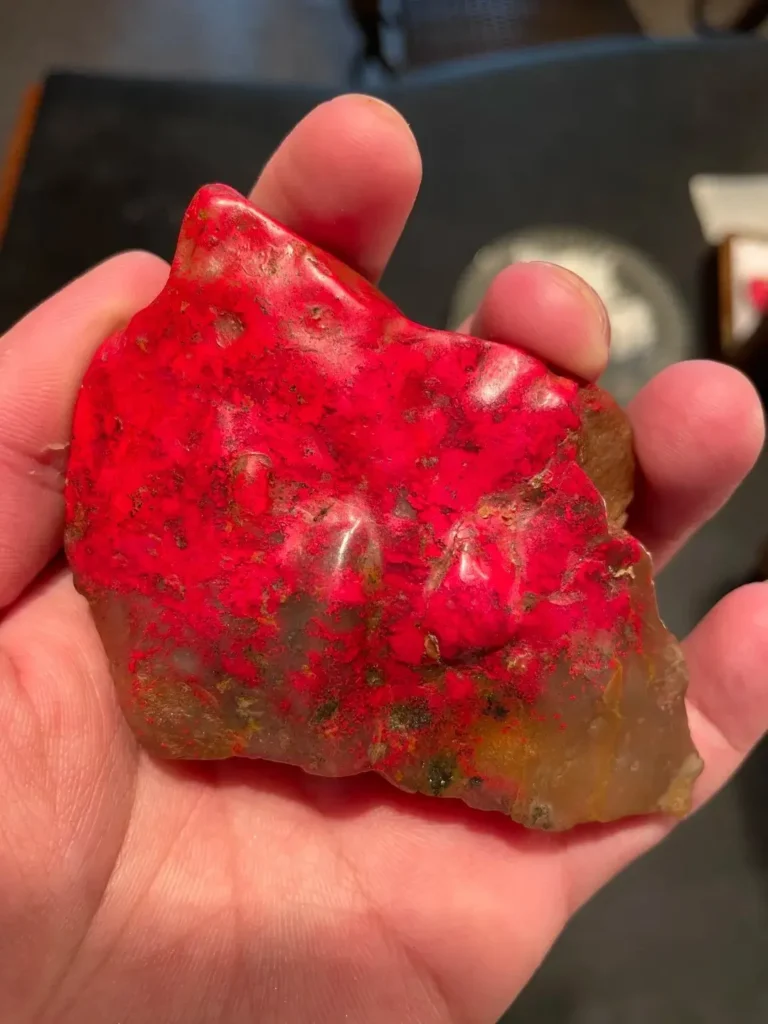
Hidden in remote mountains for centuries, Changhua Chicken Blood Stone remained unknown to many people until it was reportedly discovered and used during the Ming Dynasty. It earned its name from the vivid red color inside the stone, which resembles fresh chicken blood. During the Qing Dynasty, Emperor Qianlong regarded it as a national treasure.
Unlike most seal stones made from a single material, Changhua Chicken Blood Stone consists of two distinctive parts: the “Base” and the “Blood.”
- Base: The Base refers to the non-red portion of the stone. It mainly consists of dickite, with smaller amounts of kaolinite, alunite, halloysite, and quartz. When the Base contains translucent Frozen Stone material, such as Lotus Root Pink Frozen, Mutton Fat Frozen, or Ox Horn Frozen, it is considered a high-quality material.
- Blood: The Blood refers to the red areas formed by cinnabar (mercury sulfide) within the stone. These red areas developed as mercury sulfide-bearing solutions slowly penetrated and altered the stone through long-term geological processes. High-quality Changhua Chicken Blood Stone features vivid, large, and concentrated red patterns. When the red color appears to flow naturally through the stone, collectors call it “Living Blood” (Huo Xue).
Classic Varieties of Changhua Chicken Blood Stone
The value of Changhua Chicken Blood Stone mainly depends on the brightness, distribution, and coverage of its red “Blood.” Based on the color patterns and proportion of Blood, collectors traditionally classify it into several famous varieties:
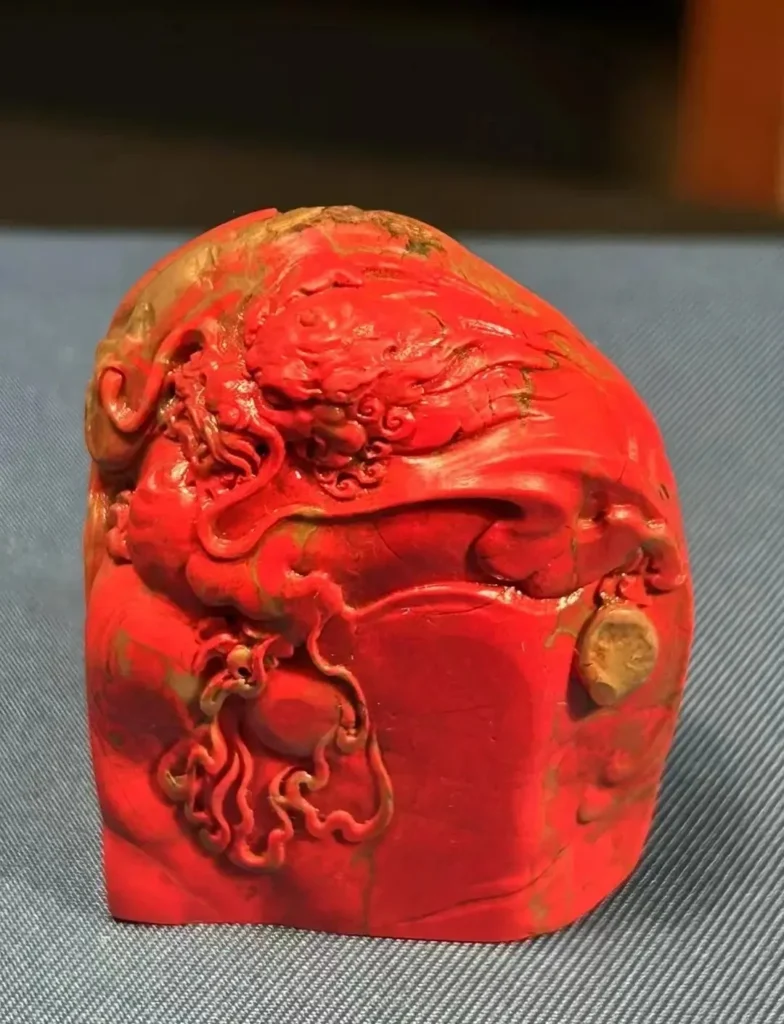
- Dahongpao (Great Red Robe): Contains more than 70% Blood. The stone appears almost completely covered with vivid red or vermilion patterns, making it one of the rarest varieties.
- Hongmaozi (Red Hat): Contains more than 30% Blood. The upper part usually displays solid red Blood, while the lower part consists of translucent Frozen Stone. The Blood typically accounts for about one-third of the finished piece.
- Liu-Guan-Zhang: The Base features black, yellow, or white colors without other mixed tones, combined with vivid red Blood patterns. The name refers to three historical figures from Chinese culture: white represents Liu Bei, black represents Zhang Fei, and red represents Guan Yu.
After centuries of mining, high-quality Changhua Chicken Blood Stone has become increasingly rare. Exceptional pieces continue to attract strong interest among international collectors and appear in important auctions.
Besides Zhejiang, Guizhou also produces Chicken Blood Stone. Related Reading: Gemstones of Guizhou: Guicui Quartzite, Luodian Nephrite, & Chinese Bloodstone | Gems of China Series
Qingtian Stone
Named after Qingtian County in Zhejiang Province, Qingtian Stone is one of China’s most celebrated seal carving stones.
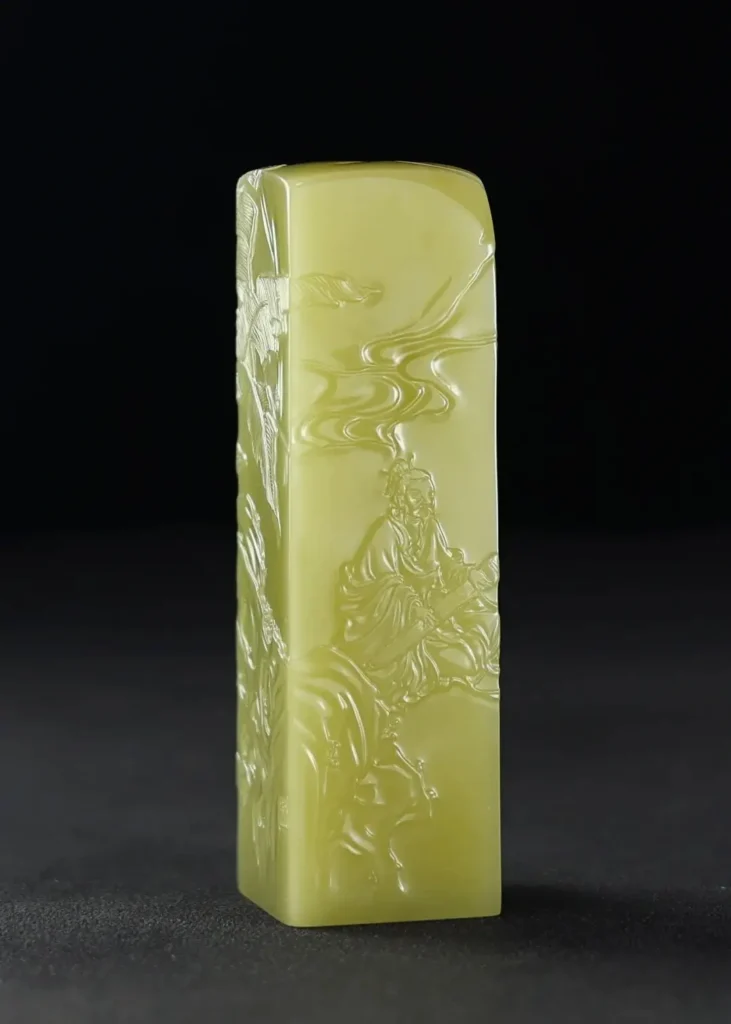
Mineralogically, Qingtian Stone is classified as pyrophyllite. It is one of the oldest materials used in traditional Chinese stone carving. Its mining and use date back approximately 6,000 years to the Songze Culture period, when archaeologists discovered Qingtian Stone huang ornaments from this era.
Qingtian Stone features a fine texture, ranging from slightly translucent to opaque, with a soft, waxy luster. It is especially famous for its remarkable color diversity. A single piece of Qingtian Stone may display multiple colors at the same time, including green, white, yellow, red, brown, purple, blue, black, and various multicolored patterns.
Classifications and Notable Varieties
Based on color, Qingtian Stone can be divided into hundreds of varieties, which are grouped into several major categories:
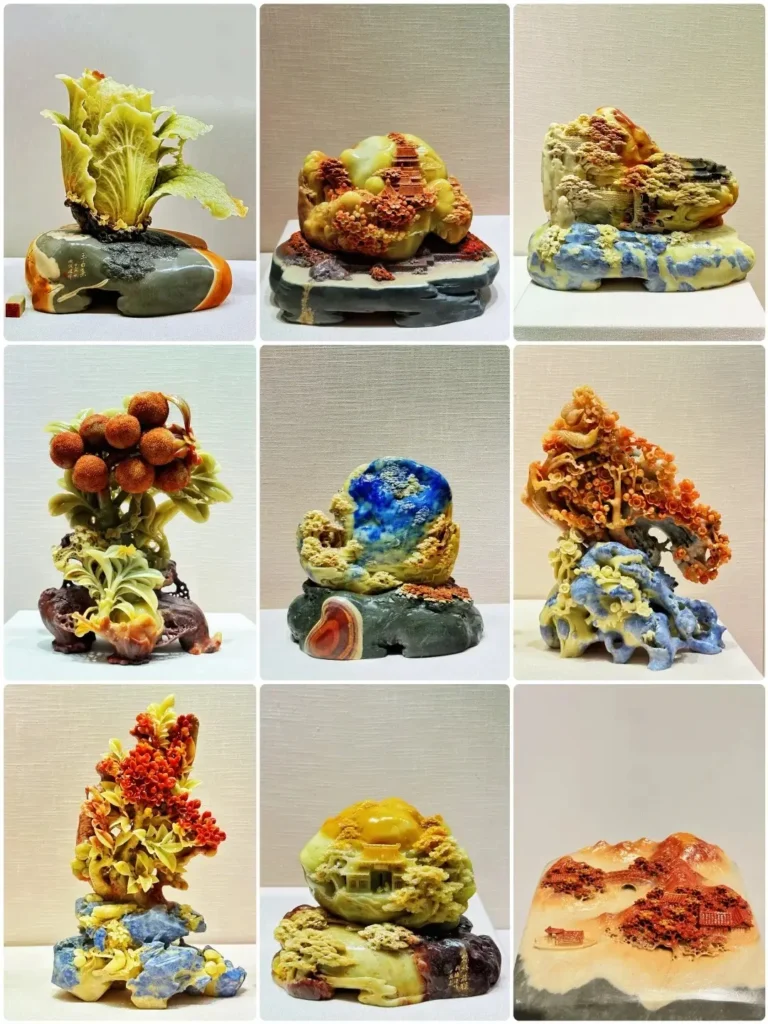
- Green: Fengmenqing, Dengguang Dong, Lanhuaqing, and Zhuyeqing.
- Yellow: Huangjinyao, Yudong, Caihua Qingtian, and Huangguo.
- White: Baiguo and Zhuyoudong.
- Red: Zhushaqingtian and Honghuaqingtian.
- Brown: Jiangyoudong.
Among all Qingtian Stone varieties, Fengmenqing, Dengguang Dong, and Wucai Dong are considered the most highly prized.
Over thousands of years, Qingtian Stone has developed far beyond its original use as a seal material. It has been widely used to create scholar’s studio objects, stone inscriptions, sculptures, and other traditional Chinese stone carvings.
Due to prolonged mining activities, high-quality rough Qingtian Stone has become increasingly scarce, and the value of fine materials continues to rise.
Balin Stone
In our Inner Mongolia gemstones article, we introduced Balin Stone, which takes its name from Balin Right Banner in Chifeng, Inner Mongolia.
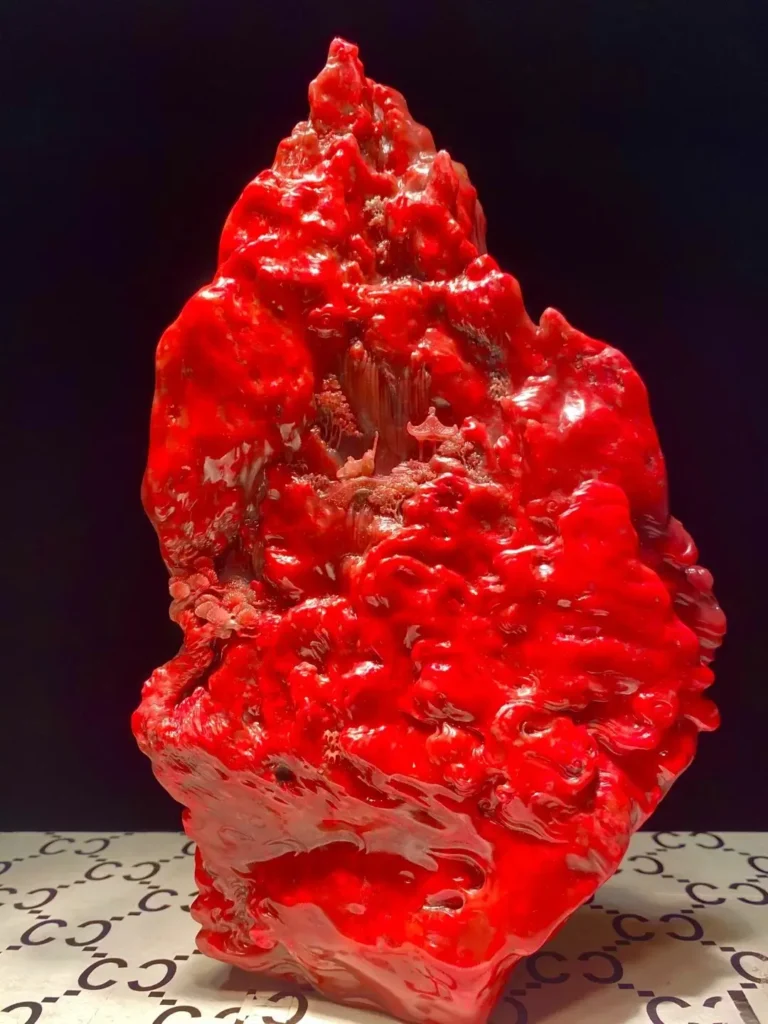
Balin Stone captivates collectors with its fine, silky texture, vibrant colors, and relatively large block size. Its history of use dates back to the Neolithic period, when people first collected and utilized this distinctive material. After large-scale mining began in the 1970s, Balin Stone was officially recognized as one of the Four Famous Chinese Seal Stones in 1979.
Based on differences in color, texture, and patterns, Balin Stone includes hundreds of varieties, which are traditionally grouped into five main categories:
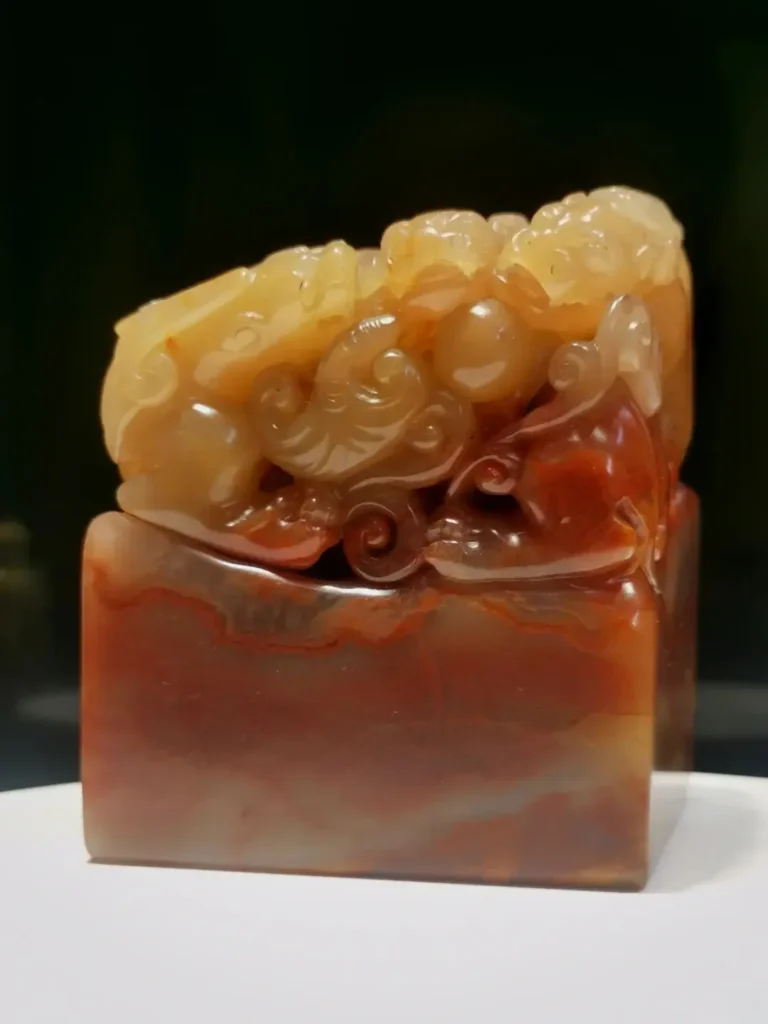
- Balin Chicken Blood Stone: The most famous variety of Balin Stone. High-quality specimens are often compared with fine Changhua Chicken Blood Stone.
- Balin Fuhuang Stone: Often compared with Tianhuang Stone for its warm yellow color and refined texture.
- Balin Frozen Stone (Jelly Stone): Known for its translucent, smooth texture and soft, jelly-like appearance.
- Balin Colored Stone: Valued for its rich patterns and vibrant color variations.
- Balin Pattern Stone: Features naturally formed images, landscapes, and abstract patterns created within the stone.
Balin Chicken Blood Stone vs. Changhua Chicken Blood Stone
Balin Chicken Blood Stone and Changhua Chicken Blood Stone share a very similar appearance. High-quality specimens can be difficult to distinguish by appearance alone. However, they show different characteristics in market value and material properties.
- Texture and Blood Color: Within the seal stone trade, insiders use the phrase “Southern Blood, Northern Base” to contrast these two famous minerals. Changhua Chicken Blood Stone from southern China boasts a brighter, more vibrant red “Blood.” Conversely, collectors prize northern China’s Balin Chicken Blood Stone for its finer, softer, and more translucent “Base.” However, Balin stone yields a lighter, often darker red “Blood.” Over time, even bright specimens can lose their luster and darken naturally.
- Market Value: Changhua Chicken Blood Stone generally commands a higher market value due to its longer mining history and more stable red coloration. However, high-quality Balin Chicken Blood Stone remains highly valued among collectors.
Conclusion
The Four Famous Chinese Seal Stones—Shoushan, Qingtian, Changhua, and Balin—show how nature and human creativity can come together through stone carving.
Their value goes beyond rarity and beauty. These stones preserve centuries of Chinese artistic traditions and offer a unique window into the history, craftsmanship, and aesthetics behind seal culture.