Mala Beads Anatomy: Do You Truly Know Your Mala?
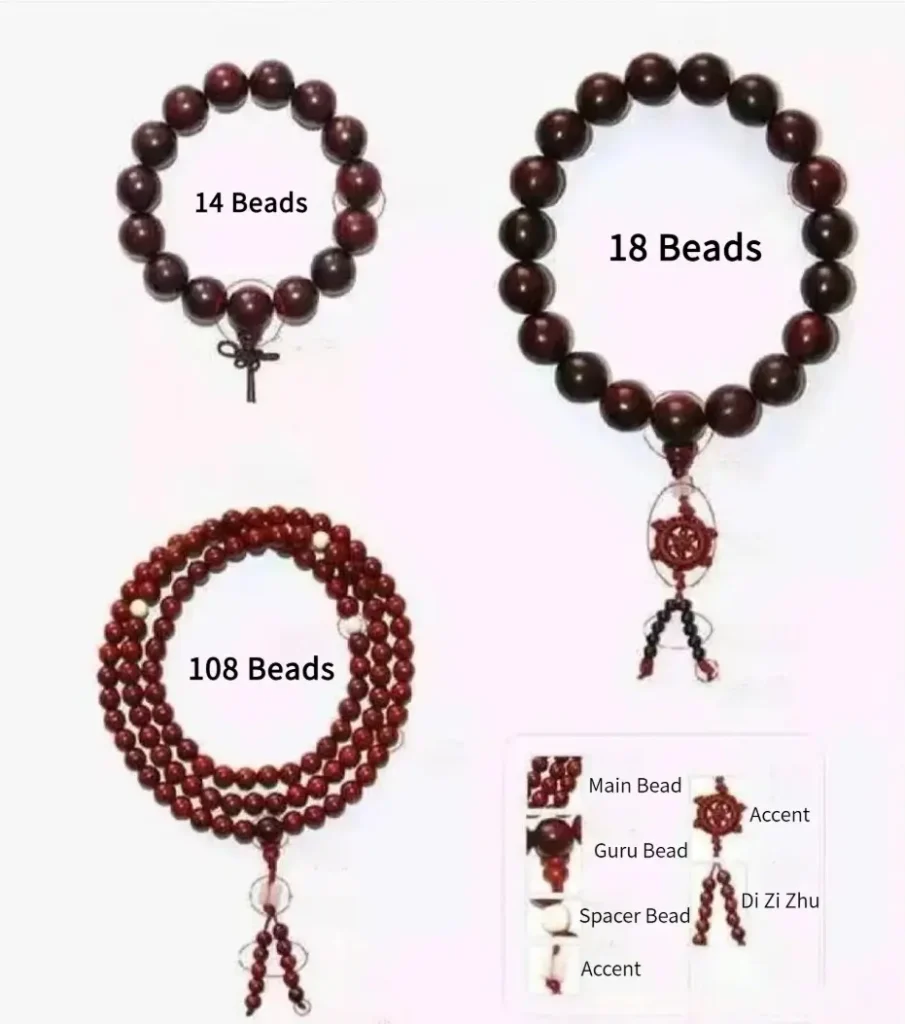
Mala Beads Anatomy reveals that what appears to be a simple strand is, in fact, a thoughtfully structured system. Each component—from the central guru bead (traditionally known in Buddhist practice) to spacer beads and counting tools—serves a specific purpose in both design and spiritual function.
This guide offers a clear, illustrated breakdown of Mala Beads Anatomy, exploring the functional design of each component and how they harmonize to support your spiritual journey.
At their core, Mala beads (Buddhist prayer beads) serve a profound, practical purpose: they are a sacred tool for counting mantras. With every recited prayer or “Om,” the practitioner moves one bead, creating a rhythmic cycle of focus. Beyond simple arithmetic, the physical act of turning the beads becomes a grounding ritual—helping to anchor the mind and quiet internal noise during meditation.
I. Mala Beads Anatomy: The Mother Bead (Guru Bead)
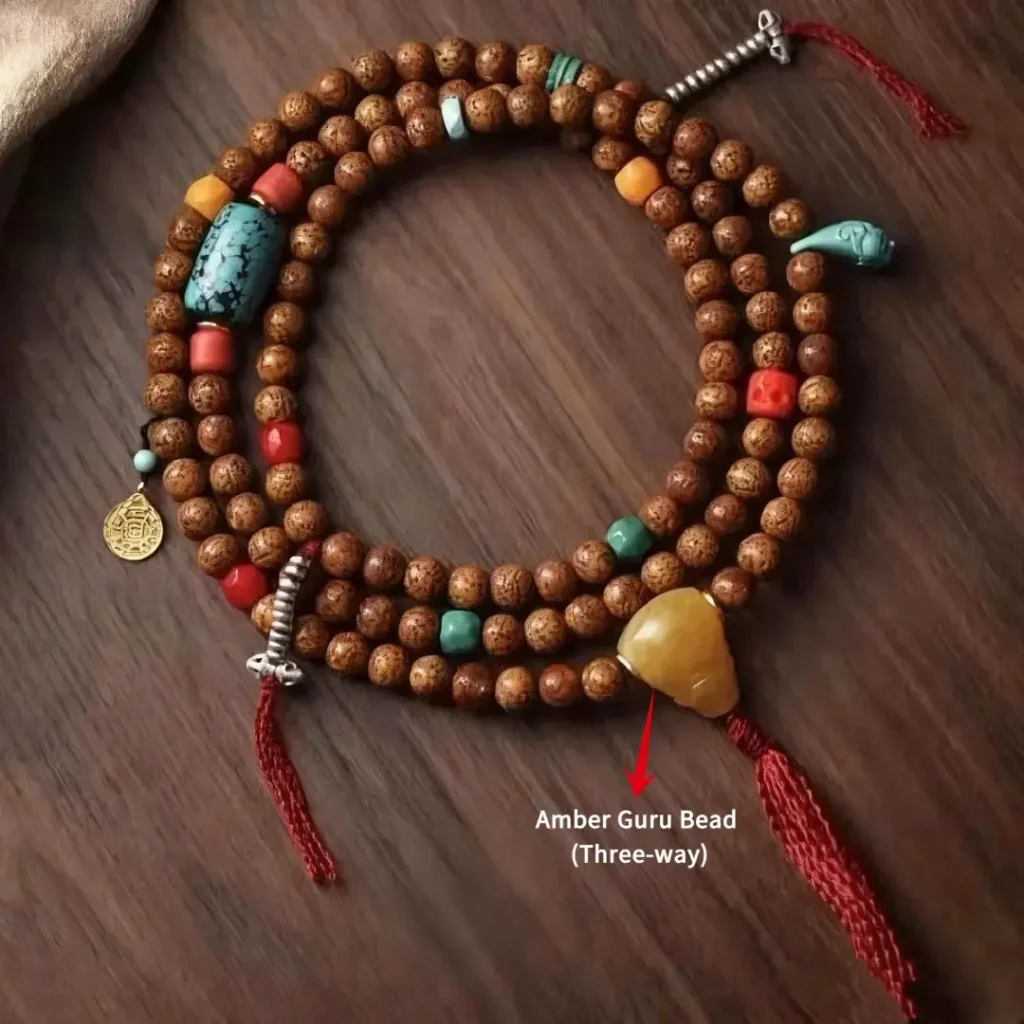
The centerpiece of a Mala is the Mother Bead (Mu Zhu)—often referred to as the Guru Bead in traditional Sanskrit-derived contexts). More than a structural connector, it represents the point where the entire strand begins and returns, embodying the Buddhist idea of “all paths returning to one.”
To maintain visual harmony, the Guru Bead and its accompanying top element are often made from the same material as the three spacer beads distributed along the strand—creating a balanced and cohesive design language.
1. The Three-Way (T-Junction) Structure
Unlike standard beads, the Guru Bead features a distinctive three-hole configuration, often referred to as a “three-way” bead.
- Cord Path: The two ends of the cord enter through opposite lateral holes and converge, exiting together through the single top hole.
- Structural Role: This design secures the entire Mala while creating a natural stopping point for counting cycles.
- Symbolic Meaning: The convergence of three directions reflects the philosophy of “wan fa gui yi”—the unity of all paths into a single source of wisdom.
2. Historical Evolution
The three-hole Guru Bead is a later development in Mala construction.
- Ancient Indian Malas: Typically used a simple two-hole bead to join the strand.
- Later Adaptations: The T-shaped, three-hole structure gradually became standard, often paired with an additional element above it (commonly known as the “Buddha Tower”).
- Timeline Note: The exact historical moment of this transition remains unclear.
3. Material and Craftsmanship
In traditional and modern practice alike, the Guru Bead is often distinguished from the rest of the Mala.
Rather than matching the main mantra beads, it is frequently crafted from contrasting or higher-grade materials, emphasizing its role as the spiritual focal point. Common choices include:
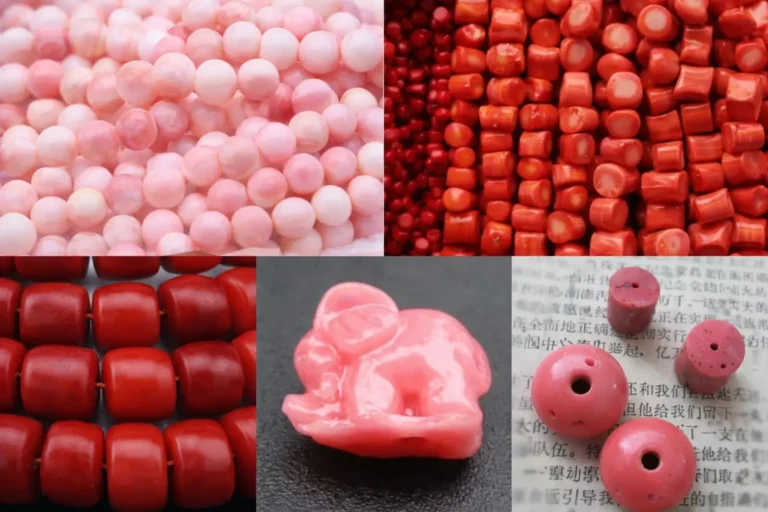
- Organic Materials: Amber, Coral
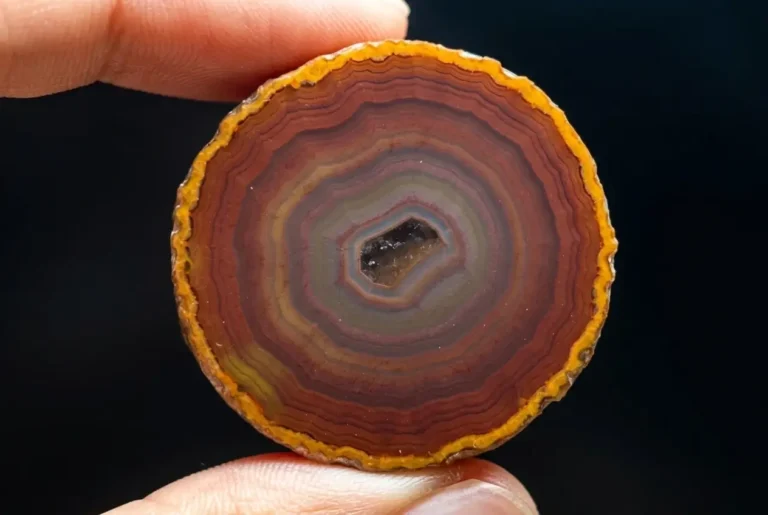
- Gemstones: Lapis Lazuli, Jadeite, Agate
This contrast not only enhances visual hierarchy but also reflects the elevated symbolic status of the Guru Bead.
II. Mala Beads Anatomy: The Stupa-Shaped Top (Fo Ta)
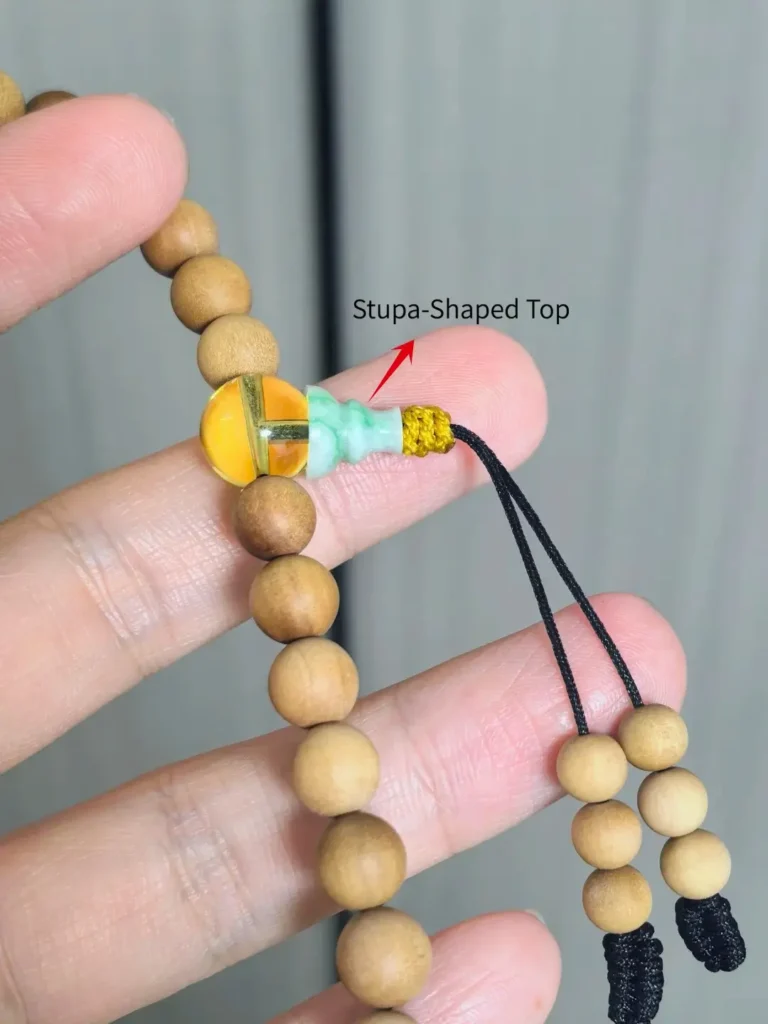
Positioned directly above the Mother Bead, this element is traditionally known as Fo Ta, often described as a stupa-shaped top due to its conical, tiered form. Rather than being a separate symbolic object, it functions as an integrated extension of the Mala’s central structure.
1. Mala Beads Anatomy: Form and Evolution
The stupa-shaped top seen in modern Malas is a later refinement.
- Early Form: In early Indian prayer beads, this component was simply a smaller bead placed above the Mother Bead, without a distinct shape.
- Later Development: Over time, it evolved into a conical, stupa-inspired form, giving the Mala a clearer vertical structure and visual focal point.
Despite this change in form, its role within the Mala remains consistent.
2. Relationship to the Mother Bead
The stupa-shaped top and the Mother Bead function as a unified central system.
- Structural Role: Together, they anchor the cord and define the starting and ending point of the counting cycle.
- Symbolic Meaning: In traditional interpretation, this pairing represents the Dharmakaya (法身) wisdom associated with Amitabha Buddha.
Rather than standing alone, the top element reinforces the significance of the Mala’s central axis.
3. Material and Craftsmanship
In well-crafted Malas, this top element is typically made from the same material as the Mother Bead, ensuring visual and structural cohesion.
Common material choices include:
- Amber
- Lapis Lazuli
- Jadeite
- Agate
- Coral
This consistency creates a clear visual hierarchy, drawing attention to the central components without disrupting the balance of the strand.
III. Mala Beads Anatomy: The Main Beads
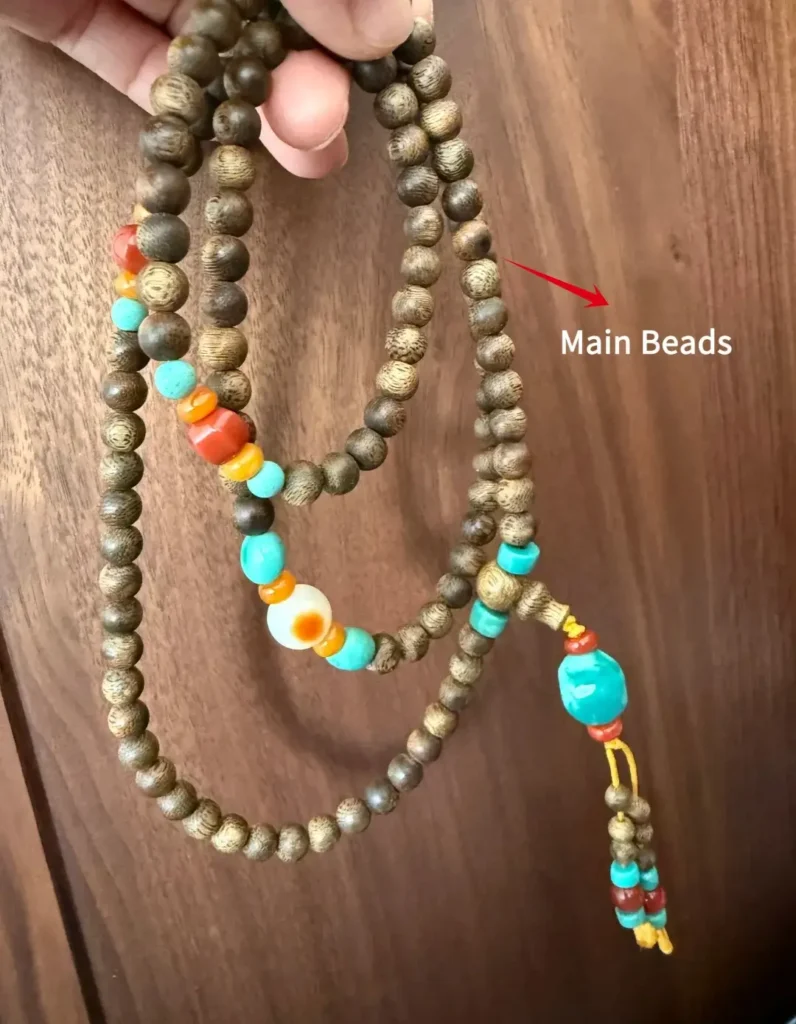
The main beads form the body of the Mala, consisting of all beads except the Mother Bead and its top element. Though visually repetitive, they are essential to both the structure and function of the strand.
1. Form and Consistency
In most Malas, the main beads are uniform in size and material, creating a consistent rhythm during handling and recitation.
- Material Uniformity: Typically crafted from the same material to ensure a cohesive appearance and balanced tactile experience.
- Design Variations: Some strands may incorporate different materials while maintaining consistent bead size, preserving both visual harmony and usability.
This consistency allows the practitioner to move through the beads smoothly, without interruption.
2. Bead Counts and Variations
The number of main beads varies depending on tradition and intended use.
- Common Counts: 18, 21, 54, and 108 beads are the most widely seen configurations.
- Practice-Specific Variations: In certain traditions, particularly in esoteric practices, bead counts may differ based on the specific method or deity associated with the practice.
Among these, 108 remains the most recognized count, often associated with the symbolic purification of worldly afflictions.
3. Symbolism Across Traditions
The meaning assigned to the main beads is not fixed and can vary across different Buddhist lineages.
In some traditions, the beads are associated with specific bodhisattvas, such as Samantabhadra or Mahasthamaprapta. However, these interpretations are not universal and should not be generalized, as symbolic frameworks differ depending on lineage, teaching, and practice focus.
IV. Mala Beads Anatomy: The Spacer Beads (Jie Zhu)
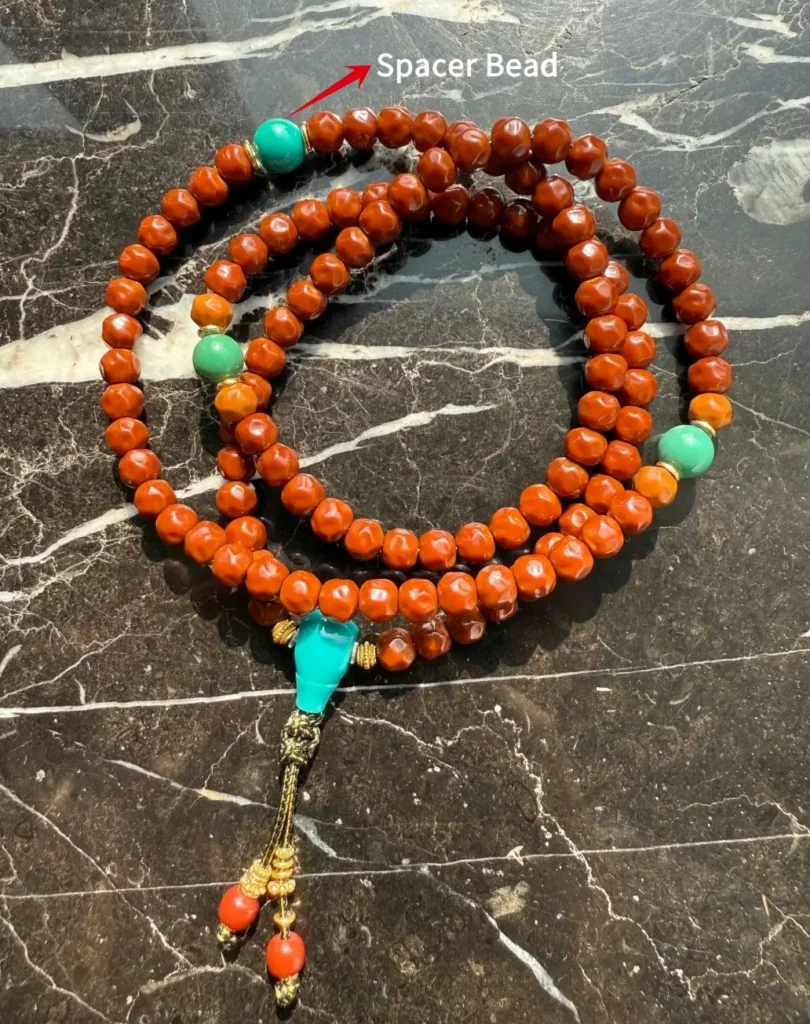
Spacer beads, known in Chinese as Jie Zhu, are larger or contrasting beads strategically placed within the Mala to divide the main beads into equal sections. Though subtle in appearance, they play both practical and aesthetic roles in the design and function of the strand.
1. Functional Role
In a traditional 108-bead Mala, a spacer is typically inserted after every 27 main beads, dividing the strand into four equal quadrants. This structure allows for:
- Counting Aid: If meditation or mantra recitation is interrupted, the practitioner can easily resume from the last spacer.
- Tactile Guidance: The change in size or texture provides a physical cue of progress without visual distraction.
It is important to note that spacers are not strictly necessary—many Tibetan practitioners omit them entirely to maintain focus on mantra repetition.
2. Material and Size
- Material Harmony: Spacer beads often match the material of the Mother Bead and Buddha Tower rather than the main beads, creating visual and spiritual cohesion across the strand.
- Size Difference: Spacers are generally slightly larger than the main beads, making them distinguishable by touch while maintaining balance in the Mala’s rhythm.
3. Aesthetic and Symbolic Considerations
- While some modern Malas incorporate ornate spacers as a form of decoration or status display, the original purpose remains purely functional. True practice lies in consistent repetition, not ornamental display.
- Properly placed spacers enhance both the visual hierarchy and the tactile experience of the Mala, guiding the practitioner’s hand and reinforcing the rhythm of meditation.
V. Mala Beads Anatomy: Counters and Tally Beads (Ji Nian)
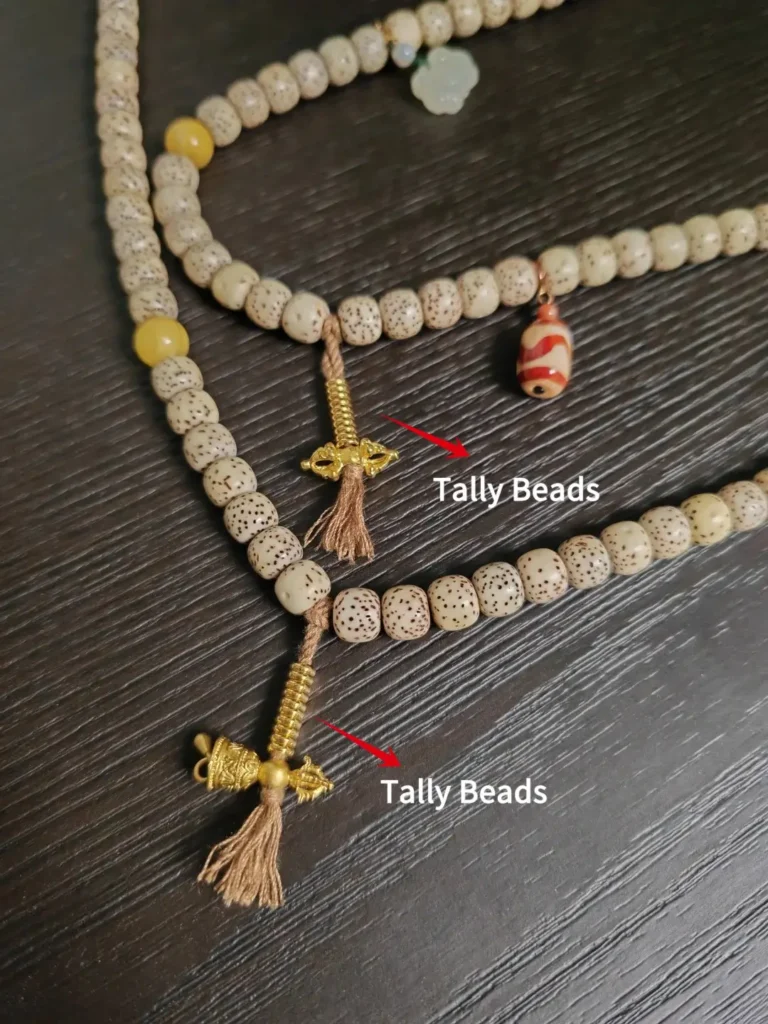
A Mala goes beyond a string of beads. It acts as a precise system to track mantra recitations using Counters (Ji Nian) and sometimes Tally Beads, letting practitioners record hundreds, thousands, or tens of thousands of repetitions.
1. Structure and Attachment
- Composition: Each counter consists of a short string of ten small beads, typically one-fifth or one-half the size of the main mantra beads.
- Traditional Placement: In Tibetan tradition, counters do not attach directly to the main cord. Instead, they hang from small rings threaded between the beads.
- Strategic Positioning: According to the Dictionary of Buddhism, these counters are typically placed after the 7th or 21st bead, counting from the Mother Bead.
This setup allows the practitioner to maintain a continuous count without visually interrupting meditation.
2. Stepwise Counting System
The system works like a manual decimal tracker, with specific charms marking different numeric milestones:
- The Bell (Hundreds): Each time a full circuit of 108 beads is completed, the practitioner moves one bead along the Bell string.
- The Vajra / Dorje (Thousands): Once all ten beads on the Bell string are moved (1,080 recitations), one bead on the Vajra string is advanced. A full cycle of the Vajra string marks 10,800 recitations.
- Counting Clip (Ten-Thousands): For extremely high counts, a silver clip (often lotus-shaped) is moved along the strand. Each shift corresponds to 10,000 mantras.
By combining these three levels, a practitioner can track massive recitation volumes—up to 11,6640 mantras or beyond—without losing precision.
3. Materials and Craftsmanship
- Functional Sets: Everyday Malas often use copper or iron counters strung on simple cord.
- Premium Malas: Fine sets feature gold or silver counters, sometimes inlaid with Turquoise, Coral, or other precious stones.
- Symbolic & Decorative Role: In Himalayan traditions, silver bells and Vajras are both functional and spiritually meaningful. Their placement and design vary across lineages, reinforcing the Mala’s role as a meditative guide while reflecting the practitioner’s devotion.
VI. Mala Beads Anatomy: The Cord (Luo Sheng)
The Cord (Luo Sheng) serves as the structural backbone of the Mala, binding all individual beads into a single, sacred loop. While it may seem like a simple component, the choice of material and tension reflects deep-seated regional traditions.
Many traditions see it as a representation of Avalokiteshvara (the Bodhisattva of Compassion). It weaves through each bead—each sentient being—binding them together and guiding the practitioner toward the heart of wisdom.
1. Material and Color
Practitioners select cords based on both preference and lineage:
- Han Chinese Traditions: These Malas offer more flexibility. Practitioners often choose any durable string that fits the bead bores, prioritizing personal aesthetics.
- Tibetan Traditions: Himalayan customs follow stricter guidelines. Artisans typically use red cotton thread, either in single or triple-strand weaves. While some unique cases use leather cords, cotton remains the professional standard for its durability and symbolic resonance.
2. Tension and “Breathing Room”
The most significant difference between regional styles lies in how tightly one strings the beads:
- Tight Stringing (Han Style): Han Chinese practitioners generally prefer a snug fit, where the beads sit closely together with minimal movement.
- Loose Stringing (Tibetan Style): Tibetan Malas typically feature two to three centimeters of extra space on the cord. This intentional “slack” serves a vital functional purpose:
- Tactile Precision: The extra room allows the practitioner to slide each bead clearly and individually.
- Extended Recitation: This gap proves essential during long prayers or the Ngöndro (Four Preliminary Practices), ensuring every count remains distinct and accurate.
VII. Mala Beads Anatomy: Disciple Beads (Di Zi Zhu)
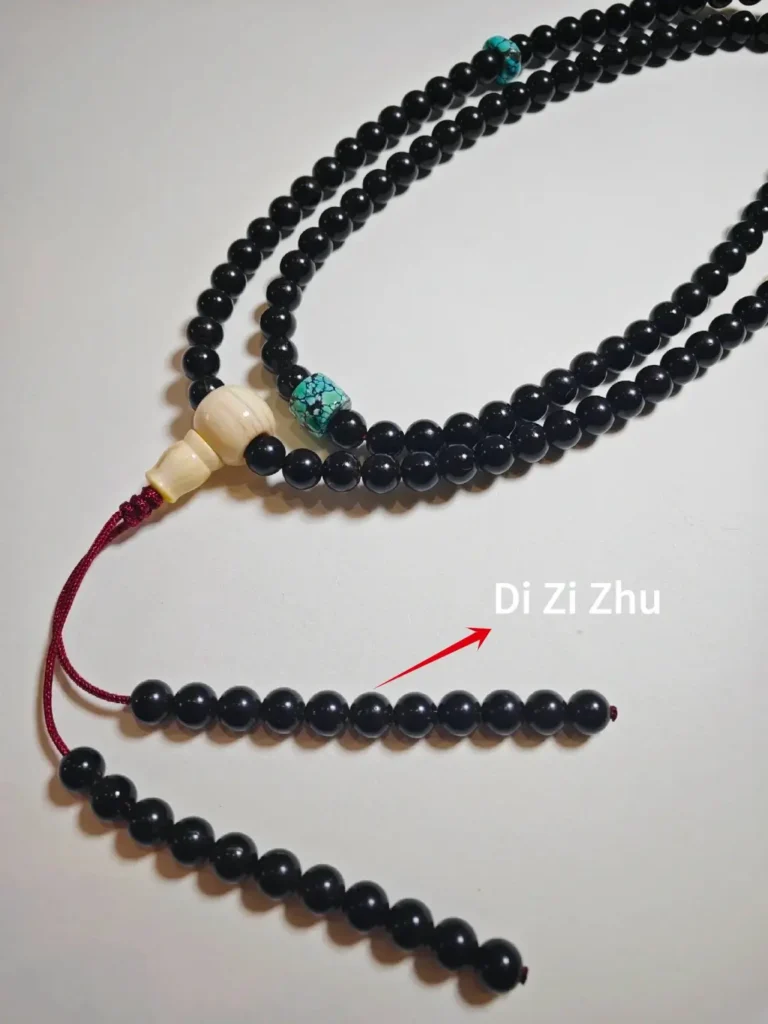
At the end of a mala’s cord, one often finds a pair of delicate side strands known as Disciple Beads (Di Zi Zhu). While they provide a refined visual finish, their role extends beyond ornamentation—serving both structural and symbolic purposes within the overall design.
1. Structural Balance and Counterweight
In traditional mala construction, Disciple Beads—together with the back ornament (Bei Yun) or other ritual elements—help maintain physical balance.
- Balance and Drape: They ensure the mala hangs evenly when worn around the neck or wrapped around the wrist.
- Proportion: These beads are typically smaller than the main mantra beads, preserving a harmonious visual hierarchy.
- Arrangement: Most designs feature between six and twelve beads, divided into two short, symmetrical strands.
2. A Functional Counting Alternative
For malas without dedicated metal counters, Disciple Beads can also serve as a practical counting tool.
- Abacus-Inspired Logic: Similar to a traditional abacus, they follow a decimal (base-ten) system.
- Flexible Use: Practitioners may use the beads to track repetitions of ten, adjusting the method according to their personal recitation practice.
3. The Symbolism of the Ten Paramitas
A common configuration features ten beads per strand, a number rich in Buddhist symbolism. These ten beads represent the Ten Paramitas—the essential virtues cultivated on the path toward enlightenment:
- Generosity (Dana)
- Morality (Sila)
- Patience (Ksanti)
- Diligence (Virya)
- Meditation (Dhyana)
- Wisdom (Prajna)
- Skillful Means (Upaya)
- Vow (Pranidhana)
- Spiritual Power (Bala)
- Knowledge (Jnana)
By concluding the mala with these beads, the design subtly reminds the practitioner that each recitation is not merely repetition, but a step toward cultivating these inner virtues.
Pro-Tip: The Significance of Bead Counts
In the world of fine Malas, the number of beads is never arbitrary. Each count holds a specific symbolic resonance, guiding the practitioner through different levels of spiritual realization.
108 Beads: The Standard of Transformation
This is the most iconic configuration. It represents the quest for 108 Samadhis (states of meditative consciousness) to sever the 108 earthly afflictions (Kleshas) that bind the human spirit.
Numerical Variations and Their Meanings
While 108 is the standard, other counts offer specialized focus:
- 54 Beads: Represents the 54 stages of a Bodhisattva’s journey toward enlightenment, including the Ten Faiths, Ten Dwellings, Ten Deeds, Ten Transferences, Ten Grounds, and the Four Roots of Goodness.
- 42 Beads: Symbolizes the 42 levels of the Bodhisattva path, specifically focusing on the Ten Dwellings through to the ultimate stages of “Equal Enlightenment” and “Wonderful Enlightenment.”
- 27 Beads: Refers to the 27 Sages of the “Four Pairs and Eight Stages” in Theravada Buddhism, representing various levels of attainment leading to Arhatship.
- 21 Beads: Signifies 21 levels of realization, encompassing the Ten Grounds, the Ten Paramitas, and the ultimate attainment of Buddhahood.
- 14 Beads: Represents the 14 Fearlessnesses of Avalokiteshvara (Guan Yin), providing protection and merit to the practitioner.
Specialty and Portable Configurations
- 1,080 Beads: This massive strand represents the Ten Realms of Existence, each containing 108 afflictions, totaling 1,080. These are typically reserved for high-ranking masters or specific ritual ceremonies.
- 36 and 18 Beads: These counts share the same spiritual essence as the 108-bead Mala. Artisans divide the sacred 108 by three or six primarily for portability. These shorter strands allow practitioners to carry the essence of their practice conveniently in daily life without losing its foundational meaning.
Jewea: A Meditative Companion Beyond Ornament
An in-depth look at Mala Beads Anatomy reveals that every component—from the “Oneness” of the Mother Bead to the rhythmic guidance of the Spacers—is far more than decorative. Each element serves as a precision tool designed to anchor your mindfulness practice. Through this structural harmony, a simple strand of beads transforms into a sacred map for your spiritual journey.
At Jewea, we honor this ancient heritage by merging traditional craftsmanship with the finest natural gemstones. We meticulously handcraft every Mala to ensure both structural integrity and aesthetic soul, providing you with a reliable meditative companion or a deeply meaningful piece of wearable art. For those who feel called to experience this craftsmanship firsthand, we invite you to explore our comprehensive [The Art of the Shibazi Bracelet: DIY Guide to Crafting the Eighteen Beads Treasure] and begin your own creative journey.