Have You Seen Thin-Walled Jade Vessels Only 0.5 Millimeters Thick?
In jade carving, vessels require considerable craftsmanship and consume a large amount of jade, making them relatively uncommon in the jade market.
In ancient China, jade vessels were reserved for the use of the powerful and elite. Carvers pushed the boundaries of both form and technique, striving for the ultimate in ingenuity, refinement, and thinness. Their work left behind remarkable treasures that still impress us today.
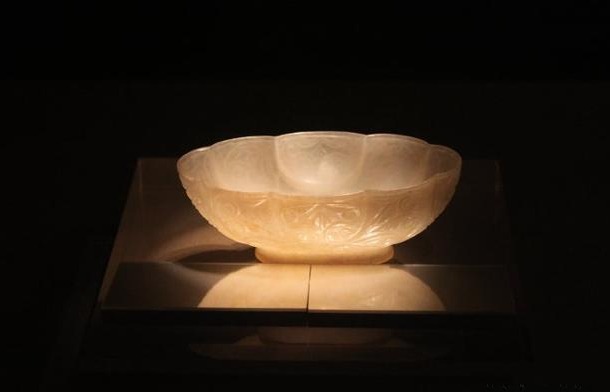
One outstanding example is the white jade honeysuckle-patterned eight-lobed long cup from the Tang dynasty. The carver used shallow relief carving created by cutting away the surrounding ground, combined with fine incised lines, to create the decoration. Most remarkably, the thinnest part of the cup wall near the rim measures only about 0.5 millimeters. When illuminated, the thin jade wall allows light to pass through, giving the cup a delicate and translucent appearance.
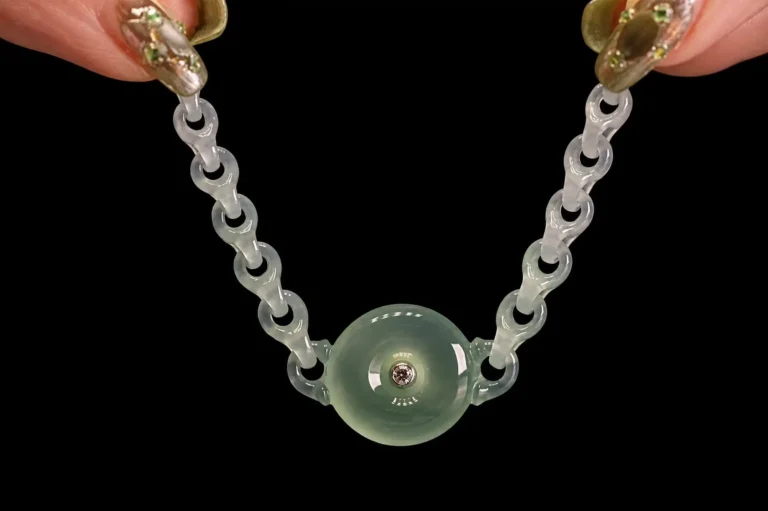
In our previous article, Jade Chain Carving: The Art of Creating Movable Interlocking Jade Chains, we explored another traditional Chinese jade-carving technique. In this article, we turn to another remarkable craft in Chinese jade carving: thin-walled jade vessels.
The Development of Thin-Walled Jade Vessels
Thin-walled jade vessels date back to the Tang dynasty. The craft continued through the Song, Yuan, and Ming dynasties, but its technical difficulty and high failure rate prevented it from becoming widespread.
The craft reached a new stage in the Qing dynasty. The Qianlong Emperor had a strong appreciation for thin-walled jade vessels, so the imperial court established a specialized “Xifan” workshop and brought in jade carvers from Suzhou to make thin-walled vessels. During this period, jade carvers also incorporated features of Hindustan jade, further refining the thin-walled technique.
According to the Palace Museum, the historical term Hindustan jade mainly refers to jade objects from the region where West and Central Asia meet, including areas around Kashmir and western Pakistan.
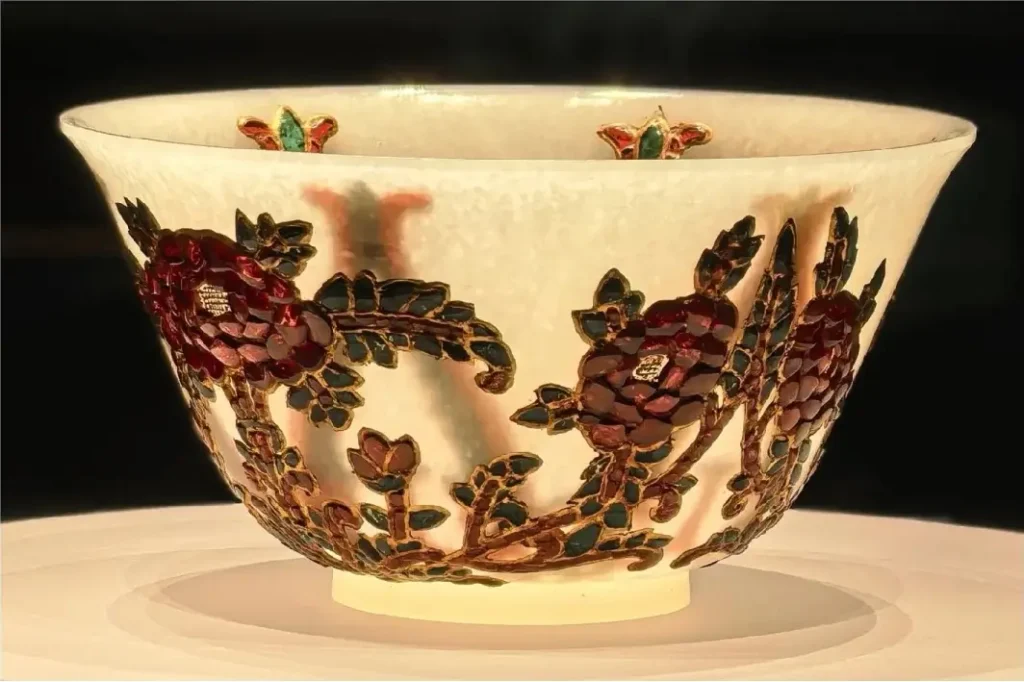
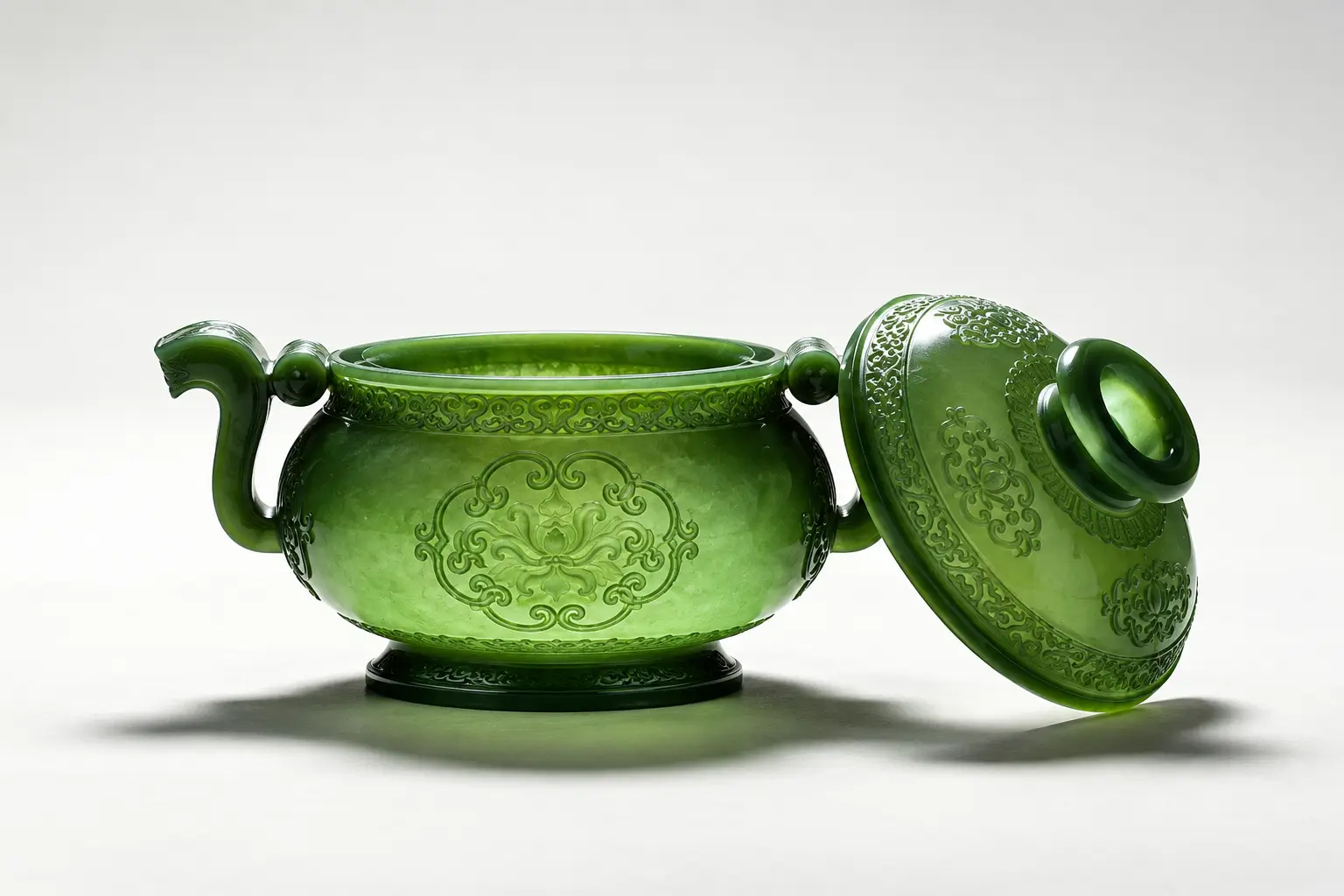
These jade objects have distinctive regional characteristics. Carvers used abrasive techniques to shape them, creating vessels with relatively thin walls and light, elegant forms. Plant and floral motifs were common, including passionflower and clematis designs. Some pieces also featured fine gold or silver wire and inlays of gemstones or glass set into the vessel walls.
Thin-walled jade vessels reached a peak during the Qianlong period. They featured distinctive forms, elaborate decoration, and were produced in large numbers. After the Qianlong reign, production gradually declined, and the thin-walled technique came close to being lost.
In the 1930s, Beijing jade master Pan Bingheng played an important role in reviving and further developing the technique.
After 1949, Suzhou jade carvers gradually resumed making thin-walled jade vessels, although production was initially limited mainly to smaller objects such as brush washers, powder boxes, and snuff bottles. From the 1990s onward, growing interest from collectors and buyers in Taiwan, Hong Kong, and Macao helped revive interest in thin-walled jade vessels in Suzhou.
How Thin Are Thin-Walled Jade Vessels?
The Qianlong Emperor once used a line of poetry to describe the lightness and delicate craftsmanship of thin-walled jade vessels:
“Thinner than a carved sheet of paper, lighter than a lifted feather.”
Measurements of Qing-dynasty thin-walled jade vessels in the collections of both the National Palace Museum in Taipei and the Palace Museum in Beijing show wall thicknesses of around 1.0–1.5 mm, with walls as thin as 1.0 mm considered uncommon.
Contemporary Suzhou thin-walled jade vessels have pushed this further. Industry sources document works with walls measuring around 0.5–1.0 mm.
How thin is 0.5 mm? As a simple comparison, 0.5 mm is roughly the thickness of five sheets of ordinary paper.
Because the vessel contains a large hollow space while using very little material, its overall density can, in some cases, be lower than that of water, allowing it to float.
This is not a physical characteristic of every thin-walled jade vessel. Whether a vessel can float depends on factors such as its volume, wall thickness, internal space, and overall weight.
What Jade Is Suitable for Thin-Walled Vessels?
Hetian jade comes in several varieties, including White Nephrite, Green Nephrite, Bluish-Green Nephrite, and Black Nephrite. In traditional Suzhou-style thin-walled vessels, Green Nephrite, Bluish-Green Nephrite, and Bluish-White Nephrite are relatively common.
When selecting jade for thin-walled vessels, carvers consider its texture, structure, toughness, cost, and translucency.
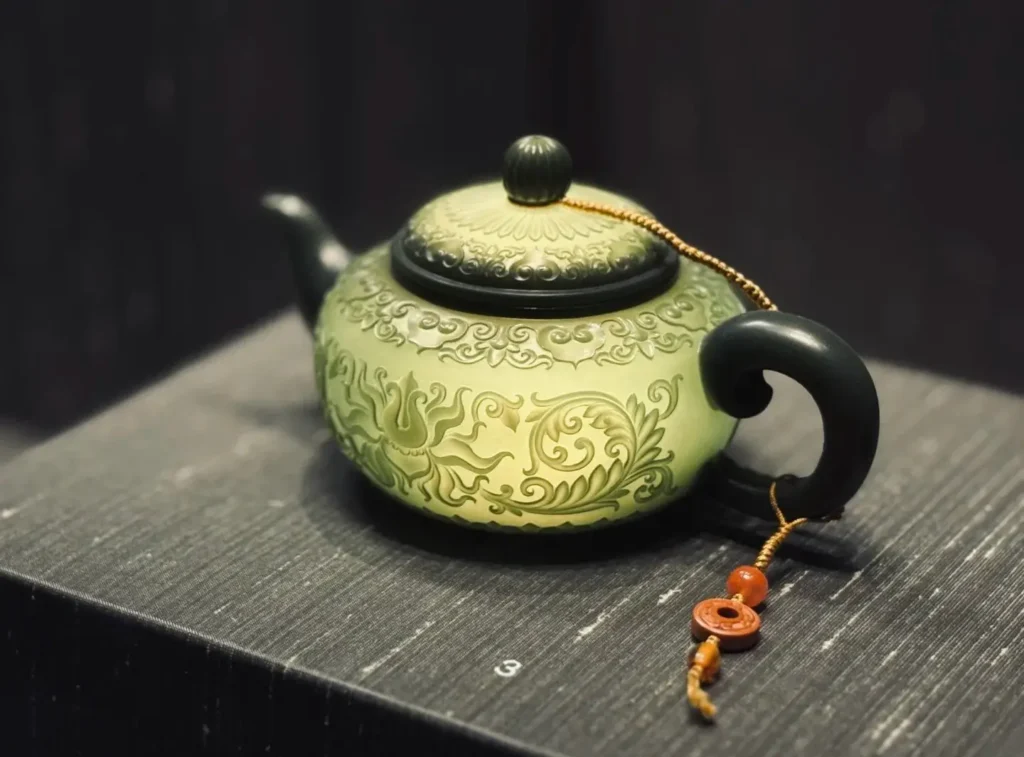
Green Nephrite and Bluish-Green Nephrite are relatively abundant, making them well suited to vessels that require a substantial amount of jade. As the walls become thinner and allow more light to pass through, their color can appear softer and lighter. Some may even show what Chinese jade carvers describe as “green turning to white,” giving the finished vessel a more even and translucent appearance.
White Nephrite can also be used to make thin-walled vessels. However, some white jade vessels may appear slightly gray or cool under strong transmitted light, which can reduce the warm, lustrous appearance normally associated with White Nephrite.
In general, carvers use mountain material more often for jade vessels. Making large vessels such as incense burners and bottles from seed material is relatively more difficult and costly. As a result, vessels made from seed material are often very expensive.
How Are Thin-Walled Jade Vessels Made?
A thin-walled jade vessel typically goes through several stages, including material selection, design, cutting, rough shaping, carving, hollowing, and polishing.
The exact process varies with the carver, the vessel’s form, and the type of jade. But the basic steps remain much the same.
1. Selecting the Jade
The first step is to choose jade that is suitable for making a vessel.
The ideal material should have a fine texture, sound structure, and good toughness, with as few visible cracks or structural flaws as possible.
Because the finished walls are extremely thin, even a small crack that seems insignificant in the rough stone can become the starting point for damage during carving.
2. Design
Making a thin-walled vessel involves more than simply grinding the jade thinner. The vessel’s form, wall thickness, decoration, and the jade itself all need to work together. Carvers develop the design around the jade’s color, structure, size, and natural form.
For darker-colored jade, a carver may use thinner walls to control how much light passes through. With lighter-colored or more translucent jade, thicker walls may help control the amount of light and achieve the desired appearance.
This is why thin-walled jade carving follows the principle of working with the material, rather than simply trying to achieve the thinnest possible wall.
3. Cutting the Rough Stone
Once the design is set, the carver removes excess jade to match the vessel’s size and form, while leaving enough material for the later stages of carving.
Because the carver still needs to hollow out the vessel, the initial cutting must also account for the final form and make efficient use of the jade.
4. Rough Shaping
At this stage, the carver shapes the rough jade into the vessel’s basic outer form.
The carver must carefully control the vessel’s proportions, symmetry, and overall structure. For a lidded vessel, the body and lid must also be sized to fit each other precisely, so the rim and inner lip align properly.
For paired or matching sets, the carver also needs to make the lids interchangeable.
5. Carving
The decoration on a thin-walled jade vessel must work in harmony with its light, delicate body.
Traditional designs often include plants, flowers, leaves, and border motifs. Carvers may use different techniques, including relief carving, shallow carving, and fine incised lines.
Because the walls are so thin, the depth of the carving requires careful control. Carving too deeply can weaken the vessel wall, while carving too shallowly may fail to create clear definition and depth in the design.
6. Hollowing the Vessel
Hollowing is one of the most critical and riskiest stages in making a thin-walled vessel.
Once the outer form has taken shape, a lidded vessel enters the hollowing stage after the lid has been shaped and the inner lip has been established. The carver gradually removes jade from the inside, turning a solid piece into a hollow vessel and bringing the walls down to the thickness specified in the design.
Traditional methods use different tools and techniques to hollow and grind the interior. For example:
- A hollowing tool can gradually grind away the jade inside the vessel, but the material removed from the interior cannot be reused.
- Core drilling can remove a tubular section of jade from the interior, allowing more of the material to be recovered.
If the jade removed from the interior is large enough and of suitable quality, the carver can use it to make a bangle or a small jade ornament.
For large vessels, such as large incense burners and censers, carvers may plan from the design stage how to use the original block in layers. This allows the jade removed from the interior to become part of other pieces made from the same material. In Chinese jade carving, This approach is often described as “nested material use.”
A Short Story: Pan Bingheng and Nested Material Use
According to biographical accounts, one day in 1930, a jade merchant brought Pan Bingheng a high-quality piece of Green Nephrite measuring about one chi square and weighing more than 200 jin. He asked the 18-year-old Pan to make a square jade lei, four tea canisters, and four flower vessels—nine pieces in total.
Pan boldly used the nested material-use method for the first time. He completed all nine pieces and even made an additional vase from the remaining material. The achievement attracted considerable attention in Beijing’s jade-carving community.
Returning to the hollowing process, this stage tests not only a carver’s technical skill but also their composure. As the walls become thinner, the vessel becomes less able to withstand the stresses of cutting and grinding. A small mistake can lead to a crack or even destroy the entire vessel.
7. Polishing
Polishing is one of the final critical stages in making a thin-walled jade vessel.
The thinner the walls, the more carefully the carver must control the polishing process. Over-polishing one area can make the wall uneven or even polish through it. Poor handling around the decorative areas can also weaken the original depth and definition of the carving.
For vessels with wide openings, such as plates, bowls, and cups, carvers can use abrasive stones, starting with a coarser grade and gradually moving to finer ones.
For vessels with narrow openings, such as bottles and ewers, carvers can gradually add diamond abrasive of different grades into the vessel. The carver then rotates the vessel at high speed, allowing the abrasive to strike the inner walls and gradually grind and polish the surface.
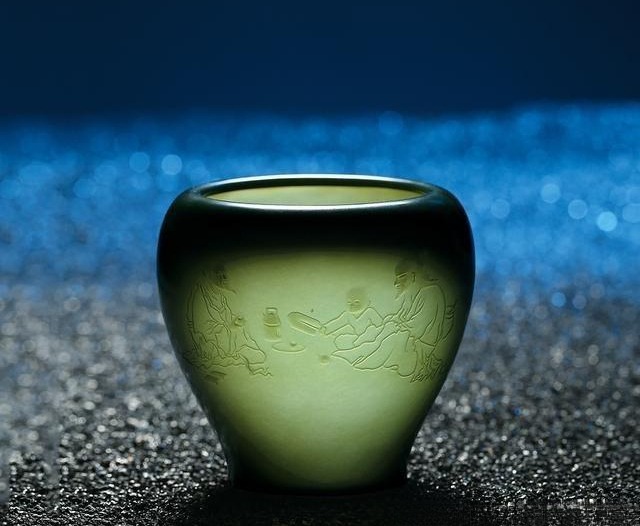
After thorough polishing, a thin-walled jade vessel develops a smooth surface and a soft luster. When the walls are thin enough and the jade allows some light to pass through, light can also shine through the walls, giving the carved decoration a distinctive sense of depth.
How to Appreciate Thin-Walled Jade Vessels?
You cannot judge a thin-walled jade vessel by its wall thickness alone.
Master Pan Bingheng distinguished thin-walled jade from thin-walled porcelain. He described thin-walled porcelain as “thin as paper, white as jade, bright as a mirror, and resonant as a chime.” He described thin-walled jade as “clear as water, resonant as a chime, and cloudless.”
When appreciating thin-walled jade vessels, it helps to look at four qualities: refinement, precision, ingenuity, and lightness.
- Refinement: This shows in how the carver controls the wall thickness. The walls should suit the jade’s quality, color, form, and decoration. The thickness should remain well balanced rather than simply aiming for the thinnest possible wall.
- Precision: This shows in the vessel’s structure and workmanship. A fine thin-walled vessel should have relatively even walls, a clean interior, and a well-balanced relationship between its outer form and inner space. On more complex forms, the rim, base, and transitions between sections require especially careful control.
- Ingenuity: This lies largely in the design. The proportions of the vessel, the placement of its decoration, and the jade’s own color and structure should work together. The result should feel light and graceful without looking fragile, and refined without losing the natural character of the jade.
- Lightness: This refers to the vessel’s visual sense of weightlessness. Its outer lines should flow smoothly, with the decoration working in harmony with the form. Excessive ornament can make a piece feel heavy. Even when a thin-walled jade vessel carries rich decoration, a well-designed piece can still look light, open, and graceful.
A truly fine thin-walled jade vessel is not simply about being as thin as possible. It is about bringing the jade, wall thickness, form, decoration, and play of light into harmony.
Jewea Summary
Thin-walled jade vessels are one of the most distinctive forms of vessel craftsmanship in traditional Chinese jade carving.
Their value lies not simply in being thin, but in the centuries-long pursuit of the limits of both material and craftsmanship.
For modern jade carving, the thin-walled tradition also reminds us that the value of traditional craftsmanship lies not only in preserving an ancient way of making things. It also lies in how craftsmen understand their materials, manage risks, and create new possibilities within the limits of the material.
Perhaps that is why thin-walled jade vessels have remained so fascinating for hundreds of years.