How to Identify Hetian Seed Jade Through Its Skin Color
Buyers often ask us to check whether a piece of Hetian seed jade is genuine. We see these questions both online and in person. Many pieces turn out not to be true seed jade at all. In some cases, though, photos simply do not provide enough detail to make a reliable judgment.
In this article, we use real specimens to show you what to look for in Hetian Seed Jade Skin. We will look at natural skin and color, then compare them with the common features of imitation seed-jade skin.
I. What Makes Hetian Seed Jade Skin Distinctive
In our earlier article, Hetian Jade Types: From Mountain Material to Seed, Alluvial & Gobi Jade, we explained how seed jade forms. Mountain jade enters the river system and travels downstream. Over a very long period, constant water flow, friction, and collisions wear away the softer, looser parts. What remains is the denser, tougher jade.
This process usually gives seed jade a smooth, oily feel. But that does not mean every piece of seed jade has good jade quality.
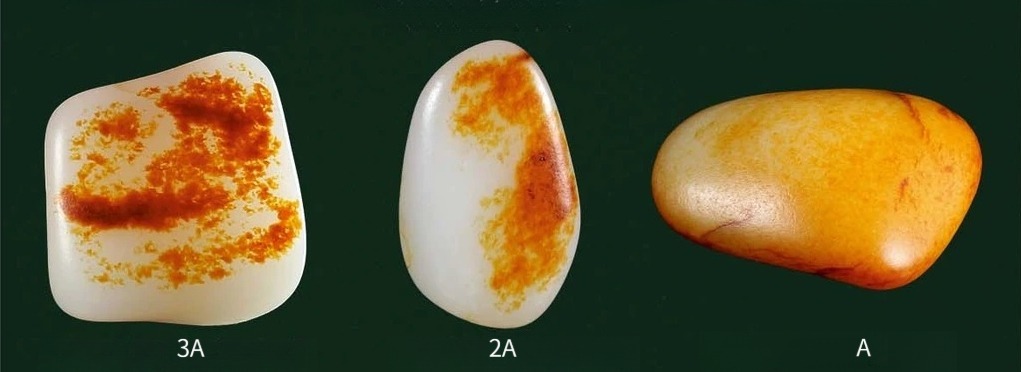
The same long journey through the river leaves behind another distinctive feature: Hetian Seed Jade Skin.
People once treated the skin as a flaw and often removed it during carving and polishing. That changed as Hetian jade became harder to find, especially natural seed jade. As prices rose, carvers began leaving part of the skin intact. It preserves a natural feature of the material and can also provide a useful clue when assessing whether a piece is seed jade.
In general, natural seed jade skin has several distinctive features.
1. Pores Vary in Size and Depth
The “pores” we talk about here are not actual holes. They are small, orange-peel-like pits that form on the surface of Hetian seed jade after years of river erosion, friction, and impact. They look a bit like the pores on human skin, which is why the trade calls them “pores.”
Human skin can be smooth or coarse. Natural seed jade skin varies in much the same way. Some pieces have very fine pores, while others have much rougher ones.
But in either case, natural pores rarely look exactly the same. Their size and depth change from one spot to another.
The reason is simple. Seed jade forms as it moves and gets knocked around in a real river environment. One day, it may hit a large rock. The next, it may scrape against sand and gravel. The force and direction keep changing. It does not tumble in a washing machine, rolling evenly in every direction at 360 degrees.
That is why natural pores have an irregular, random-looking pattern.
2. Natural Color Variation and Gradation
Besides years of river erosion and repeated impacts, seed jade also absorbs trace elements from its surroundings over time. These elements gradually seep into the jade and create different colors. This is what we commonly call skin color.
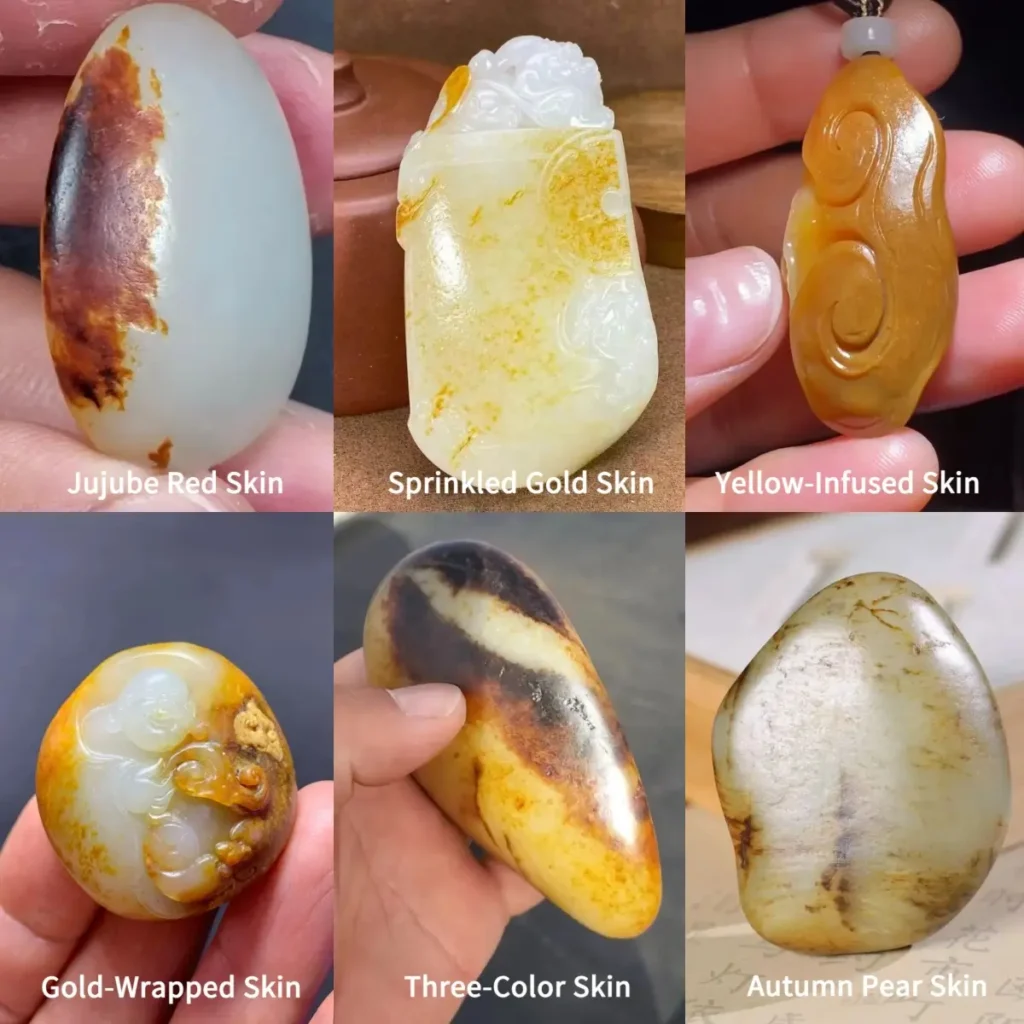
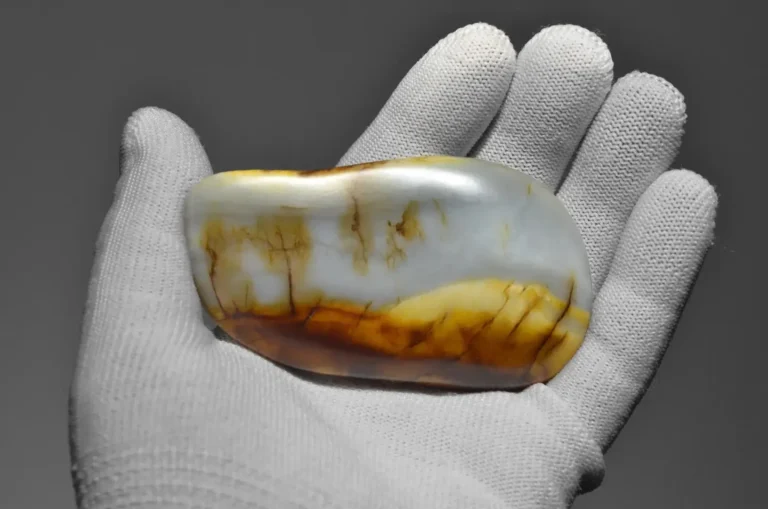
Common skin colors include Jujube Red Skin (Zao Hong Pi), Sprinkled Gold Skin (Sa Jin Pi), and Autumn Pear Skin (Qiu Li Pi).
Whatever the color, natural skin color usually looks soft and organic. It does not spread evenly. Instead, it shows subtle shifts in tone, with lighter and darker areas creating a natural sense of depth.
In general, looser areas of the jade absorb these elements more easily. As a result, they often show deeper color than denser areas.
In other words, natural skin color does not simply sit on top of the jade like a layer of paint. It develops in connection with the jade’s internal structure and its long formation process.
3. Nail-Like Inclusions and “Water-Grass” Inclusions
In our article Hetian Jade Nail-Shaped Marks: What They Reveal About Seed Jade, we introduced nail-shaped marks on the surface of Hetian seed jade. Here, we look at nail-like and “water-grass” patterns inside the jade.
As we mentioned earlier, seed-jade skin color develops over a very long period. Trace elements gradually seep into the jade from the outside, leaving color beneath the surface.
If you cut a piece of seed jade and examine it from the side, you may see that the color does not stop at the surface. It can extend into the jade as well. The color inside is usually lighter than the surface skin, and the affected area is often less dense.
nail-like pattern
The term “nail-like pattern” is quite literal. The color seems to drive into the jade like a nail.
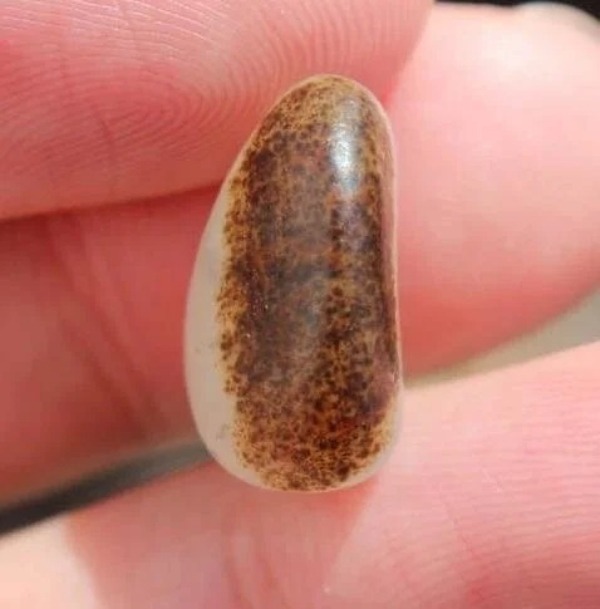
On carved seed jade, these nail-like patterns may remain exposed, making them relatively easy to spot.
With a rough seed-jade specimen, you usually need a flashlight. Shine the light from different angles and look carefully for any color that extends into the jade.
water-grass inclusions
Besides nail-like patterns, “water-grass” inclusions are another important feature found in natural seed jade. Manganese ions are generally associated with the color-forming process.
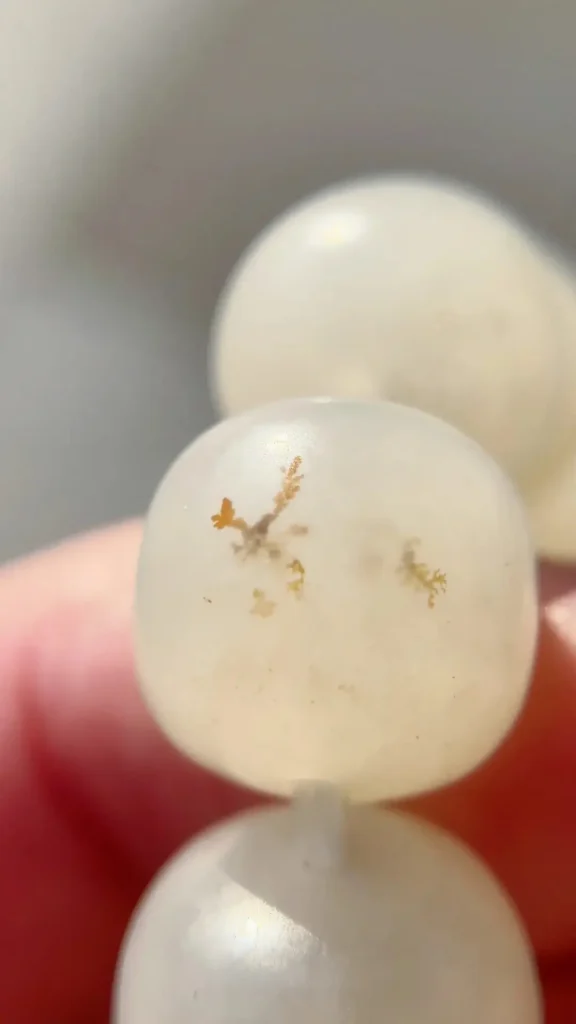
When manganese deposits and crystallizes, it can form black crystals. Some look like blades of water grass, while others resemble centipedes. That is why jade traders use names such as “water-grass inclusions,” “water-grass flowers,” and “centipede legs.”
These inclusions usually occur along fractures in Hetian jade. They may appear as a thin black line or a black band. Under a magnifying glass, you can sometimes see finer, water-grass-like patterns within them.
There is one important point to keep in mind:
Water-grass inclusions can help indicate that a piece has not been artificially dyed, but they do not prove that the jade is seed jade.
Other types of Hetian jade, including Russian jade and Qinghai jade, can also develop water-grass-like inclusions from manganese deposits.
So never identify seed jade from a single feature. Look at the skin, skin color, shape, internal structure, and oily luster together. Only by considering all of these features can you make a more reliable assessment.
II. What Fake Seed-Jade Skin Looks Like
Because natural seed-jade skin has recognizable features, it has also become one of the biggest targets for imitation in the jade market.
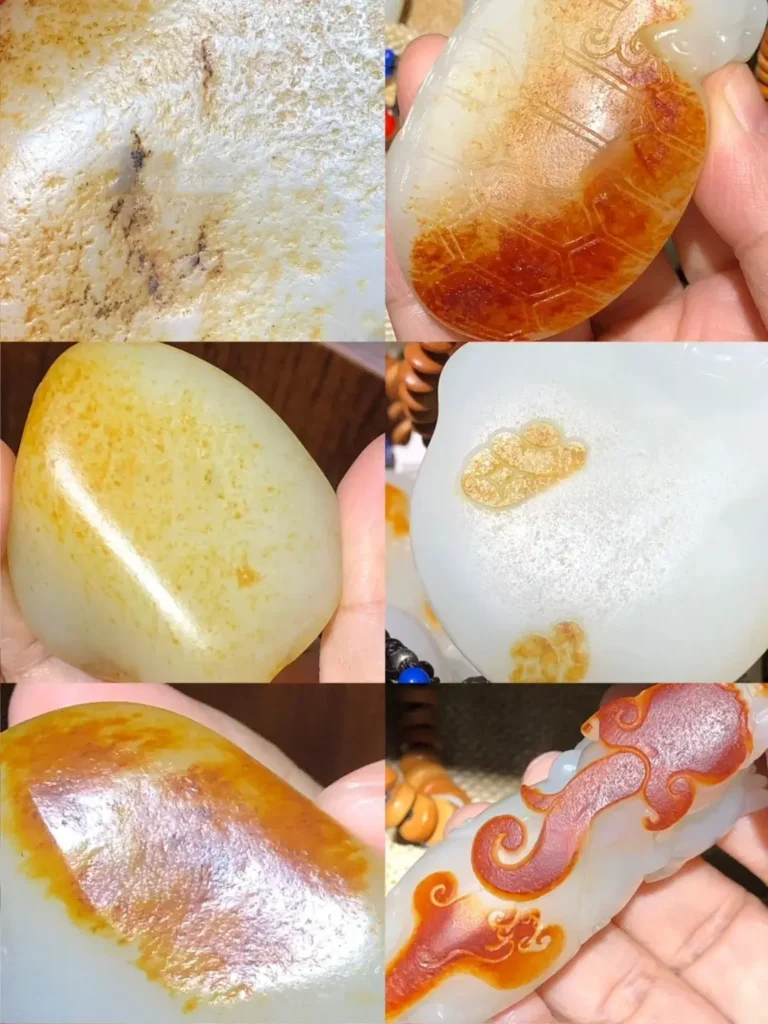
Sellers can artificially create seed-like skin on many types of jade, including Korean jade, Russian jade, mountain jade, and Qinghai jade. They may then sell the material as seed jade. This can leave buyers paying far more than the jade is worth and misjudging its true value.
Most imitations on the market are still fairly low-end. Their skin color often looks exaggerated, the carving tends to be rough, and the price is usually low. If you already know the basics of Hetian jade and have studied the examples and specimens we have covered in earlier articles, these pieces are usually not too difficult to spot.
The more convincing imitations are the mid- to high-end ones. These pieces may start with mountain jade or high-quality Russian jade, both of which can have good natural-looking jade quality. Sellers then create an artificial skin on the surface. Some may also add a second layer of color to genuine seed jade.
That makes these imitations much harder to judge. The underlying jade may already look good, and the added skin color can make it easy for a seller to present the piece as valuable seed jade and charge a seed-jade price. For an inexperienced buyer, the difference can be very difficult to spot.
Still, no matter how sophisticated the treatment is, artificial skin does not form the way natural skin does. It usually leaves behind clues of the work done to create it.
1. Uniform Pores with an Artificially Regular Pattern
Natural seed-jade pores form over a long period under changing conditions and repeated, uneven impacts. Their size, depth, and distribution naturally vary from one area to another.
Imitation seed-jade pores, by contrast, are often made with drills, tumbling, abrasive tools, or other artificial methods.
No matter how skilled the maker is, artificial processing cannot fully reproduce the random, complex forces that act on jade in a natural river environment over thousands of years. The pores therefore tend to look too uniform and lack natural variation.
If the pores across an entire piece look so neat and orderly that they could line up for a military parade, be very suspicious of artificial treatment.
2. Bright, Even Color with Little Natural Variation
Imitation makers favor sprinkled-gold skin, followed by jujube-red skin.
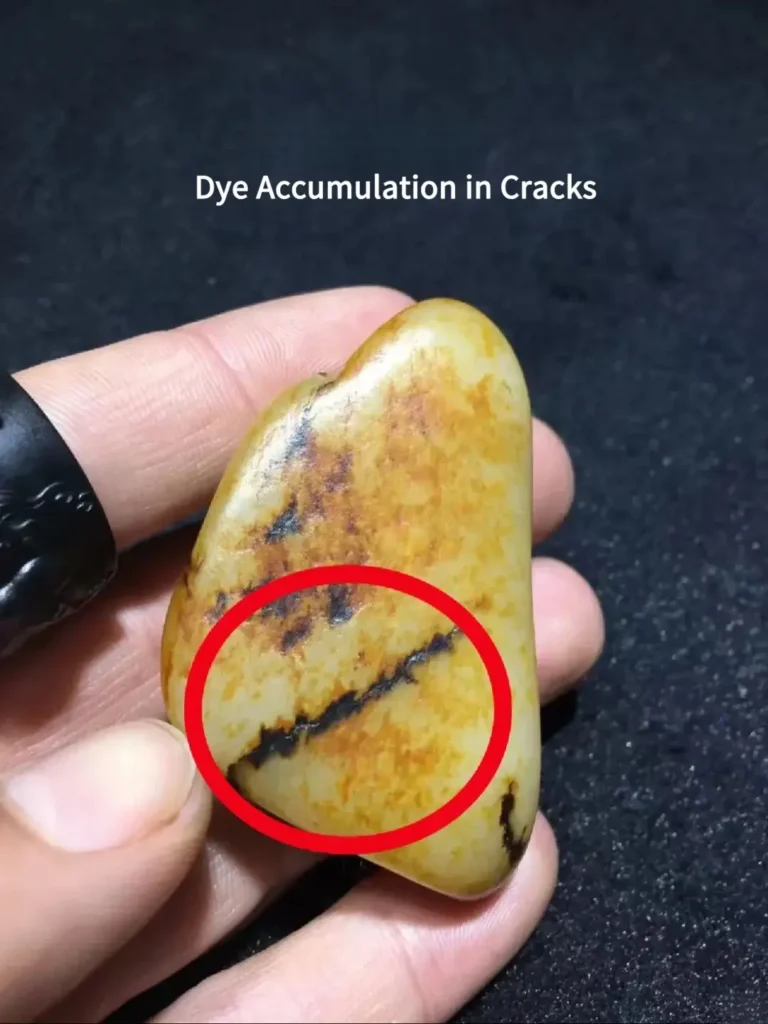
These artificial colors can look as if someone turned the saturation on a screen all the way up. They appear vivid and intense, with a strong visual impact. Apart from areas along fractures, where dye may collect and create darker patches, the color across the surface often shows little natural variation. It can look flat and monotonous.
But bright color alone does not mean the skin is fake. Natural seed jade can also have vivid, beautiful skin colors.
The problem is that sprinkled-gold skin and similar types are common targets for imitation and fraud. So if a piece is sold as seed jade and shows overly vivid color, stiff-looking white jade, and mediocre carving, take a closer look.
3. Artificial Grinding Marks on the Surface
Artificial seed-jade skin does not have the naturally formed nail-like patterns or water-grass inclusions found in natural skin. But it can leave another telltale sign: grinding marks.
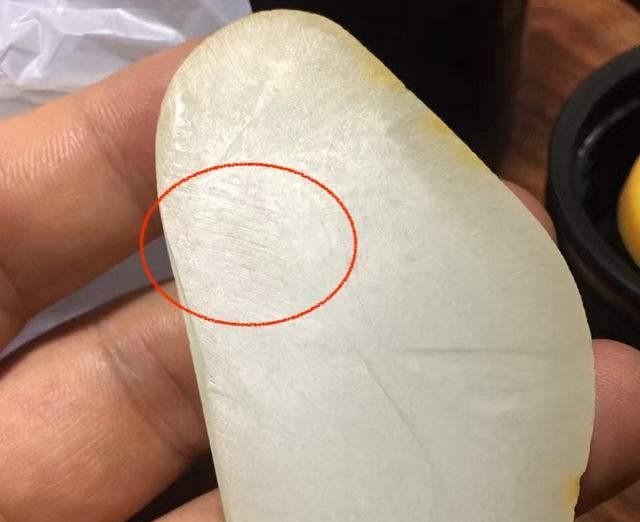
Imitation seed jade needs to mimic more than natural skin color. Its shape also needs to look like a natural seed jade pebble, with no obvious sharp edges or corners.
So whether the maker starts with mountain jade, Russian jade, or Qinghai jade, they usually need to reshape and grind the material first. They round off the edges and give it a more natural, pebble-like form. This process can leave cutting and grinding marks on the surface.
These marks are often very fine and difficult to see with the naked eye. So if you collect or study Hetian jade, a 10× loupe and a flashlight are basic tools to have.
III. When a Small Patch of Skin Hides the Bigger Picture
Natural seed-jade rough pieces and carved pieces that retain a large area of skin are relatively easy to assess when you look at all the features we have discussed above.
The real challenge comes with bracelets, carvings, and beads that retain only a small patch of skin.
When only part of the skin remains, it becomes much harder to judge. You may mistake artificial skin for natural skin. You may also mistake genuine natural skin for fake skin simply because too few features remain to tell the full story.
When Most of the Evidence Gets Cut Away
Take the piece below as an example.
If you look at the whole piece, you can identify the artificial skin fairly easily. The pores and color look too uniform.
But what if someone turns it into a bracelet and leaves only a small patch of skin?
What if they polish it into beads and keep only a tiny spot?
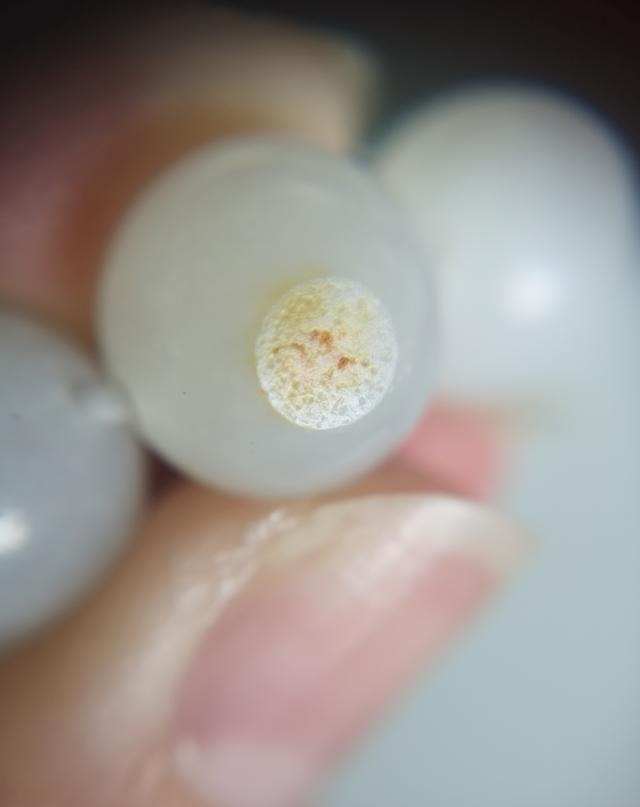
The answer becomes much harder to see. The cutting and polishing process may remove the most obvious signs of artificial treatment. You may be left with nothing more than a small area of skin color and a few pores.
That small patch can hide the bigger picture.
When Natural Skin Looks Suspicious
Now look at the next piece.
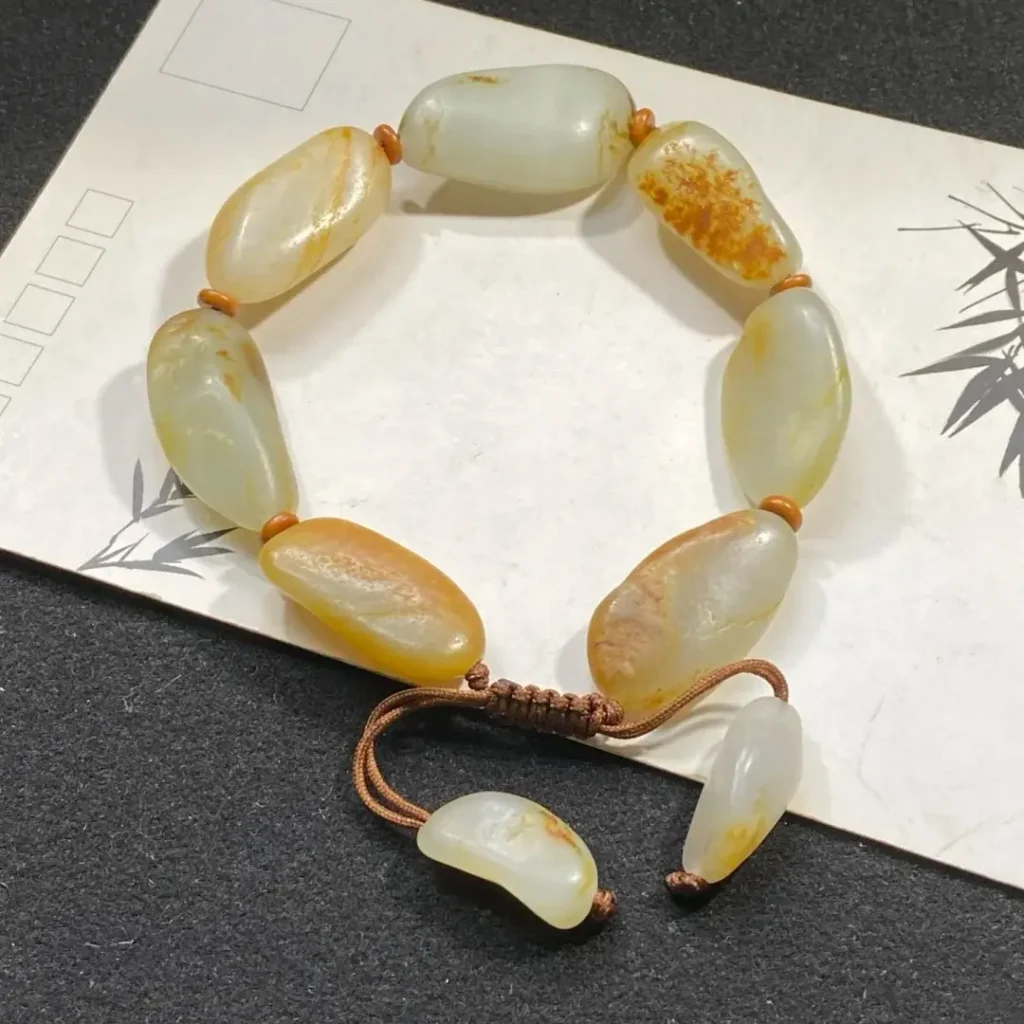
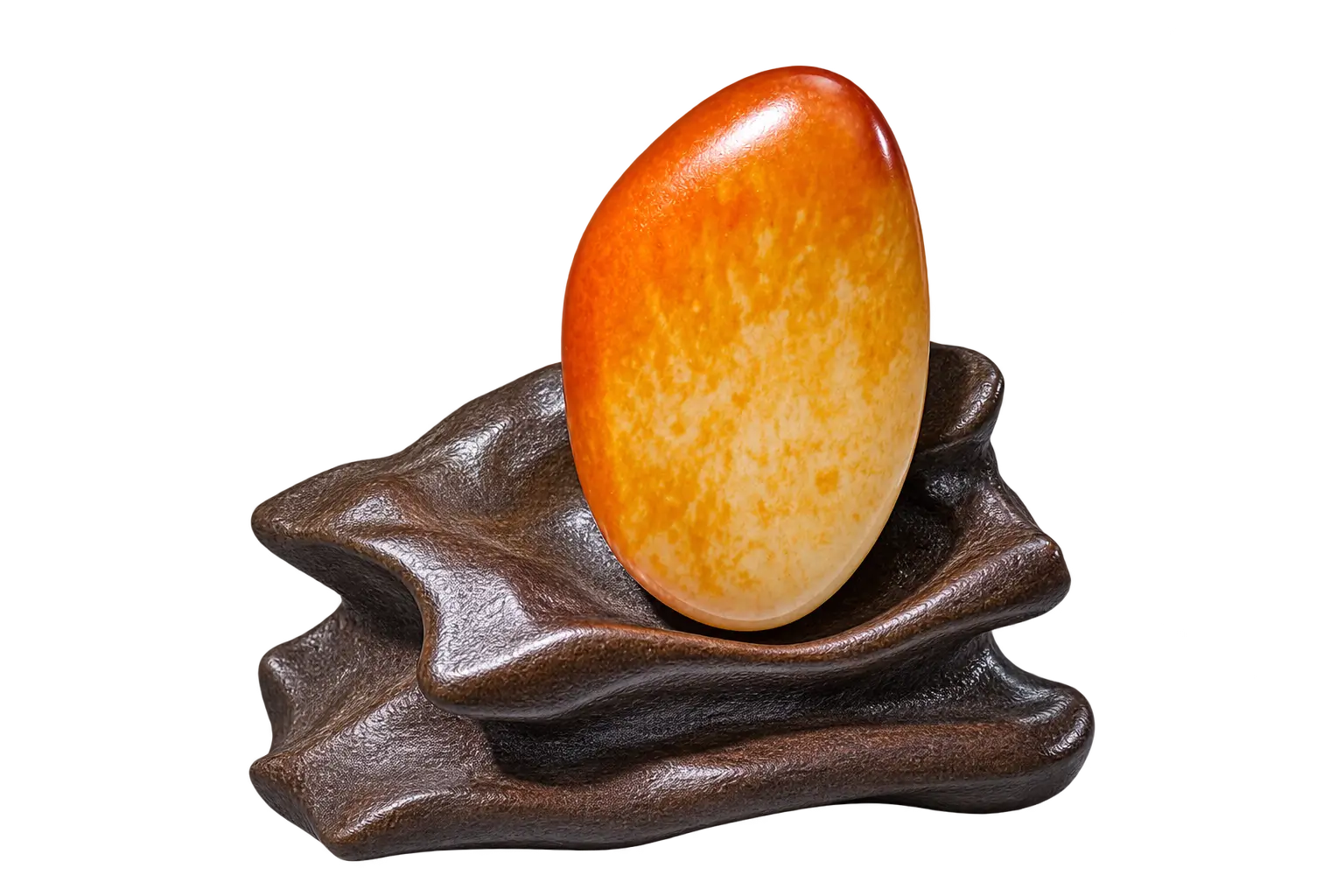
Many people would call it fake at first glance. The color looks quite vivid, and the pores appear relatively uniform.
But this is actually genuine natural seed jade.
The reason is simple: the piece happens to retain a particularly vivid section of natural skin. Look at it from the side, and you can also see the color extending into the jade beneath the surface.
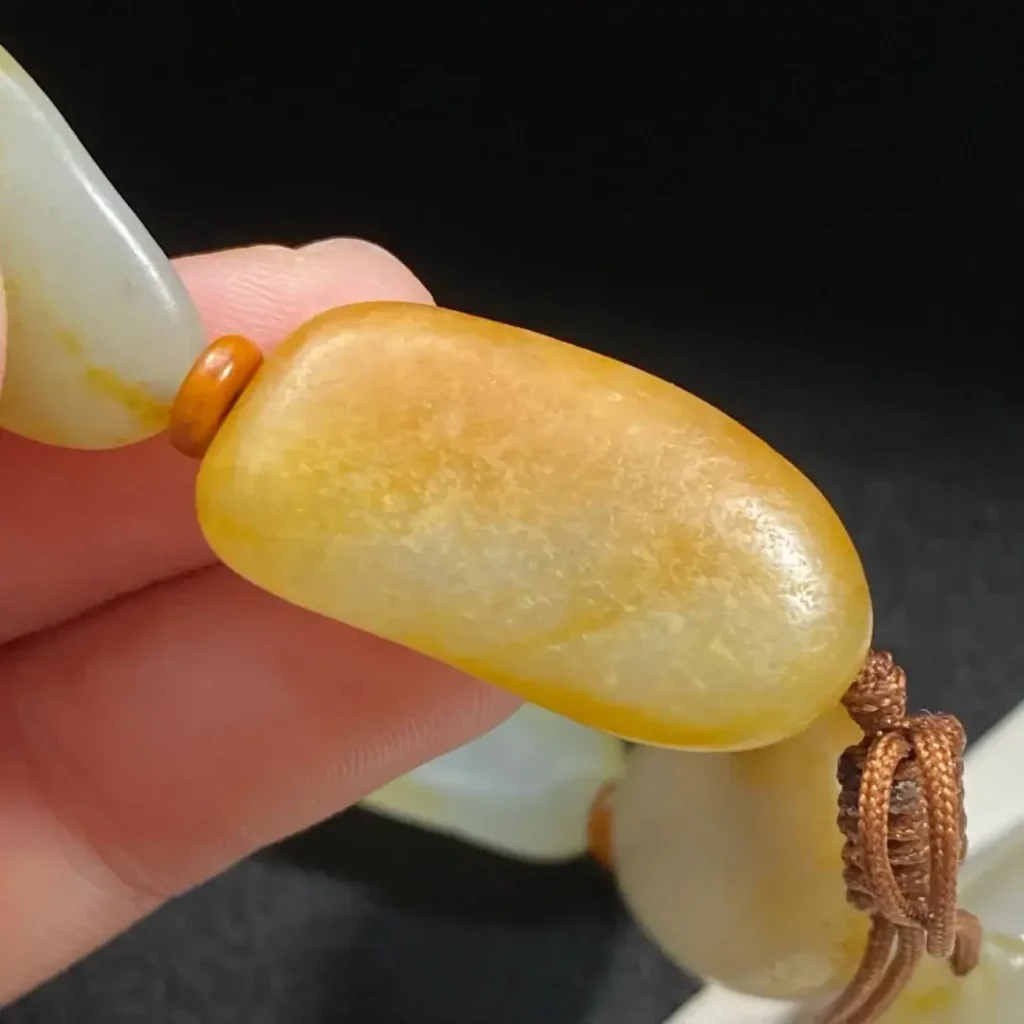
So even natural skin can sometimes look suspicious when you examine only one small area.
Why High-End Imitations Are Harder to Spot
Low-quality imitation seed jade is usually easier to identify, even when it retains only a small patch of skin. The underlying jade often gives it away.
High-end imitations are a different story.
Makers often choose good-quality Russian jade as the starting material. The jade itself can already look fine, making the finished piece much harder to judge. Once the maker adds artificial skin and sells it as seed jade, the price can rise dramatically.
For example, a Russian jade bracelet with fine, smooth jade and a creamy white color might sell for around $14,000 on the market.
Add artificial skin and sell it as seed jade, and the asking price can jump to roughly $70,000–$84,000.
That is why we keep coming back to the same point:
You cannot identify seed jade by one feature alone. Look at the skin, skin color, shape, internal structure, and oily luster together. Consider the whole piece before you make a judgment.
The more expensive the piece, the more important this approach becomes.
Final Thoughts
Hetian Seed Jade Skin can tell you a lot, but no single feature can tell you everything.
In my view, the best way to judge seed jade is to slow down and look at the whole piece. Skin, color, pores, shape, structure, and luster all matter.
Natural jade does not always look perfect, and convincing imitations do not always look obviously fake. The more valuable the piece, the more carefully you should look beyond the skin.