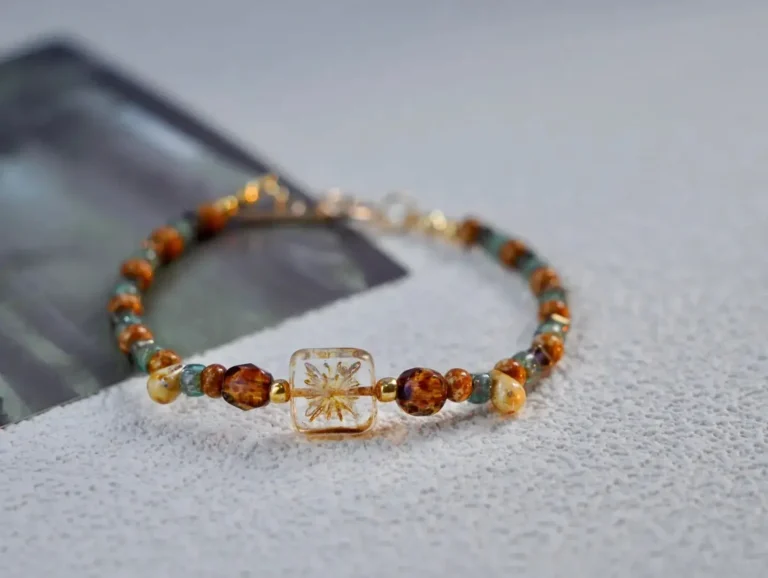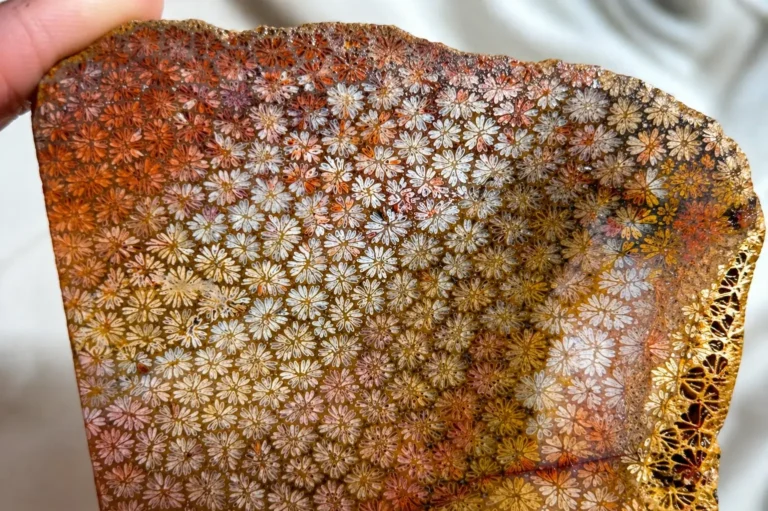
Chalcedony Jewelry: The Quiet Beauty of Natural Structure
In everyday jewelry selection, Chalcedony Jewelry is often misunderstood as a lower-cost alternative to jade. This view misses a fundamental fact. Chalcedony is not a substitute for precious gemstones. It is a distinct mineral expression with its own structural and aesthetic logic.
At Jewea, Chalcedony Jewelry is never treated as a processed material. It is interpreted as a wearable form of the mineral itself. Its color, structure, and surface glow all work together as part of a natural design language.
What Chalcedony Is: Structural Differences from Agate
To understand Chalcedony Jewelry, we need to start with its mineral structure.
From a mineralogical perspective, chalcedony and agate both belong to cryptocrystalline quartz, a microcrystalline form of silica (SiO₂). Unlike macrocrystalline minerals, their crystal structure is extremely fine. The crystals are too small to see with the naked eye. This creates a dense and continuous material texture.
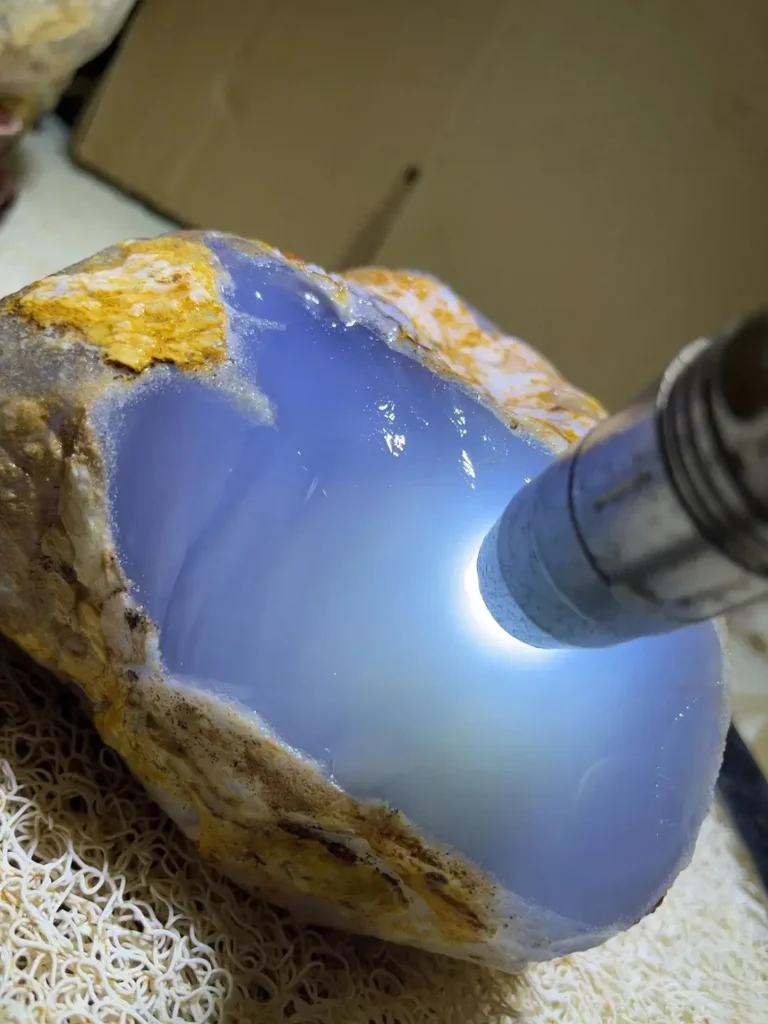
This structure typically results in three key visual traits:
- No visible grain
- A waxy to slightly greasy luster
- Even or semi-even color distribution
Key Structural Difference Between Chalcedony and Agate
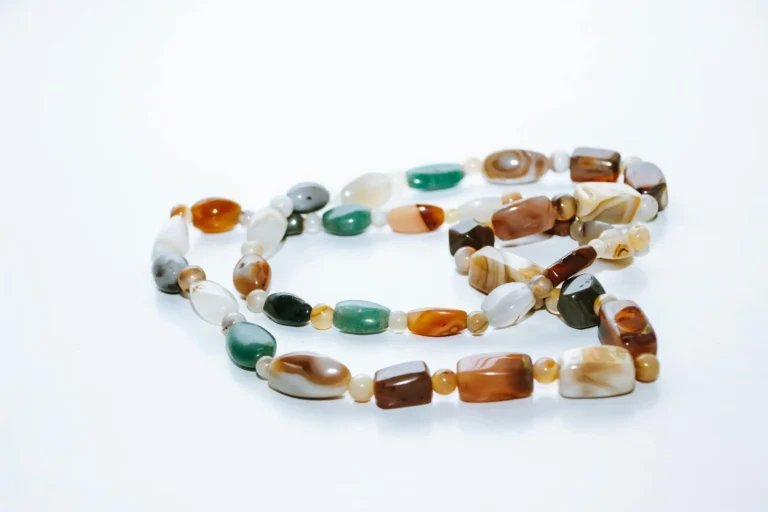
The main difference between chalcedony and agate lies in whether their internal structure shows rhythmic or layered variation during formation.
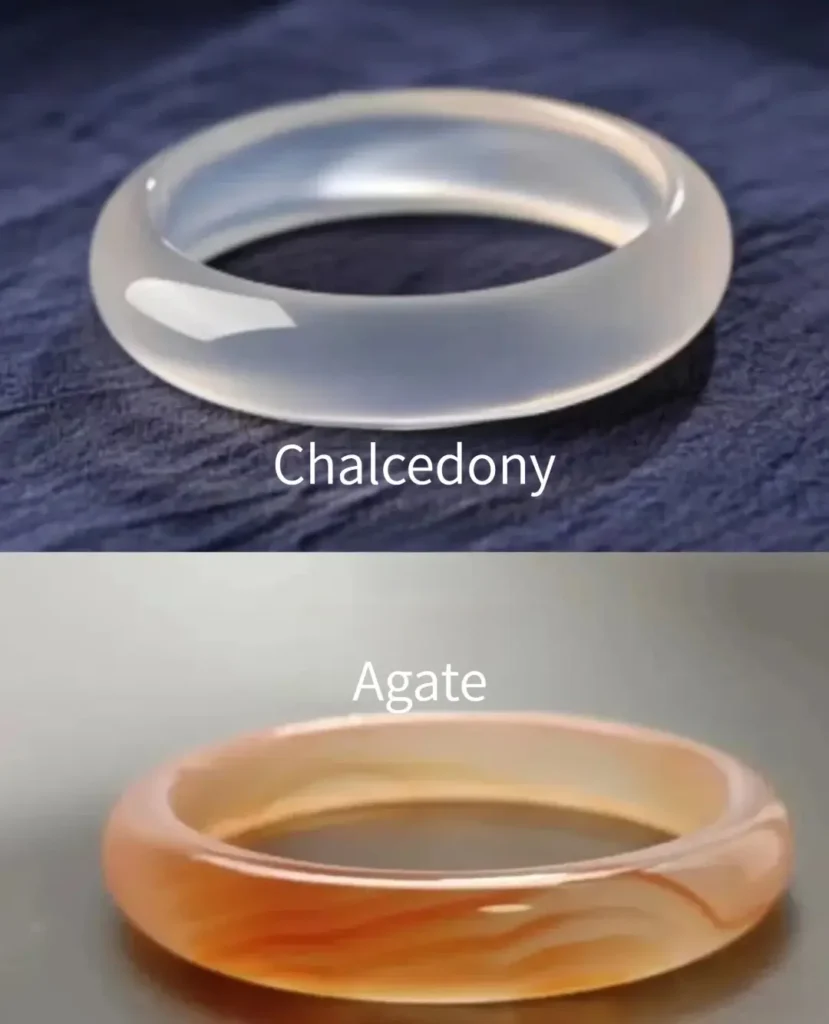
- Agate forms under changing conditions during deposition. This often creates visible banding or concentric layers.
- Chalcedony forms in a more stable and continuous environment. As a result, it usually shows no obvious banding. Its color appears more uniform or softly transitional.
It is important to note that this difference is structural, not hierarchical. It does not indicate a difference in material quality or value.
This lack of distinct banding, along with its even or gently shifting color distribution, gives chalcedony a smooth and visually continuous appearance. This quality is a key source of inspiration in Jewea’s approach to Chalcedony Jewelry design.
Jewea Chalcedony Jewelry: Turning Material Structure into Design Language
In Chalcedony Jewelry design, we don’t treat materials as decoration. We read them rather than simply apply them.
1. Green Chalcedony Jewelry: A Natural Color System Driven by Trace Elements
Green tones in chalcedony (often referred to as Australian jade) usually come from trace elements such as nickel (Ni) entering the SiO₂ structure. The final shade varies depending on formation conditions and geographic origin.
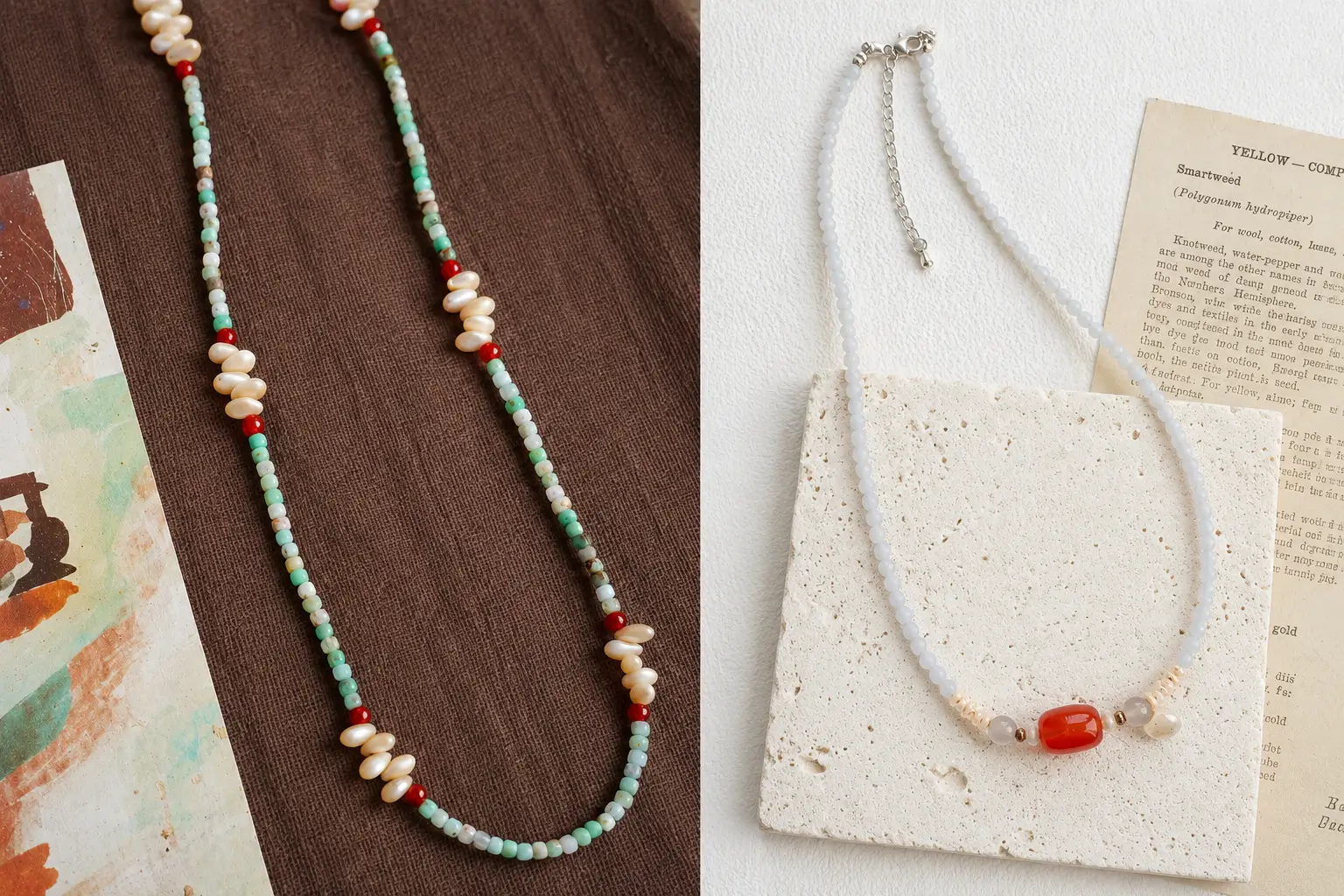
For Jewea’s Green Chalcedony Multi-Wear Long Necklace, we selected beads ranging from soft green to apple green. These tones shift in a smooth, continuous way. This effect comes from the material’s structural consistency. Chalcedony does not contain strong internal breaks, so it naturally produces uninterrupted transitions in color.
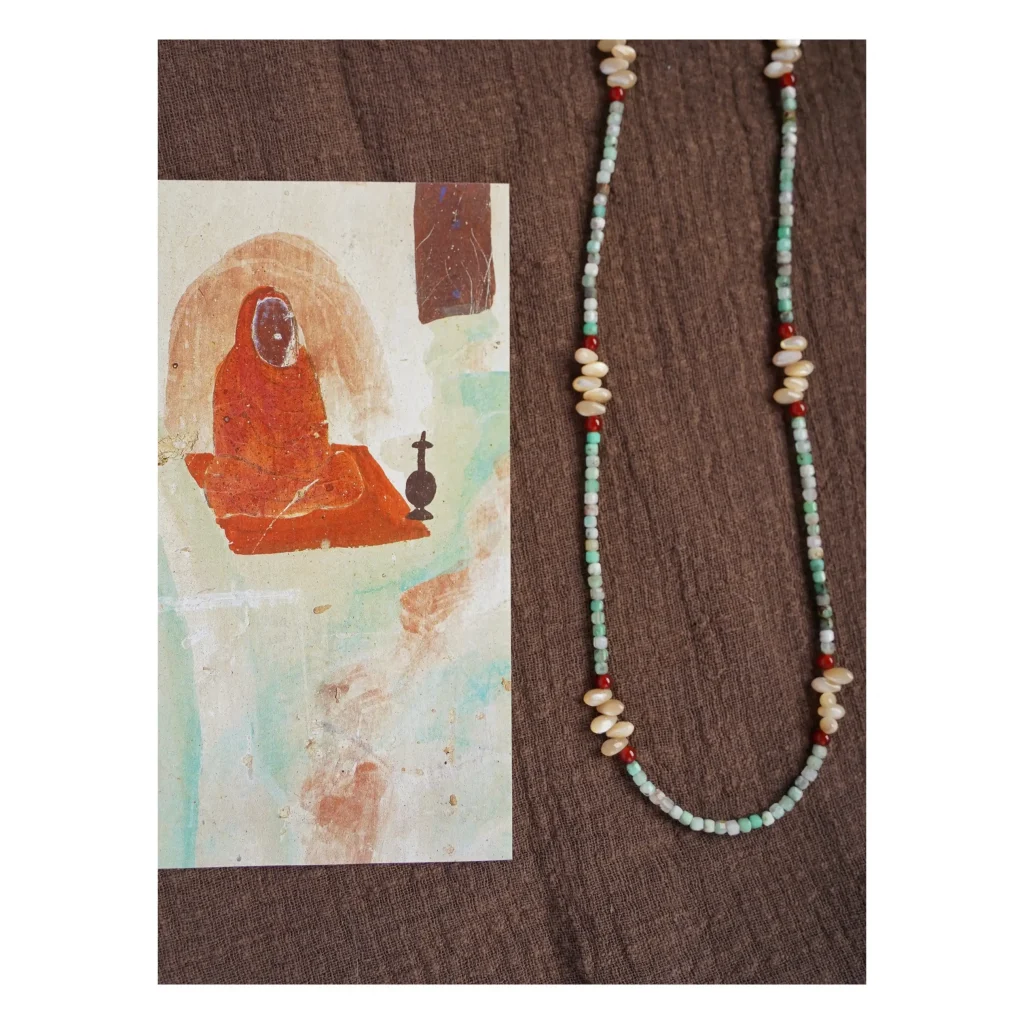
We add small accents of red agate and natural shell elements into the design. These contrasting materials appear in controlled proportions. They introduce visual rhythm and prevent the composition from feeling too uniform or flat.
This piece supports multiple wearing styles:
- Long sweater necklace
- Eyewear chain
- Multi-wrap bracelet
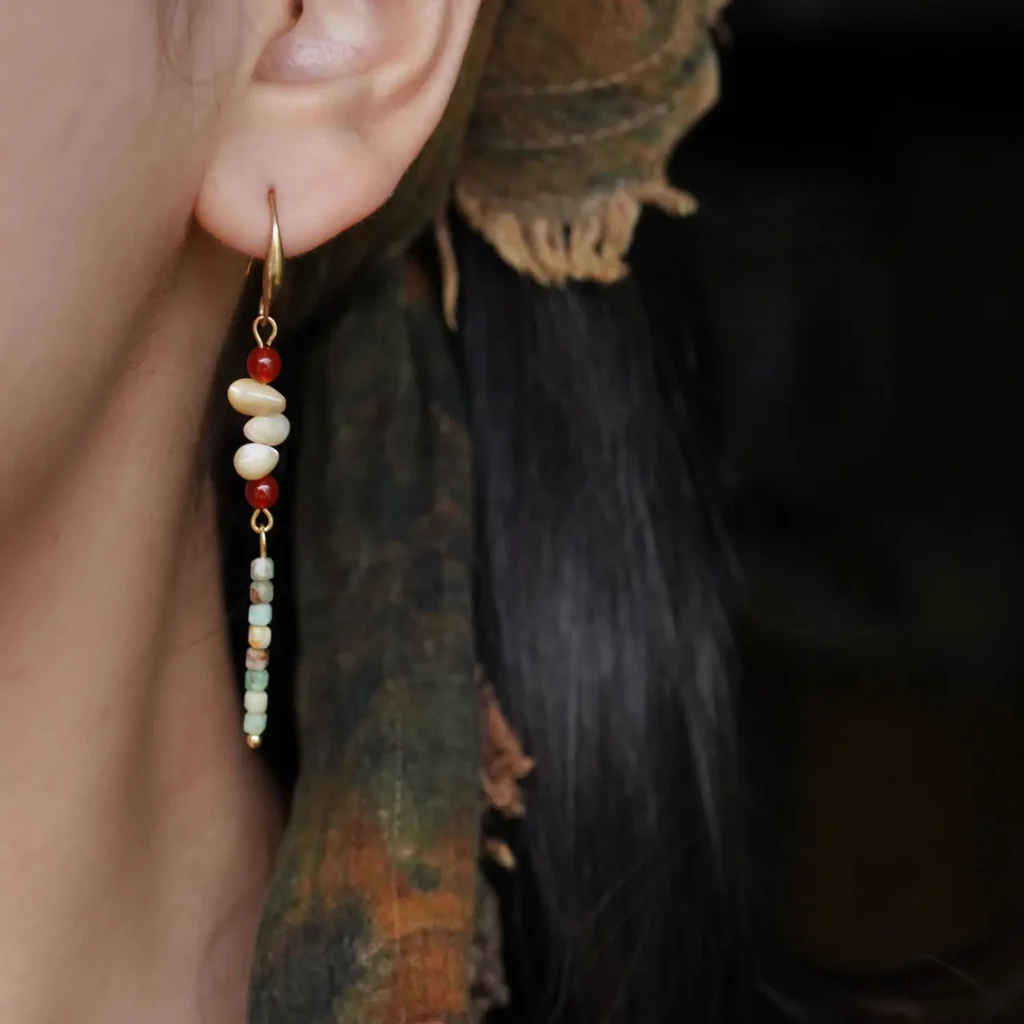
The matching 6 cm linear earrings continue the same material logic. Their vertical form adds lightness and movement, creating a clean and elongated visual silhouette.
Blue Chalcedony: Light Scattering and Low-Saturation Blue Tones
The color of Blue Chalcedony is the result of multiple interacting factors, rather than a single cause. In mineralogical terms, it is influenced by:
- Trace coloring elements (such as Cu)
- Light scattering within its microcrystalline structure, including Rayleigh scattering effects
- Variations in crystal size and density that affect how light is diffused
Because of these combined effects, natural blue chalcedony typically appears in low-saturation blue or blue-grey tones with a subtle milky haze. The overall visual impression is soft, muted, and evenly diffused rather than vivid or highly saturated.
Blue Chalcedony Minimal Necklace: A Visual Balance of Warm and Cool Structure
In Jewea’s Blue Chalcedony Minimal Necklace, the design follows a restrained, minimal structure that allows the material itself to remain the visual focus.
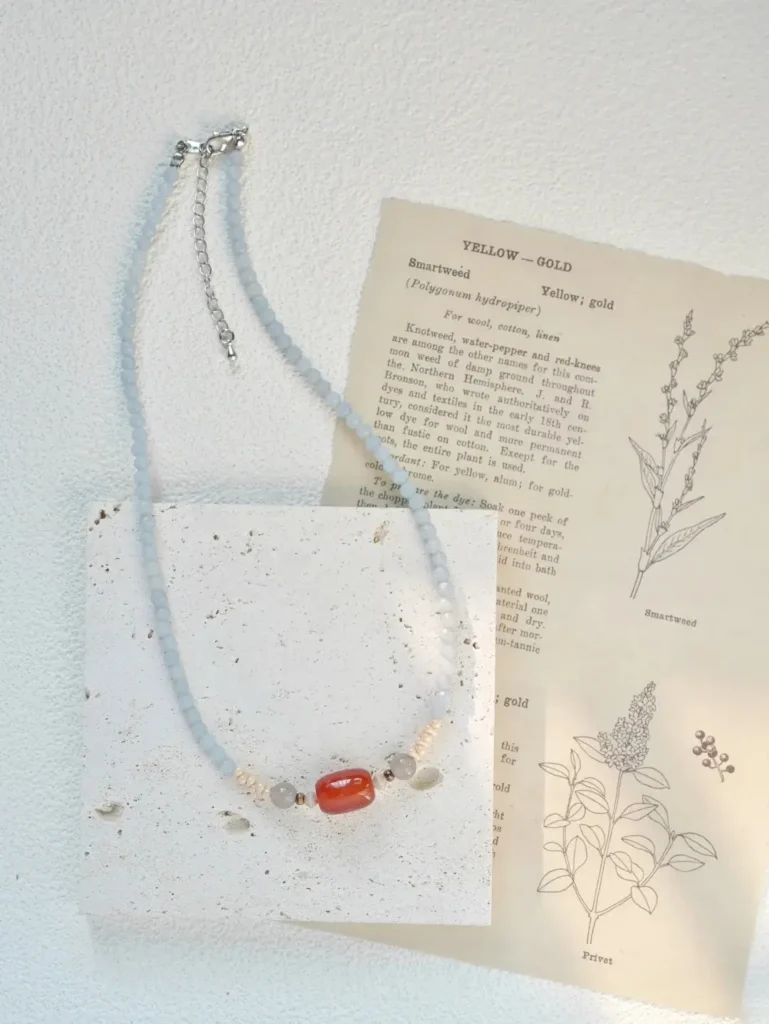
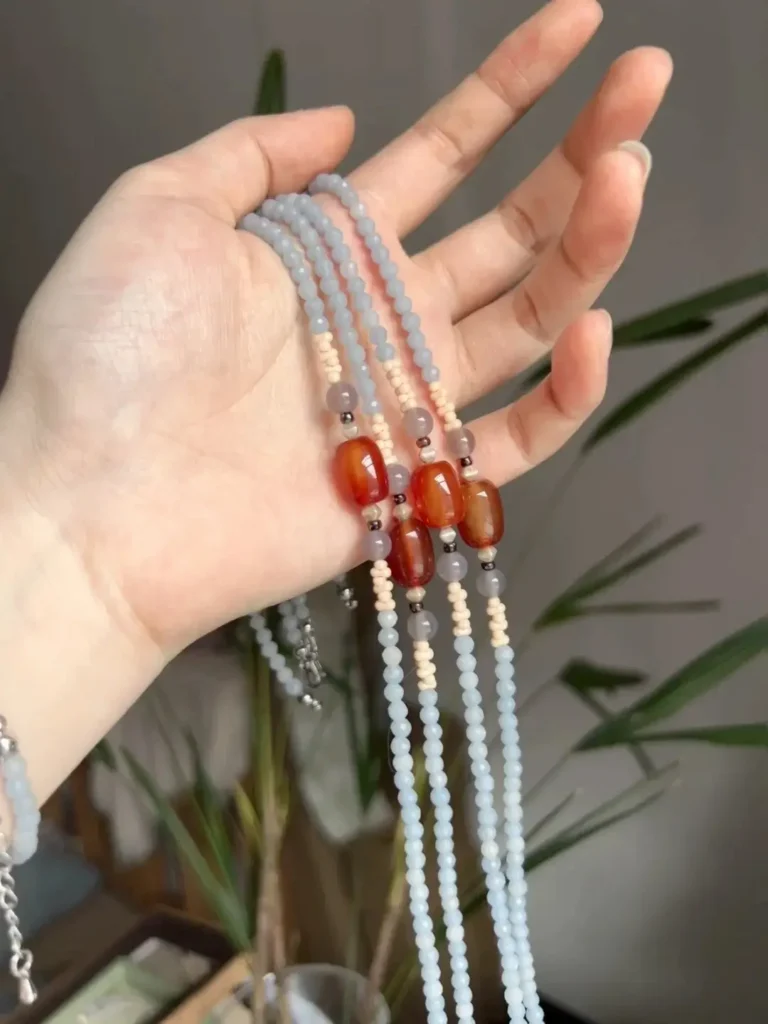
The design takes inspiration from the color-block paintings of Spanish artist Guim Tió Zarraluki. It uses angel-blue chalcedony beads to form a continuous strand with a soft, cool-toned glow.
A faceted red agate bead sits at the center, placed intentionally as a point of contrast.
This design relationship can be understood as follows:
- Blue chalcedony functions as a continuous background field with low visual contrast
- Red agate acts as a focal anchor with high visual contrast
Together, they create a stable warm–cool balance that enhances clarity, depth, and visual structure without disrupting the overall minimal aesthetic.
Hydration Behavior of Chalcedony and Everyday Changes in Appearance
Chalcedony typically contains a small proportion of absorbed water or structural water. The exact amount varies depending on its geological origin and formation conditions.
When exposed to environmental changes such as high temperatures, dry conditions, or prolonged strong light, this water content may gradually migrate or decrease. As a result, the surface luster can appear less vivid. In the industry, this effect is commonly referred to as “dehydration” or “loss of water content.”
It is important to note that this change mainly affects surface optical performance, not the internal mineral structure itself.
During everyday wear, chalcedony may also show subtle variations in luster due to contact with skin oils and shifts in ambient humidity.
If the surface appears dull, gentle rinsing in clean water can help restore its appearance. This allows the surface-adsorbed water to return to a more balanced state, improving visual clarity. More precisely, this process should be understood as a rebalancing of surface adsorption, rather than a structural transformation.
How to Identify Chalcedony Jewelry: A Physical, Sensory Approach
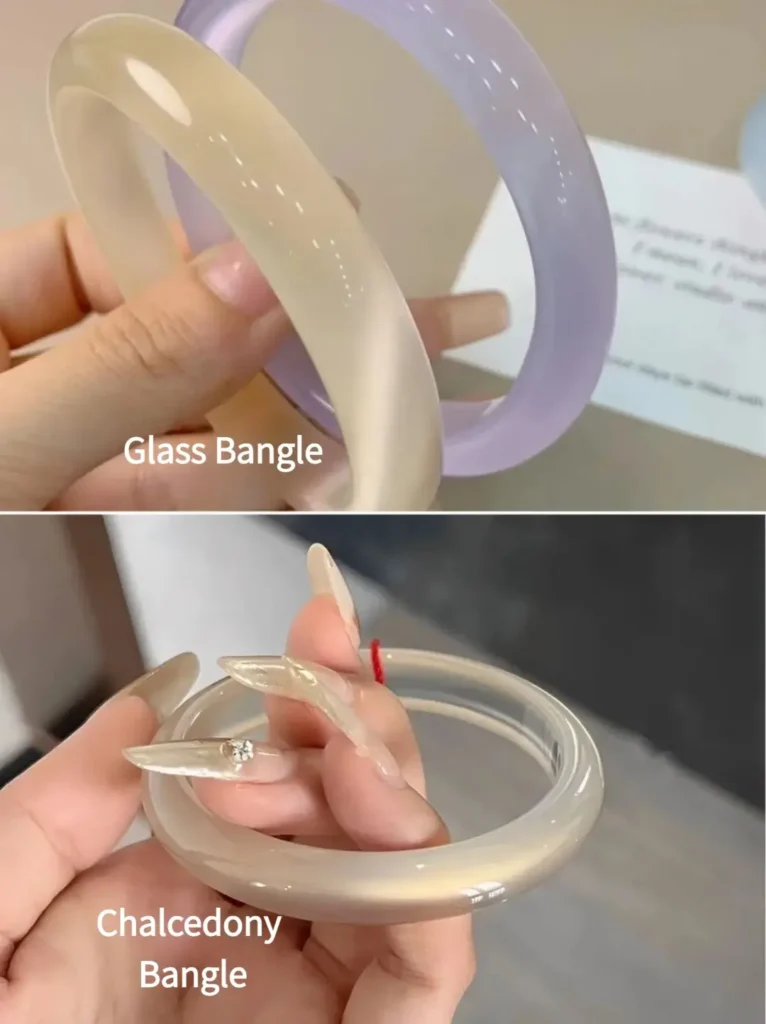
As Chalcedony Jewelry becomes more popular, imitation pieces made from glass or resin have also entered the market. You can use a few basic physical characteristics to make a preliminary assessment.
1. Observe the Luster (Optical Characteristics)
- Natural chalcedony shows a subtle waxy to slightly oily luster. Light appears to sit within the stone rather than reflecting sharply from the surface. This creates a soft, layered depth.
- Imitations (glass or resin) tend to have high surface reflectivity. They produce sharp, sometimes harsh highlights and often feel visually flat, with a more artificial, plastic-like appearance.
2. Feel the Temperature (Thermal Conductivity)
- Natural chalcedony has relatively low thermal conductivity. When you first hold it, it feels noticeably cool and retains that coolness for a longer time.
- Imitation materials, especially resin or plastic, feel lighter and warm up quickly to match skin temperature.
3. Listen to the Sound (Acoustic Response)
Due to its dense cryptocrystalline structure, natural chalcedony may produce a clear, crisp sound when gently tapped against another piece. However, this characteristic is not fully reliable on its own, as sound can vary depending on shape, thickness, and size. It should be used only as a supporting indicator, not a definitive test.
Conclusion
The value of chalcedony does not come from how closely it resembles higher-grade gemstones. It comes from what it already is: a form of Cryptocrystalline Quartz defined by structural continuity and optical softness.
The color of chalcedony arises from the interaction between trace elements and its geological formation environment. Luster is produced by the way its microcrystalline structure scatters light. In everyday wear, its appearance can also shift due to the interaction between surface-adsorbed water and surrounding environmental conditions.
In Jewea’s design logic, Chalcedony Jewelry is not a reproduction of nature. It is a direct extension of natural structure into an everyday, wearable scale.