Cinnabar Jewelry: The Mineral Truth Behind Natural Cinnabar and Market Imitations
When it comes to red jewelry, ruby, red coral, and Nanhong agate may come to mind first. In recent years, however, Cinnabar Jewelry has become increasingly popular with consumers, valued for its traditional symbolism and distinctive vintage look.
You may have heard the saying in China that “nine out of ten cinnabar pieces are fake.” But how much truth is there behind the claim? Cinnabar has a long history, from its use as a natural red pigment in ancient Chinese art to the polished beads and pendants sold as jewelry today. So what are you actually buying—natural cinnabar, or a composite material made from powder and resin?
In this guide, we take a closer look at Cinnabar Jewelry through its mineral properties, natural forms, common treatments and imitations, and practical ways to assess what you are buying.
What Is Cinnabar?
Cinnabar is the mineral name for mercury sulfide (HgS). In traditional Chinese usage, it has also been known as dansha, chidan, and other historical names.
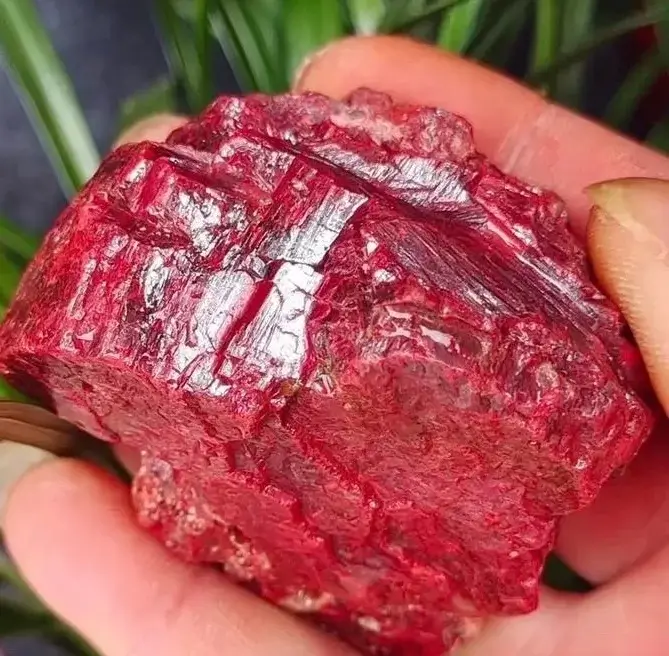
As a mineral, cinnabar can range from dark red and bright scarlet to lighter red and vermilion. When impurities are present, it often takes on a duller, brownish-red appearance.
Cinnabar has also played an important role as a natural red pigment in traditional Chinese art. Ancient artists ground the mineral into a fine powder and used it to create rich red tones in paintings, murals, and decorative works. Cinnabar is among the mineral pigments that helped shape the distinctive palette of Dunhuang art.
If you are interested in how minerals became colors in ancient Chinese art, our guide Natural Mineral Pigments: The Ancient Colors of Dunhuang explores cinnabar, hematite, realgar, orpiment, and other natural pigments used throughout the history of Dunhuang.
Natural Occurrence and Forms of Cinnabar
Cinnabar rarely occurs as a pure mineral in nature. It usually forms alongside other minerals and host rock. We can generally encounter it in four main forms.
1. Cinnabar in Host Rock
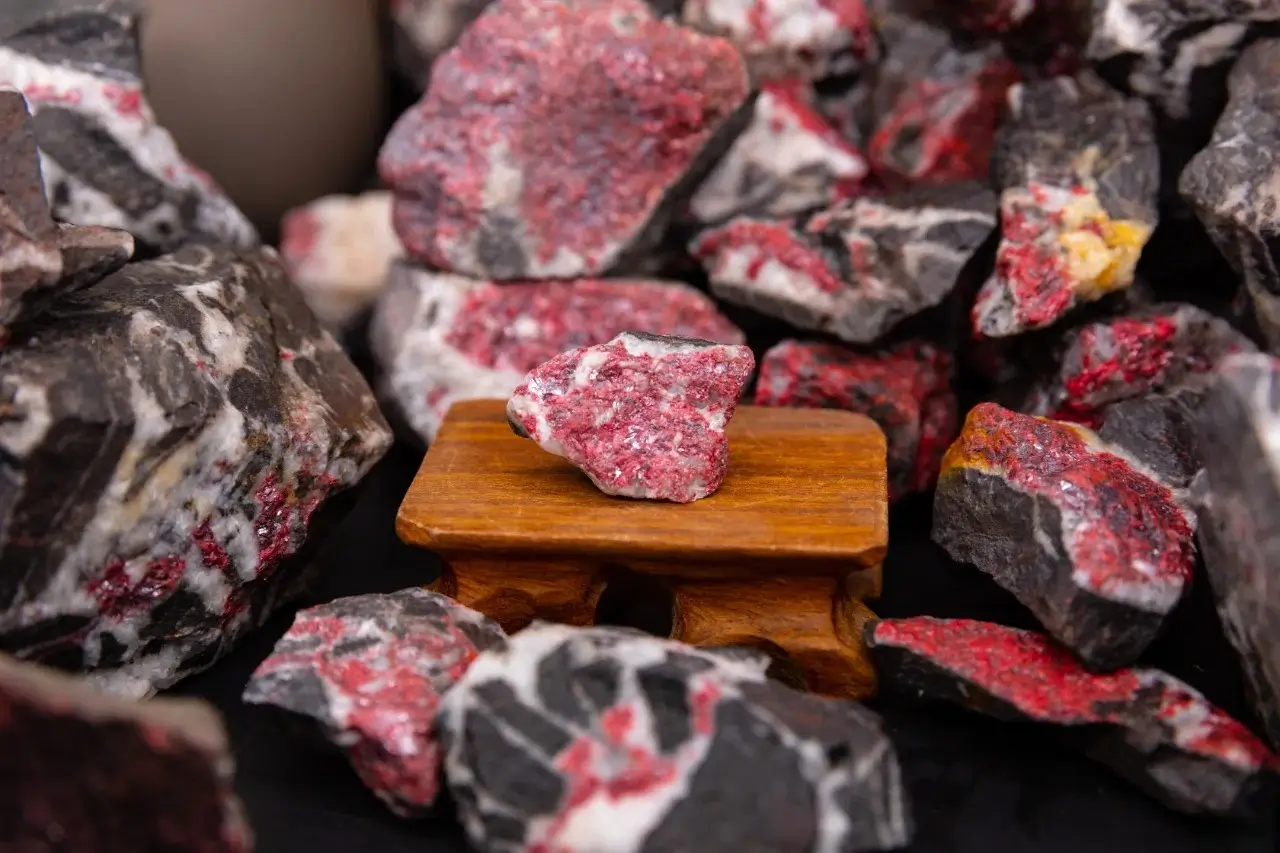
Most cinnabar occurs within host rock and alongside other minerals and impurities. Separating the cinnabar from the surrounding material requires crushing and processing the ore.
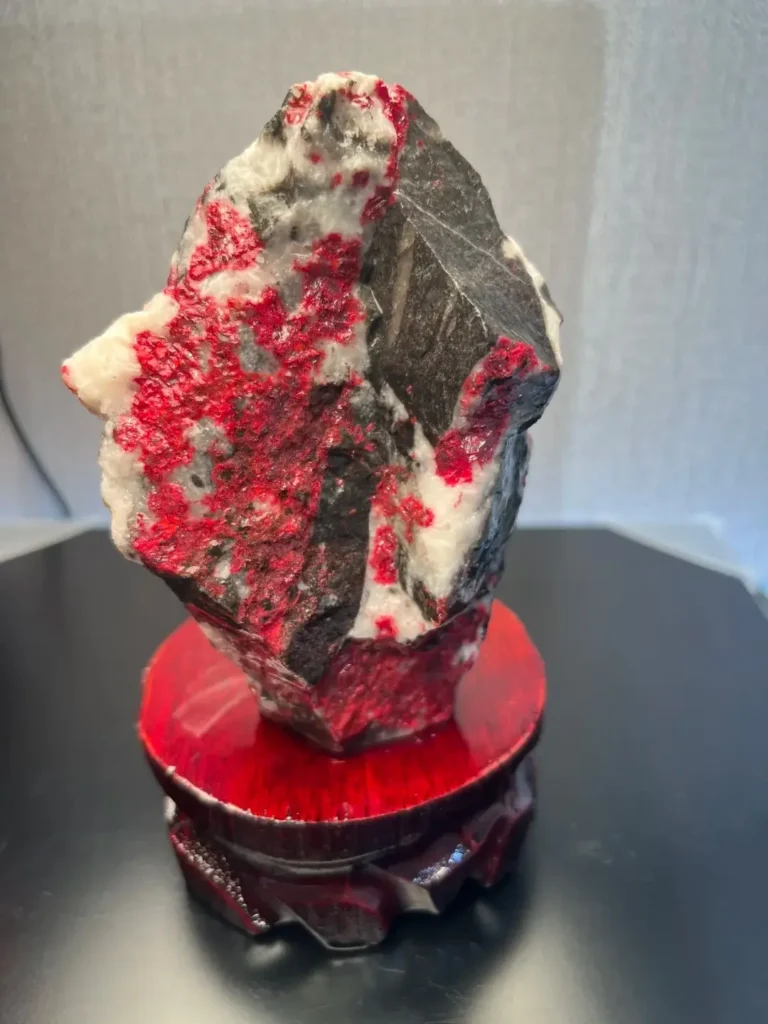
This process usually yields small, fragmented pieces of cinnabar. Much of the material occurs as fine grains or even powder rather than large, solid pieces.
2. Cinnabar in Chicken-Blood Stone
Chicken-Blood Stone is a prized ornamental stone in Chinese and broader East Asian collecting culture. Its distinctive red “blood” comes primarily from fine-grained cinnabar inclusions within the host rock.
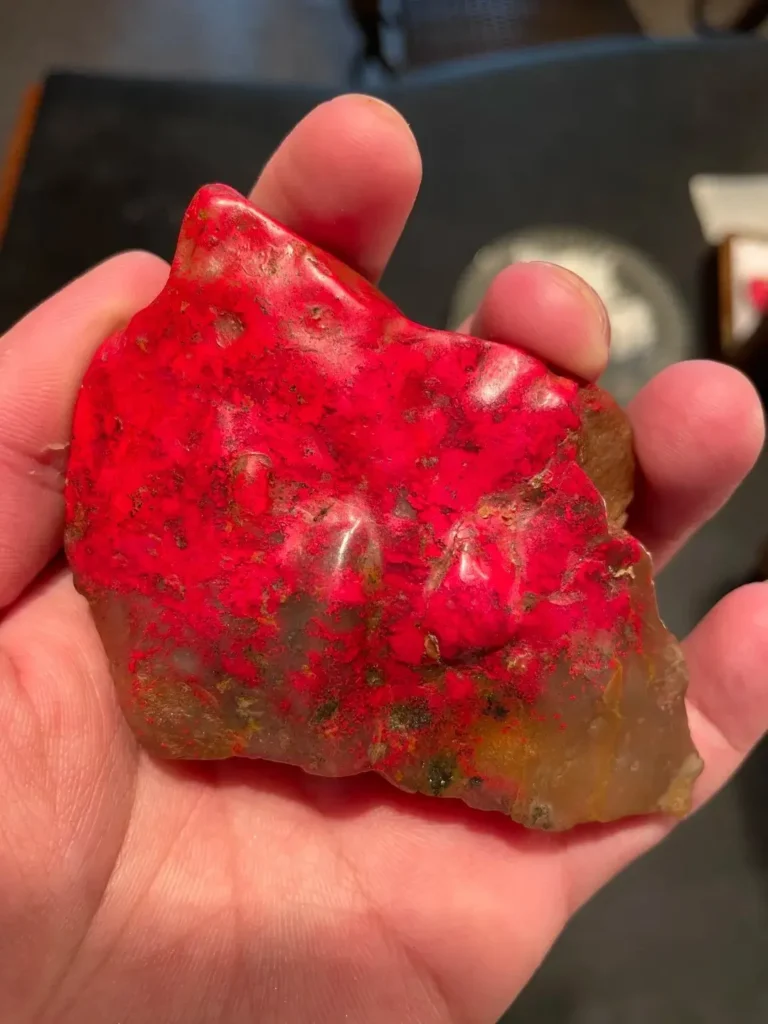
The cinnabar occurs as tiny grains dispersed through the stone, rather than as a single solid mass.
3. Wugensha
In the Chinese mineral and collecting market, Wugensha (无根砂) refers to loose pieces of cinnabar-bearing material that have naturally separated from their host rock through weathering and geological processes.
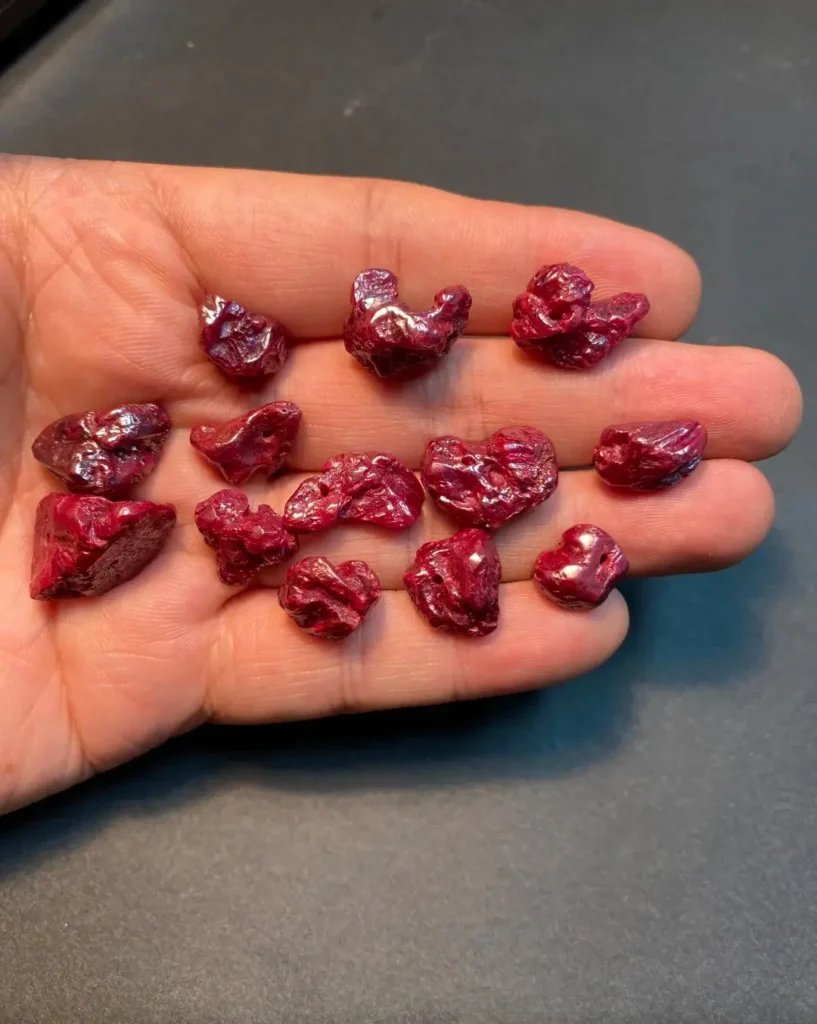
These pieces often contain relatively high concentrations of cinnabar and fewer impurities than typical cinnabar ore. Their natural form and limited availability can make them more desirable to collectors.
4. Cinnabar Crystals
Well-formed cinnabar crystals are among the rarest and most sought-after forms.
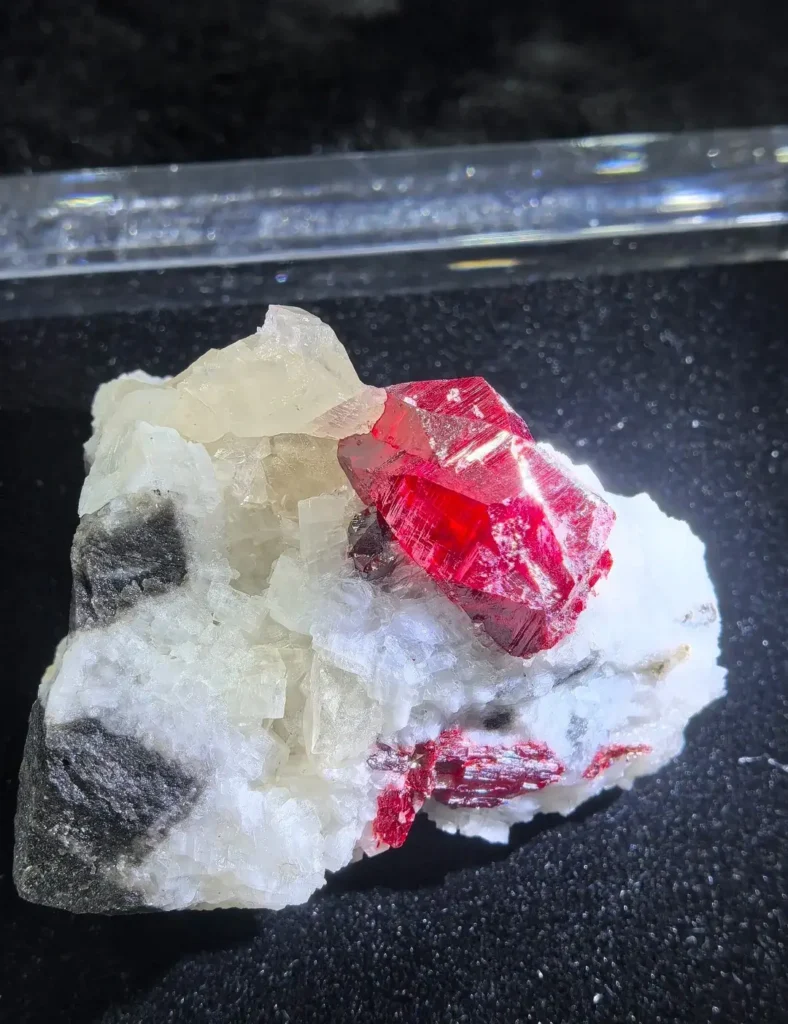
Unlike massive cinnabar ore, these crystals often grow with minerals such as calcite or quartz. Fine specimens can transmit light and appear translucent, sometimes even transparent when viewed under suitable lighting.
Collectors usually preserve these crystals as mineral specimens rather than cut or carve them. Their rarity and delicate nature make them far more valuable as natural specimens than as jewelry material.
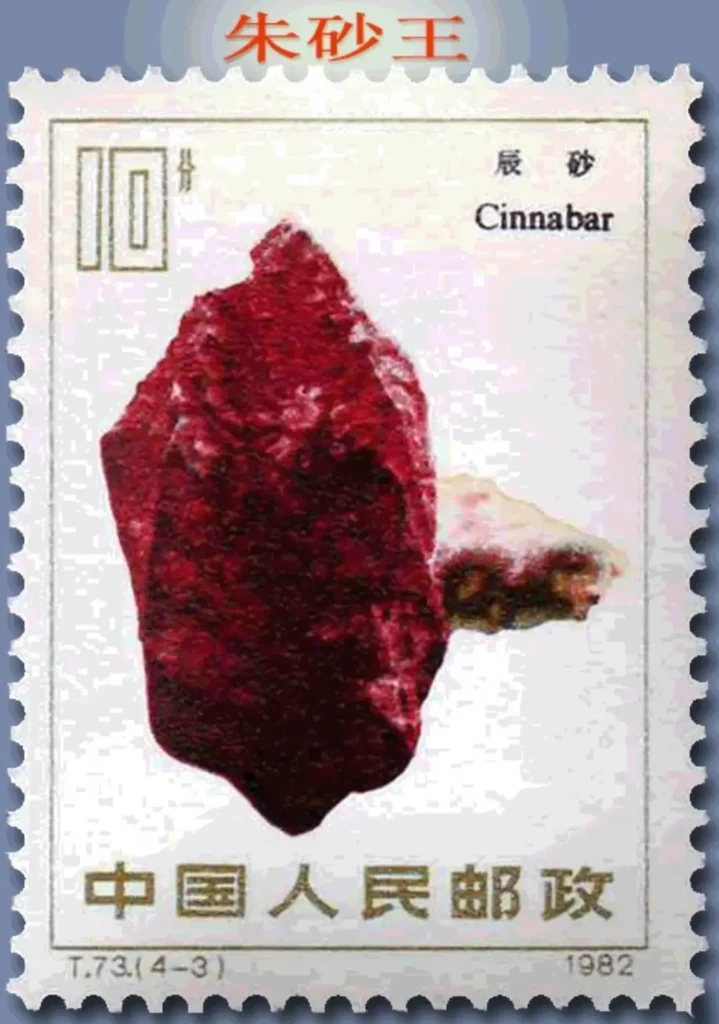
Further Reading: The “Cinnabar King”
The specimen known as the “Cinnabar King” is a famous cinnabar crystal from the Wanshan mercury-mining district in Guizhou, China. According to published Chinese sources, it was discovered in 1980 and measures approximately 10.8 cm long, 4.4 cm wide, and 4.2 cm high, with a reported weight of 237 g. The specimen is now held by the Geological Museum of China in Beijing.
Where Does Cinnabar Come From?
China remains one of the world’s major sources of cinnabar. Well-known deposits occur in Tongren, Guizhou, including the Wanshan mining district, as well as in Xinhuang, Hunan.
Cinnabar also occurs in several other parts of the world. Notable sources include Almadén in Spain, historically one of the world’s largest mercury-mining districts, along with deposits in Italy, Mexico, and the United States, including California.
The Uses and Value of Cinnabar
Cinnabar has long served as the primary ore for producing mercury. Its well-formed crystals also show unusual optical properties, including strong birefringence and optical activity. These properties have attracted scientific interest and have found specialized applications in areas such as laser and optoelectronic research.
Cinnabar also has a long history as a natural red pigment. Artists in China and other parts of the world used it in painting, decorative arts, sculpture, and traditional color work. Its rich red tone became known as cinnabar red.
High Density, Low Hardness
Cinnabar has an unusual combination of physical properties. It is exceptionally dense but surprisingly soft.
- Density: Cinnabar has a density of about 8.0–8.2 g/cm³. Its high density gives even small pieces a noticeably heavy feel in the hand. This property can help distinguish cinnabar from some low-density imitations, although weight alone cannot confirm authenticity.
- Hardness: Cinnabar has a Mohs hardness of only 2.0–2.5, roughly comparable to a fingernail. This makes it very easy to scratch.
- Cleavage and brittleness: Cinnabar has well-developed cleavage and can fracture relatively easily when subjected to impact or mechanical stress.
This combination of high density, low hardness, and brittleness makes natural cinnabar difficult to cut, carve, and polish into complex jewelry designs.
Why Natural Cinnabar Jewelry Is So Limited
So why do you rarely see large, intricately carved pieces made from solid natural cinnabar?
The answer lies in the mineral itself. Cinnabar has a very low Mohs hardness and can fracture easily. Cutting, carving, and polishing it can cause chips, cracks, and breakage. These properties place clear limits on the size and design of jewelry made from natural cinnabar.
Wugensha (无根砂) and other loose pieces of natural cinnabar usually work best with simple designs. Makers may polish them into small freeform pendants that follow the stone’s natural shape. Some denser pieces can also become small beads or simple pendants, but complex carving remains difficult.
This processing challenge also explains why the market contains so much reconstituted cinnabar. Instead of cutting a solid piece of natural ore, manufacturers grind cinnabar into powder and combine it with resin or another binder. They then press the mixture into beads, pendants, and other shapes.
The actual cinnabar content can vary widely from one product to another. Some high-cinnabar-content pressed pieces contain a significant proportion of cinnabar powder. Sellers may still market these products as “natural” or “raw” cinnabar, even though the material has been reconstituted.
Other products contain very little cinnabar—or none at all. Some rely mainly on red pigments to create the familiar cinnabar-like appearance.
This is not a new problem. In 2014, a testing report from the Gemmological Institute of China University of Geosciences in Wuhan (GIC) documented imitation products marketed as cinnabar that used dyed powders such as dolomite and baryte instead of cinnabar.
How to Choose and Assess Cinnabar Jewelry
If you are looking for natural cinnabar, start with the material itself. Compare the piece with the natural forms of cinnabar discussed earlier. Does its size, texture, and overall form make sense for a natural cinnabar specimen?
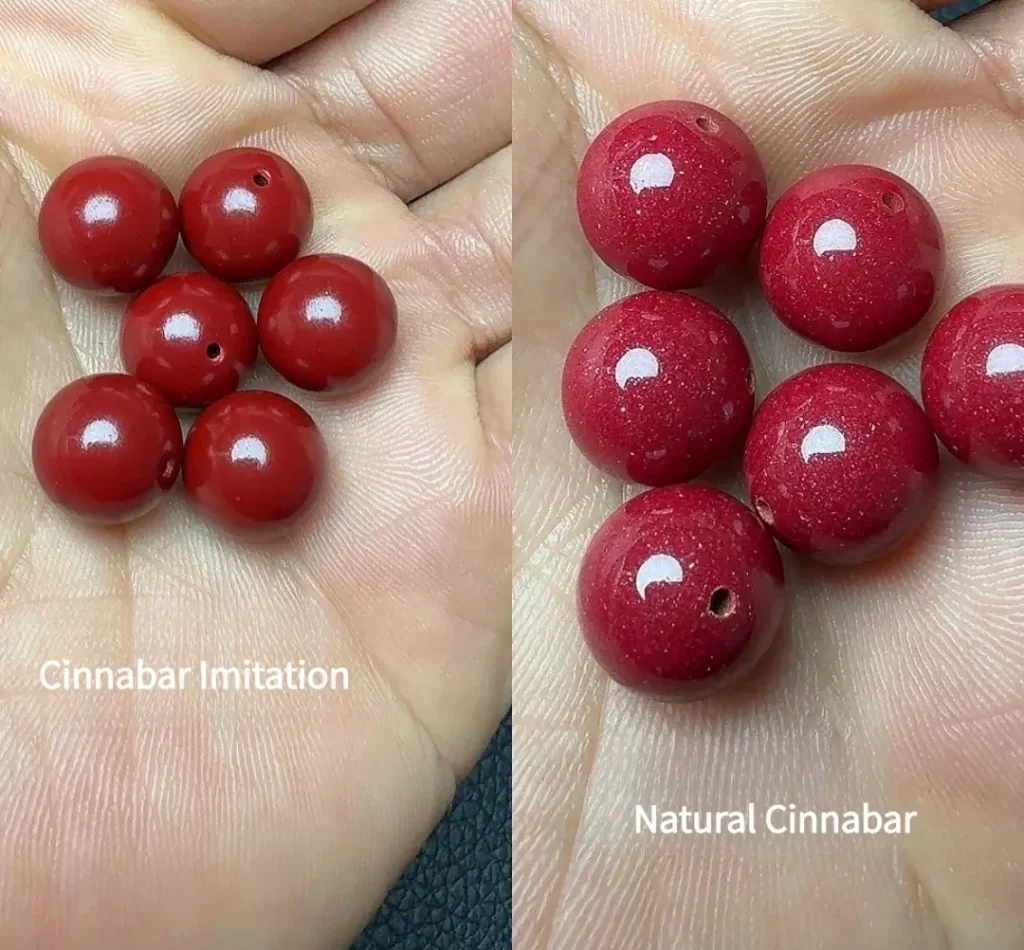
From there, you can assess a piece through four increasingly reliable methods.
1. Compare the Form and Appearance
If a piece is sold as natural raw cinnabar, its form should be consistent with the natural occurrence of the mineral.
Natural cinnabar is relatively soft and brittle, which limits how much it can be cut, carved, and polished. Natural pieces are therefore more likely to appear as small freeform pendants, small beads, irregular fragments, or preserved crystal specimens.
Be cautious when a seller presents a large piece with extremely fine carving, perfectly uniform surfaces, and no visible signs of damage as solid natural cinnabar. Such material is more likely to be reconstituted cinnabar or another composite material than a single piece of natural cinnabar.
2. Assess the Weight and Heft
Cinnabar has an unusually high density, around 8.0–8.2 g/cm³. Even a relatively small piece can therefore feel surprisingly heavy in the hand.
This simple heft test can provide a useful first impression. Natural cinnabar and high-cinnabar-content reconstituted material should generally feel much heavier than similarly sized plastic or low-density resin imitations.
However, weight alone cannot confirm that a piece is cinnabar. Other dense minerals can produce a similar sensation, and the weight of a reconstituted product also depends on its overall composition.
3. Use the Aluminum Reaction as a Preliminary Test
When non-destructive testing is not available, the aluminum reaction can provide another preliminary indication of whether a material contains cinnabar.
The test is based on amalgamation, a reaction in which mercury from cinnabar reacts with exposed aluminum to form an aluminum amalgam. Once the protective aluminum oxide layer is disrupted, the amalgam prevents the aluminum from maintaining its normal protective surface. The exposed aluminum then reacts rapidly with oxygen and moisture, producing a characteristic gray-white, hair-like growth on the metal surface.
This reaction is sometimes described as the formation of “white hairs” on the aluminum.
The test should be treated as a qualitative screening method, not a definitive identification test. A positive reaction may indicate the presence of cinnabar, but it cannot determine how much cinnabar the jewelry contains.
It can also damage the surface of the jewelry, so it is not appropriate for valuable, delicate, or collectible pieces.
For the same reason, we do not recommend treating a home reaction test as proof that a piece is “100% natural cinnabar.” At most, it can answer a narrower question: Does the tested material appear to contain cinnabar?
4. Confirm with a Qualified Third-Party Laboratory
For high-value purchases, wholesale transactions, or cases where the exact material composition matters, professional laboratory testing is the most reliable option.
A qualified gemological or mineralogical laboratory may combine methods such as Raman spectroscopy, X-ray fluorescence (EDXRF), microscopic examination, and specific-gravity testing, depending on the sample and the question being investigated.
These methods can help identify the mineral phases present, examine the material’s elemental characteristics, and distinguish natural cinnabar from some reconstituted or imitation materials.
If you need to determine the actual cinnabar content of a composite product, identification alone is not enough. The laboratory must use an appropriate quantitative analytical method.
For buyers, the key point is simple: visual appearance and home tests can help you screen a piece, but they cannot replace professional testing when the value or authenticity of the material really matters.
Final Thoughts
In traditional Chinese religious and folk practices, cinnabar has long been used in talismans and rituals associated with protection and good fortune. Some sellers use these cultural associations to exaggerate its supposed benefits and, in some cases, sell non-natural cinnabar as natural raw cinnabar for profit.
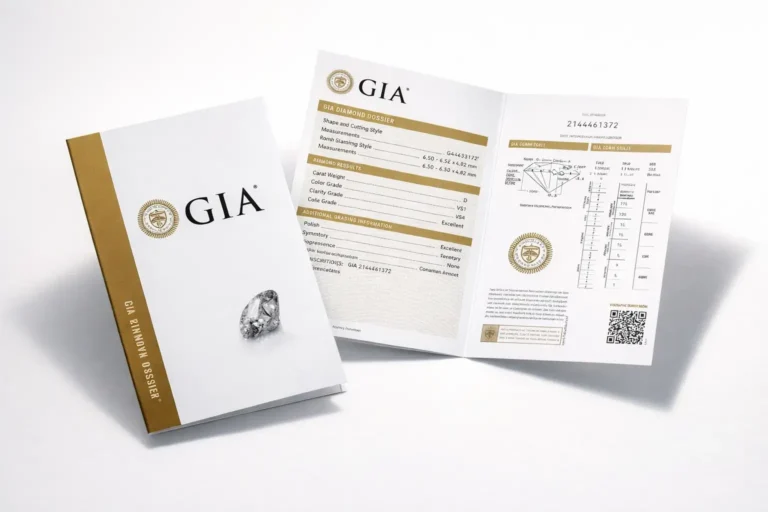
When buying Cinnabar Jewelry, don’t let claims about its supposed powers make the decision for you. If the material or value is important, ask for a certificate from a reputable testing laboratory.
Know what you are buying, pay for what you actually want, and buy with confidence.