Green Jadeite Types: Ganqing and Tielongsheng
Most jadeite buyers look for vivid green. Jadeite that is both intensely green and highly translucent, however, usually comes at a much higher price. To stay within budget, some buyers focus so heavily on color that they compromise on other qualities, such as translucency, texture, and carving.
You could call this a case of “putting all the emphasis on one strength.” The color stands out, while other aspects of the jadeite remain fairly ordinary.
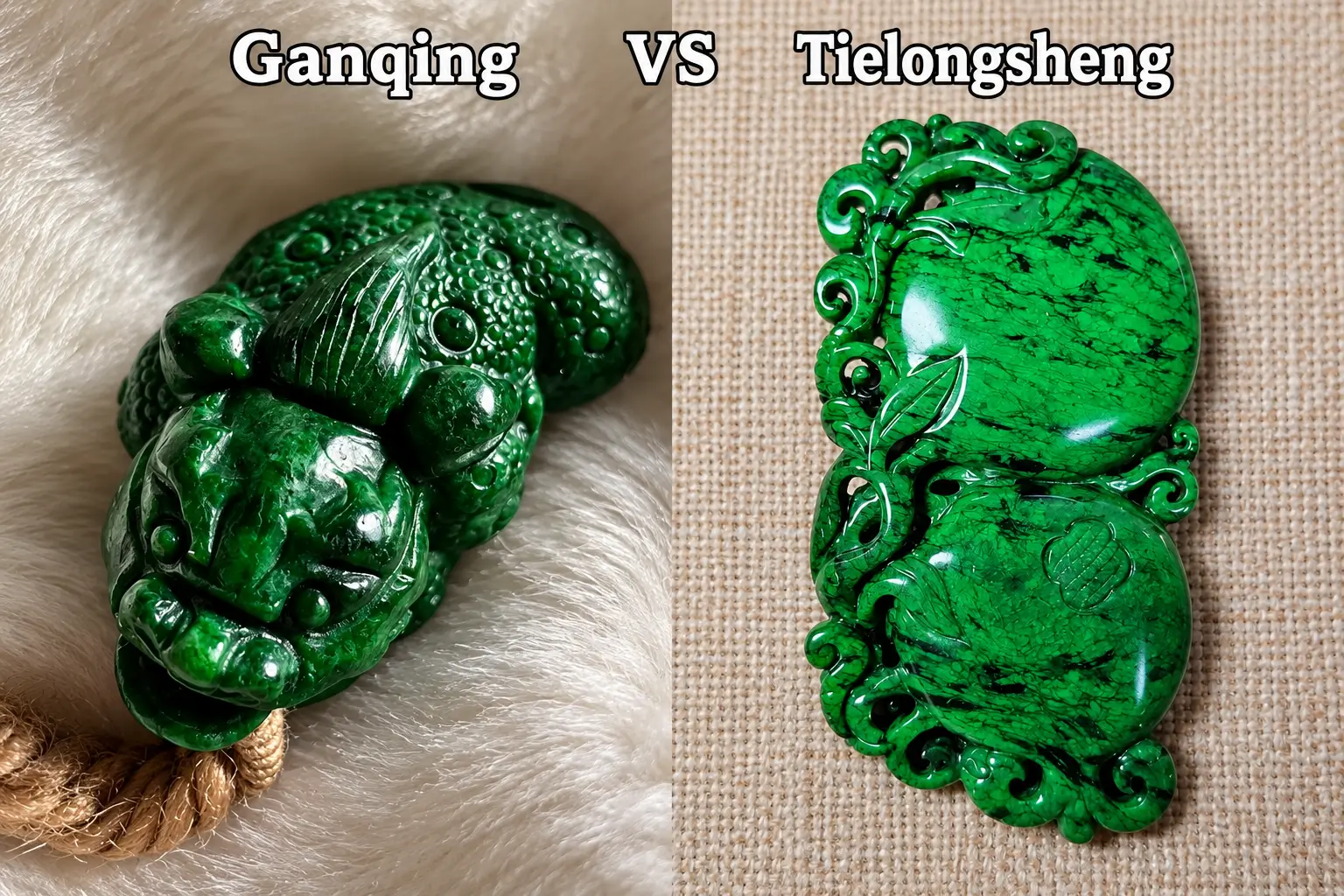
Ganqing and Tielongsheng are two distinctive green jadeite types that fit this description. They can look quite similar at first glance, which often leads to confusion. Look more closely, though, and the differences become clear—in their mineral composition, translucency, texture, and how artisans typically work with them.
What Is the Difference Between Ganqing and Tielongsheng?
When people talk about deeply green jadeite with low translucency, Ganqing and Tielongsheng are two types that often come to mind. They can look similar, but a closer look reveals clear differences.
Ganqing has relatively low hardness. Its material is brittle and less durable, so it can break easily when knocked or dropped. Ganqing was already popular before 1949. At the time, artisans often cut it into thin jade sheets for earrings. The market called these thin pieces “guangpian” (广片). Lower-quality Ganqing was usually paired with fairly rough carving.
Tielongsheng also stands out for its saturated, all-over green color, but it appeared on the market much later. It was first discovered in the Longken mining area of Myanmar in the early 1990s and gradually gained popularity. Higher-quality Tielongsheng is often cut into very thin, finely worked sheets. Reducing the thickness lets more light pass through, making the material look more translucent than it does in its original form. These thin pieces are commonly used in jewelry settings, and some high-quality gold-mounted pieces can command high prices.
The Mineral Composition Difference
Jadeite jade is a rock composed of several fine-grained minerals, with jadeite as the dominant mineral. It can also contain omphacite, kosmochlor, albite, amphiboles, tremolite, diopside, aegirine, aegirine-augite, zeolites, chromite, magnetite, hematite, and limonite. In some cases, omphacite can become the dominant mineral.
This mineral diversity helps explain why different types of jadeite jade can look and behave quite differently.
Ganqing and Tielongsheng are both classified as jadeite jade, but their dominant minerals are different:
- Ganqing: Mainly consists of chromium-bearing kosmochlor.
- Tielongsheng: Mainly consists of chromium-bearing jadeite.
Both can show a rich, saturated green color. But their mineral composition sets them apart at a fundamental level.ow a rich, saturated green color. But mineralogically, they are fundamentally different.
Ganqing
Mineralogically, Ganqing refers to a green, chromium-bearing jadeite type dominated by kosmochlor.
Ganqing has a specific gravity of about 3.40, higher than that of typical jadeite jade, while its hardness is lower, at around 5.5–6 on the Mohs scale. Along with kosmochlor, Ganqing can also contain jadeite, amphiboles, chromite, albite, and other minerals.
Ganqing usually ranges from deep green to blackish green. Its color can be intense and highly saturated. When the color becomes even darker, the material may appear nearly black. In the Chinese jade market, very dark material of this type is known as “Mocui” (墨翠).
Despite its strong green color, Ganqing generally has poor translucency and can look dull rather than bright. Black spots and other mineral grains are also common. Its coarse, granular structure makes large pieces with an even texture and few visible flaws relatively uncommon.
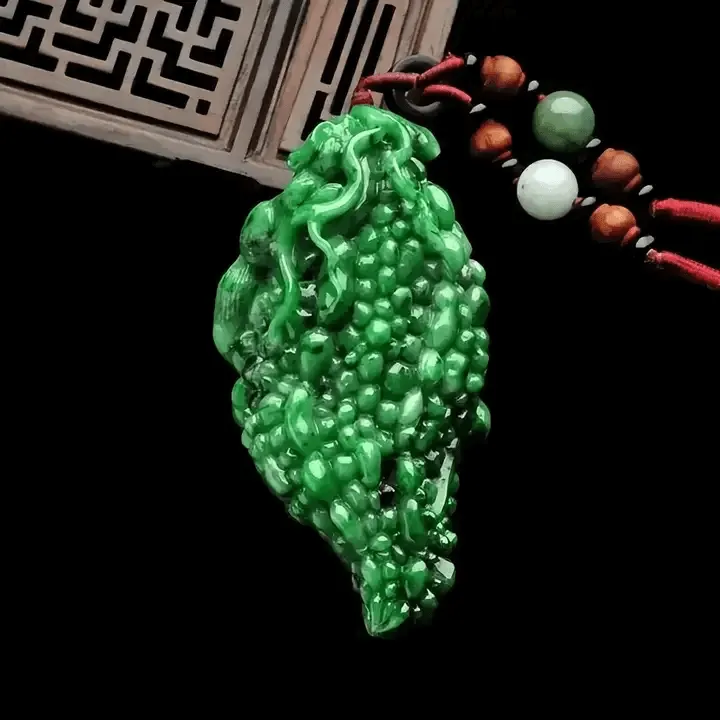
Carvers often use Ganqing for openwork designs, full-surface carving, and thin jade sheets with pierced patterns. These techniques make good use of its saturated green color while also helping work around weaknesses such as uneven texture and fractures in the rough material.
Lower-quality Ganqing tends to contain more inclusions and fractures, which can make the material even more brittle. It can feel crumbly during carving, making it difficult to achieve crisp, fine lines. The surface may also resist a smooth, bright polish.
Some Ganqing pieces may lose their surface luster after prolonged wear. In some cases, the original shine comes partly from a layer of wax applied to the surface. As the wax wears away, the surface can appear noticeably duller. Buyers should also watch for surface impregnation with resin or localized resin treatment, especially on lower-quality material.
Tielongsheng
Tielongsheng jadeite was discovered in Myanmar’s Longken mining area in the early 1990s. It began entering the market in larger quantities around 1999. The name Tielongsheng comes from the Burmese htelongsein, meaning “full green.” It is also known as Tianlongsheng.
One account traces the name “Tianlongsheng” to the layout of the Longken mining area. Local villagers reportedly found about 25 mine tunnels arranged in a belt-like pattern that resembled a coiling dragon. This led to the idea of a “dragon descending from heaven.”
Tielongsheng is a jadeite jade rock composed mainly of the mineral jadeite. Compared with ordinary jadeite jade, Tielongsheng contains a relatively high level of chromium. Chromium gives jadeite its vivid green color, but too much chromium can reduce translucency. Tielongsheng typically contains about 1%–3% Cr₂O₃.
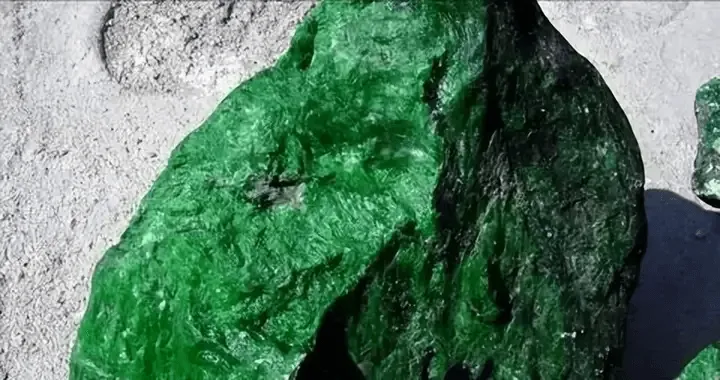
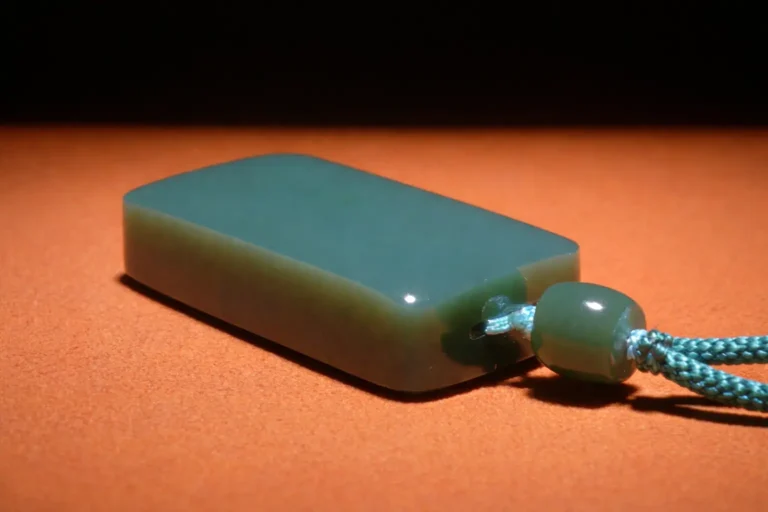
As a result, Tielongsheng usually has a vivid, saturated green color and often appears solid green throughout. Its translucency and texture, however, can vary considerably. Most Tielongsheng has low translucency because of its relatively coarse granular structure and loosely bonded crystals. Some material also has lower hardness and a relatively loose structure overall.
Higher-quality Tielongsheng is often cut into thin sheets. The reduced thickness allows more light to pass through, making the finished piece look more translucent. For this reason, it is commonly used in jewelry settings.
Lower-quality Tielongsheng may contain obvious white patches, black spots, or other visible inclusions. Its loose structure also makes it unsuitable for fine carving. Some material undergoes resin impregnation and is sold in the market as B-jadeite.
Cr₂O₃ Content, Green Color, and Translucency
According to Applied Jadeite Gemology, the amount of Cr₂O₃ in jadeite affects both its green color and translucency.
When the Cr₂O₃ content is below 1%, jadeite can appear transparent green. In thin sections, it is usually colorless under the microscope. The jadeite that makes up high-quality emerald-green jadeite jade typically contains about 0.4%–0.7% Cr₂O₃.
Once the Cr₂O₃ content exceeds 1%, jadeite can still show an emerald-green color, but its translucency decreases significantly. Some green jadeite jade with low translucency or even an opaque appearance, including Tielongsheng, falls into this range.
Jadeite containing more than 1% Cr₂O₃ is therefore also known as chromium jadeite.
Conclusion
Ganqing and Tielongsheng are both known for their intense green color. But they differ significantly in mineral composition, translucency, texture, hardness, and how they are worked.
Higher-quality Ganqing and Tielongsheng can both make attractive and wearable jewelry. But when evaluating jadeite jade, color, translucency, texture, and craftsmanship all matter. These factors are closely related, so no single one tells the whole story.
When buying jadeite, focusing only on vivid green can lead to a poor choice. A piece may have strong color but fall short in translucency, texture, craftsmanship, or durability. In other words, it may be strong in one area but weak in others.
Green matters, but good jadeite should offer more than just green.
← Jadeite Buying Guide: How to Understand Jade Trade Terms Before You Buy