Ruby and Sapphire Diffusion Treatment
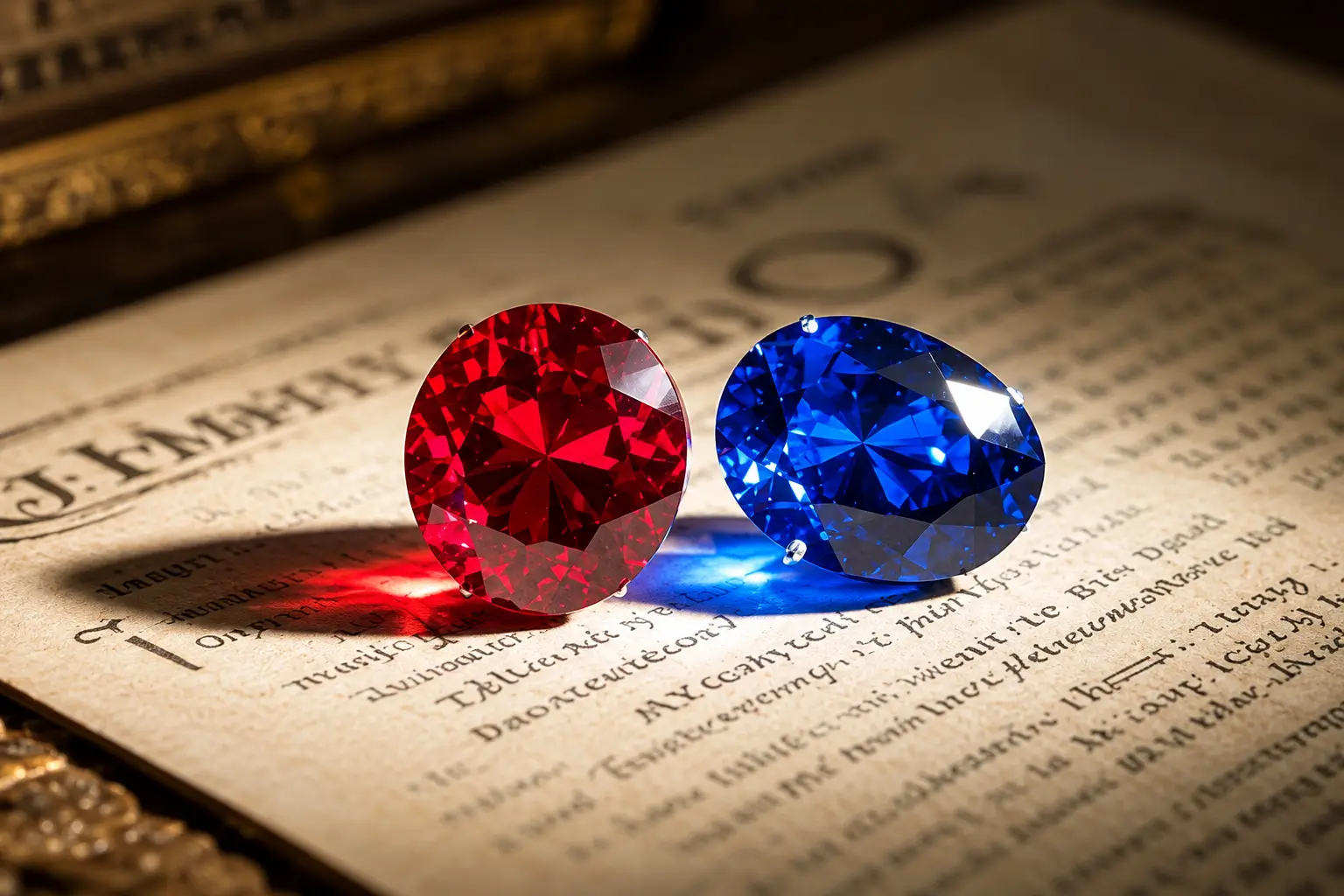
Ruby and sapphire have long been important colored gemstones in the market. Natural gemstones often contain inclusions, fractures, or uneven color. As treatment techniques have developed, people have found different ways to improve a gemstone’s color and appearance. Diffusion treatment is one of these methods, allowing more consumers to buy attractive gemstones at different price points.
In our earlier article, Unmasking Gemstone Filling, we explained the difference between enhancement and treatment. For ruby and sapphire, heat treatment is generally considered an enhancement, while diffusion, filling, irradiation, and dyeing are considered treatments.
The basic difference is straightforward:
- Heat treatment uses high temperatures to change the state or structure of elements already present in the gemstone, without adding new coloring agents.
- Diffusion treatment introduces external coloring elements into the gemstone.
For stones of comparable quality, heat-treated ruby and sapphire usually sell for less than their untreated counterparts, but they can still command significant market value. Some forms of diffusion, filling, irradiation, and dyeing can have a much greater effect on a gemstone’s market value. For buyers, knowing whether a gemstone has been treated—and understanding what type of treatment it has received—is therefore important.
In this article, we focus on one of the less obvious treatments used on ruby and sapphire: diffusion treatment.
What Is Diffusion Treatment?
Diffusion treatment can be broadly divided into surface diffusion and bulk diffusion.
In surface diffusion, heat drives external coloring ions into the outer part of the gemstone, creating a relatively thin color layer. The color remains concentrated near the surface rather than extending throughout the stone. In some cases, this layer is less than 1 mm thick.
The color does not simply sit on the surface, so ordinary rubbing will not remove it. However, if the gemstone is repolished later, the treatment layer may become thinner or disappear, revealing the lighter body color underneath.
Bulk diffusion works differently. Treatments such as beryllium diffusion can introduce coloring elements much deeper into the gemstone and, in some cases, throughout much of the stone.
We have covered Beryllium Diffusion Treatment in Sapphire: Color, Value, and Disclosure in detail. This article focuses on the more common surface diffusion treatment.
Surface Diffusion Treatment in Ruby
Early examples of surface-diffused ruby date back to 1979. Early treated rubies often had a garnet-red color with noticeable purple or brown tones. These colors did not match the appearance typically sought in fine ruby, so the market showed limited interest in them.
Later products achieved a redder appearance, but the color could still look uneven and sometimes appeared in distinct patches. Because color and overall appearance strongly affect a gemstone’s market appeal, these treated rubies have seen limited commercial use.
We can look for several clues when checking a ruby for surface diffusion treatment, including:
- Immersion testing
- Unusual or weak pleochroism
- Anomalous refractive index
- Ultraviolet fluorescence
Some of these methods require specialized equipment and experience, so they may not be practical for most buyers. One relatively simple method is to examine the ruby under short-wave ultraviolet light (SWUV).
Some surface-diffused rubies may show patchy blue-white phosphorescence under short-wave UV light. This can provide a useful clue, but it cannot confirm diffusion treatment on its own.
UV testing also requires a suitable UV light source and proper handling to produce meaningful results.
Related reading: How to Use a UV Light for Gemstone Testing: Fluorescence, Wavelengths, and Common Mistakes
Surface Diffusion Treatment in Sapphire
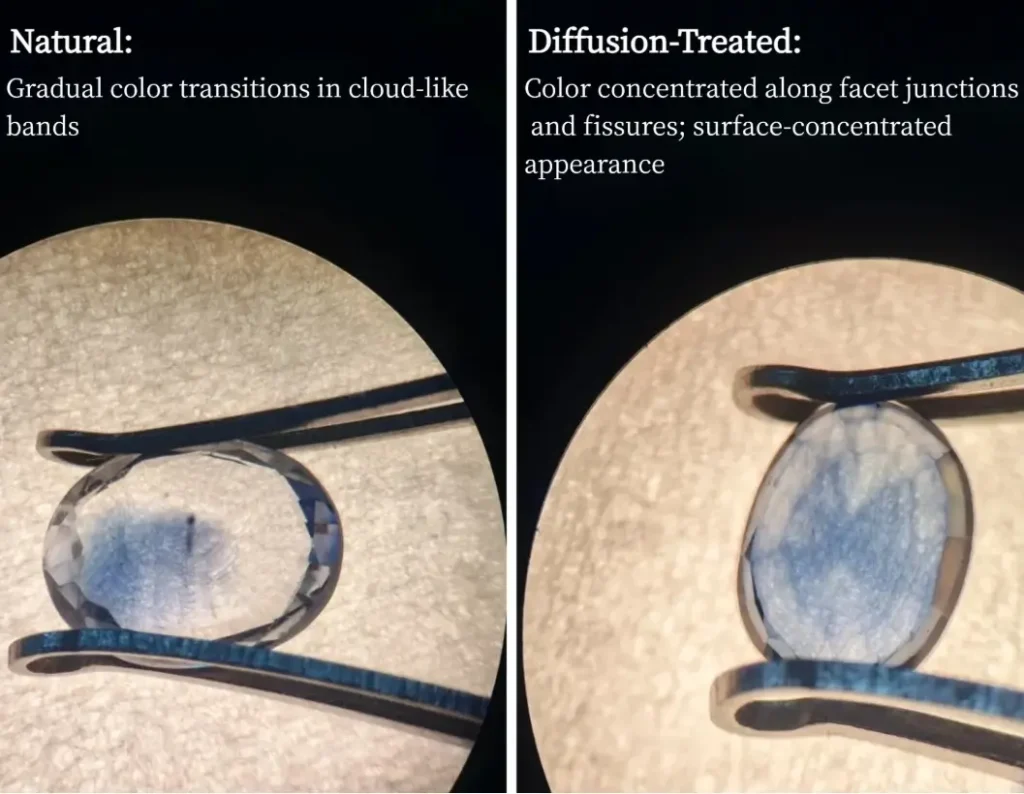
Surface diffusion treatment is much more common in sapphire than in ruby. The process uses high heat to drive external coloring ions into the sapphire crystal lattice, creating a thin layer of color near the surface. Unlike heat treatment, diffusion treatment introduces external coloring elements into the stone.
Different coloring elements can produce different colors:
- Chromium (Cr) and nickel (Ni) can turn colorless or pale sapphire orange-yellow.
- Iron (Fe), titanium (Ti), and cobalt (Co) can produce a blue diffusion layer.
The industry began using iron and titanium to diffuse sapphire in the 1980s. After the 1990s, blue sapphires treated with iron and titanium became widely available on the market. Their color can look quite close to that of natural blue sapphire, even to the naked eye. This makes magnification and other testing methods more important when checking a stone.
People have also experimented with cobalt as a coloring element. Cobalt diffusion can produce a vivid cobalt blue, but the color layer is very thin and may show many lighter patches on the surface. As a result, cobalt-diffused sapphire remains relatively uncommon in the market. In recent years, cobalt diffusion treatment has appeared more often in spinel.
How to Identify Diffusion-Treated Sapphire
Surface diffusion places most of the color near the surface of the sapphire. Understanding how the treatment works can help us spot differences between treated and natural stones. We can start with the naked eye, then use transmitted light, magnification, and UV light for a closer look.
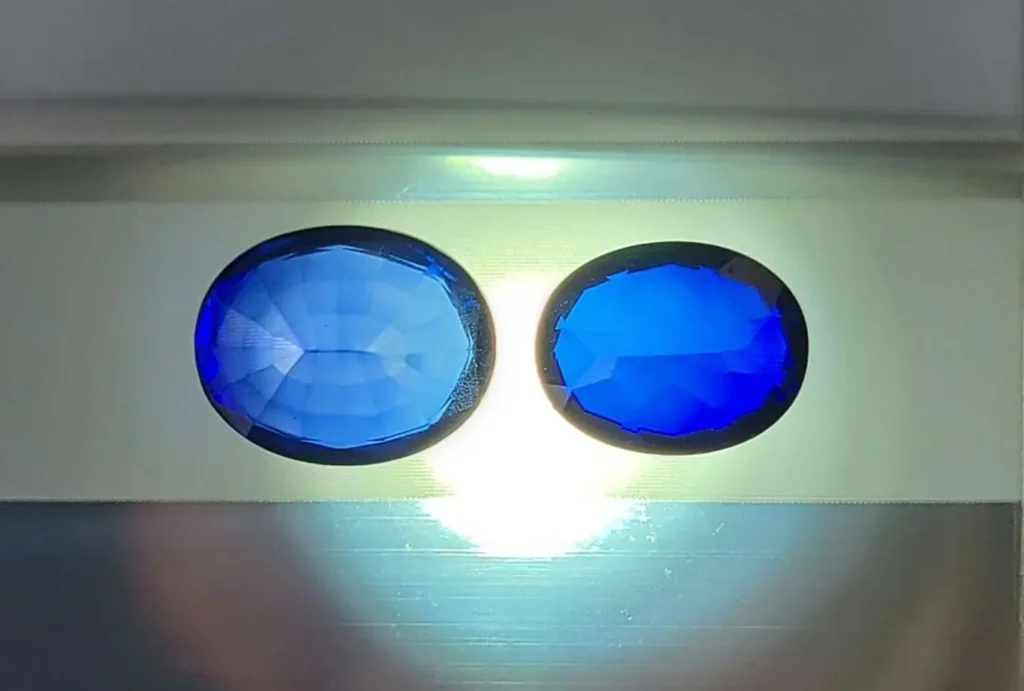
These methods provide useful clues, but they do not confirm diffusion treatment on their own. The results can vary with the treatment method, the depth of the color layer, and the properties of the sapphire itself.
1. Examine the Color
For simplicity, this article uses two categories based on the approximate thickness of the color layer:
- Type I diffusion: The color layer is about 0.004–0.1 mm thick.
- Type II diffusion: The color layer can reach about 0.4 mm in thickness.
Type II diffusion produces a thicker color layer, so the surface color usually appears more even and may look closer to that of natural sapphire.
Type I diffusion produces a thinner color layer, making uneven color more common. Some stones may appear grayish blue, with a hazy or water-washed look.
2. Examine the Stone Under Transmitted Light
For most buyers, transmitted-light observation can be a practical way to look for signs of diffusion treatment.
Place the sapphire on a translucent material, such as a clear or semi-transparent plastic bag. Shine a flashlight from underneath the stone and observe how the color passes through it. A loupe can then help you examine areas where the color appears concentrated or uneven.
Type I Diffusion
Because the color layer is thin, Type I diffusion may concentrate color around:
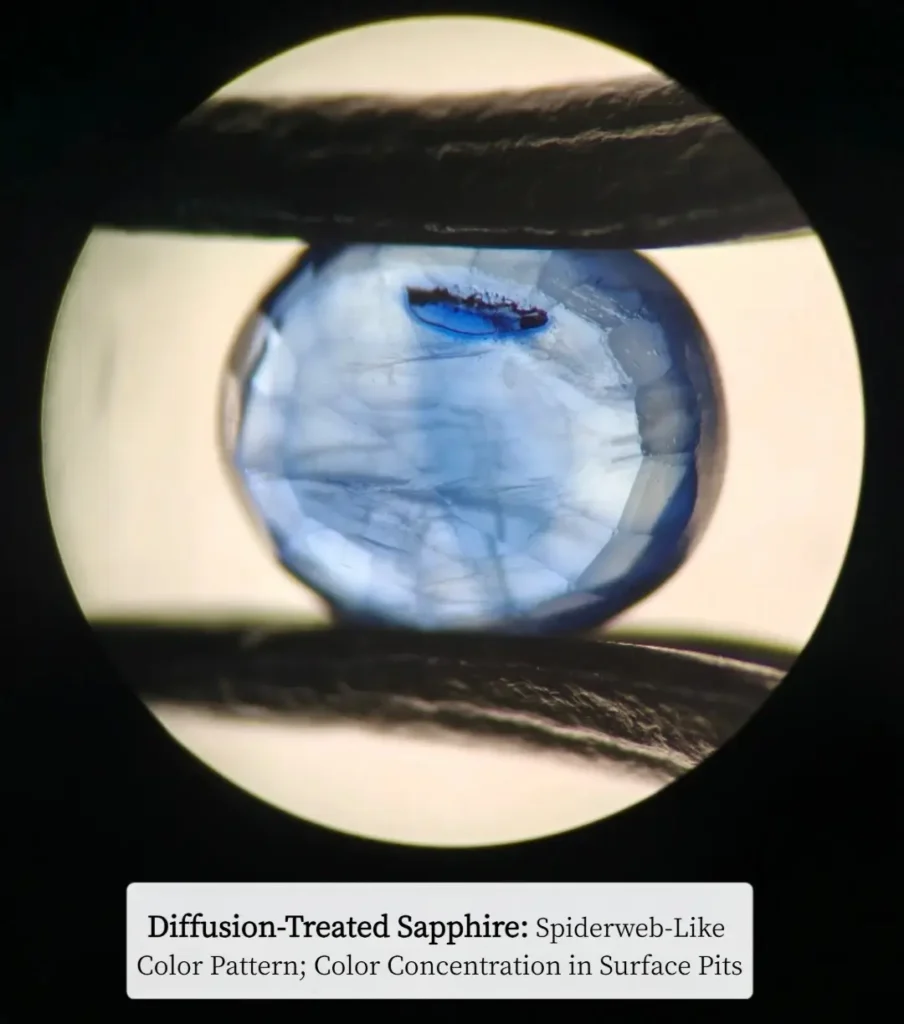
- Facet junctions (the color usually forms a spiderweb-like pattern along the facet junctions)
- The girdle
- Some facet edges
As a result, different facets may show noticeable differences in color intensity. The overall color can also look uneven.
Think of it as applying a very thin layer of color to a surface. Where the layer is thicker, the color looks deeper. Where it is thinner, the color looks lighter.
Type II Diffusion
The thicker color layer in Type II diffusion usually produces a more even overall color. Under magnification, however, you may still find areas of concentrated color around open fissures and surface pits.
These areas can collect external coloring elements during treatment, making them useful points to examine more closely.
3. Check Fluorescence Under UV Light
UV fluorescence can provide an additional clue when checking a sapphire for possible diffusion treatment.
Some surface-diffused sapphires may show chalky blue or green fluorescence under short-wave UV light (SWUV). Others may show blue, green, or orange fluorescence under long-wave UV light (LWUV).
However, UV fluorescence is not specific to diffusion treatment and cannot confirm treatment on its own. Some natural sapphires can also show fluorescence. For example, some light-blue sapphires from Sri Lanka may show a faint orange fluorescence under long-wave UV light.
We should therefore consider the UV response together with the sapphire’s origin, color, internal features, and other test results when assessing possible diffusion treatment.
How Do Laboratories Identify Diffusion Treatment?
When a ruby or sapphire shows signs of possible treatment, especially when a high-value stone is involved, a professional gem laboratory can use a more systematic approach to identify it.
In addition to microscopic examination and UV fluorescence testing, the laboratory can also use:
- Absorption spectroscopy
- Refractive index
- Other testing methods related to the gemstone’s composition, structure, and treatment features
These tests can help determine how the color formed and distinguish natural color from color created through artificial diffusion.
Jewea Summary
Gemstone treatments are generally used to improve color or appearance and make the material more commercially useful. For consumers, treatment does not automatically mean that a gemstone has little or no value. What matters is whether the treatment is clearly disclosed and whether the price reflects the stone’s actual quality and treatment status.
When buying ruby or sapphire, it is more useful to understand gemstone treatments, compare different treatment methods, and use test results to assess value than to simply look for a “natural” or “perfect” appearance. When necessary, consider professional testing.