Would You Mistake Colorless Danburite for Topaz?
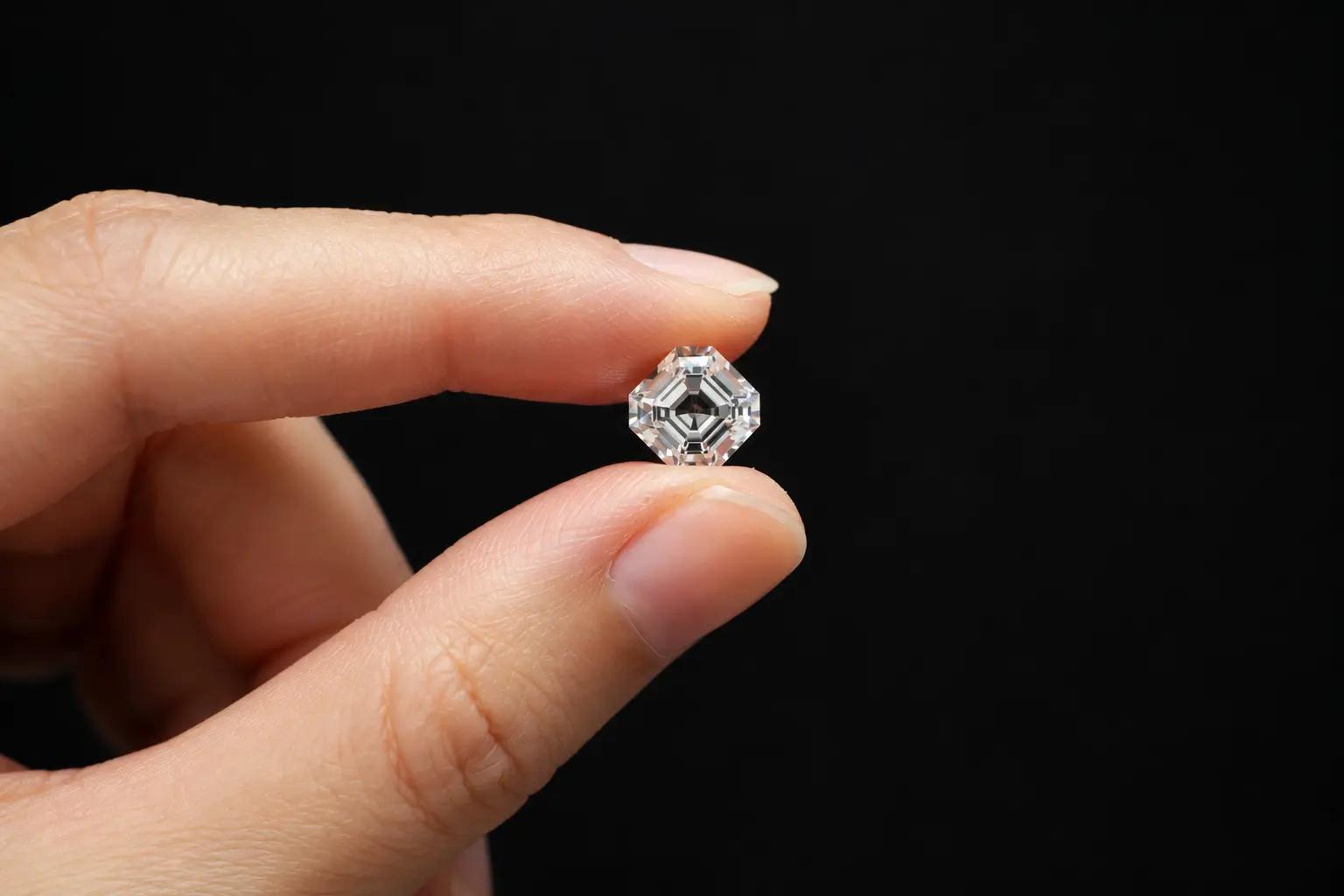
A longtime customer of mine came to me with a 0.54-carat colorless gemstone she had bought years ago. She wanted to have it set into a piece of jewelry.
At first, she called it topaz, and I didn’t think anything of it. But as we discussed the design, I took a closer look at the stone and realized it wasn’t topaz at all. It was colorless danburite.
Surprised by the discovery, she explained that she had always believed the stone was topaz. Now, it turned out to be a gemstone she had never even heard of. Naturally, she began to wonder whether she had paid too much for it years ago.
Danburite and topaz are two different minerals, but that doesn’t necessarily mean one costs more than the other. In this case, the stone’s small size, good transparency, and vitreous luster put it in a price range comparable to that of ordinary colorless topaz.
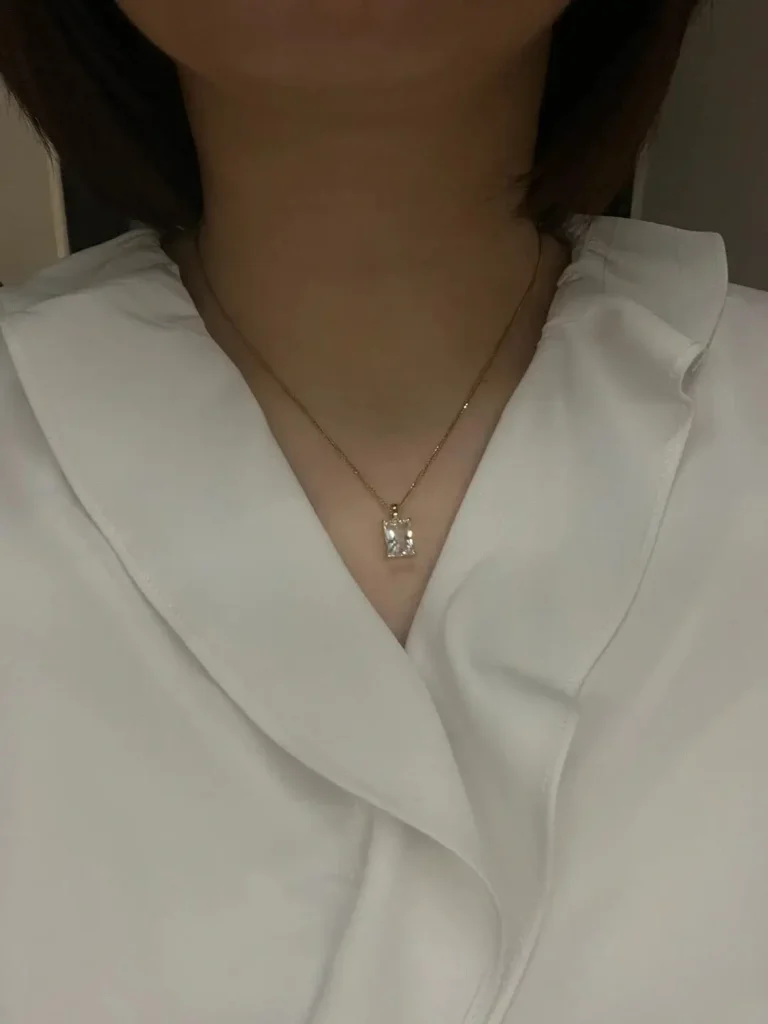
To show off the stone’s clarity and luster, we settled on a simple four-prong setting with an 18K gold chain. This understated design would let the gemstone take center stage.
This little experience reminded me that danburite may not be as well known as topaz, but it’s a natural gemstone worth getting to know. Let’s take a closer look at danburite’s mineral properties and compare it with topaz to see what these two gemstones have in common and how to tell them apart.
About Danburite
American mineralogist Charles Upham Shepard named danburite in 1839 after Danbury, Connecticut, one of the earliest reported localities for the mineral.
As the city grew, its original mineral deposits ceased to be a major commercial source. The name, however, has remained unchanged.
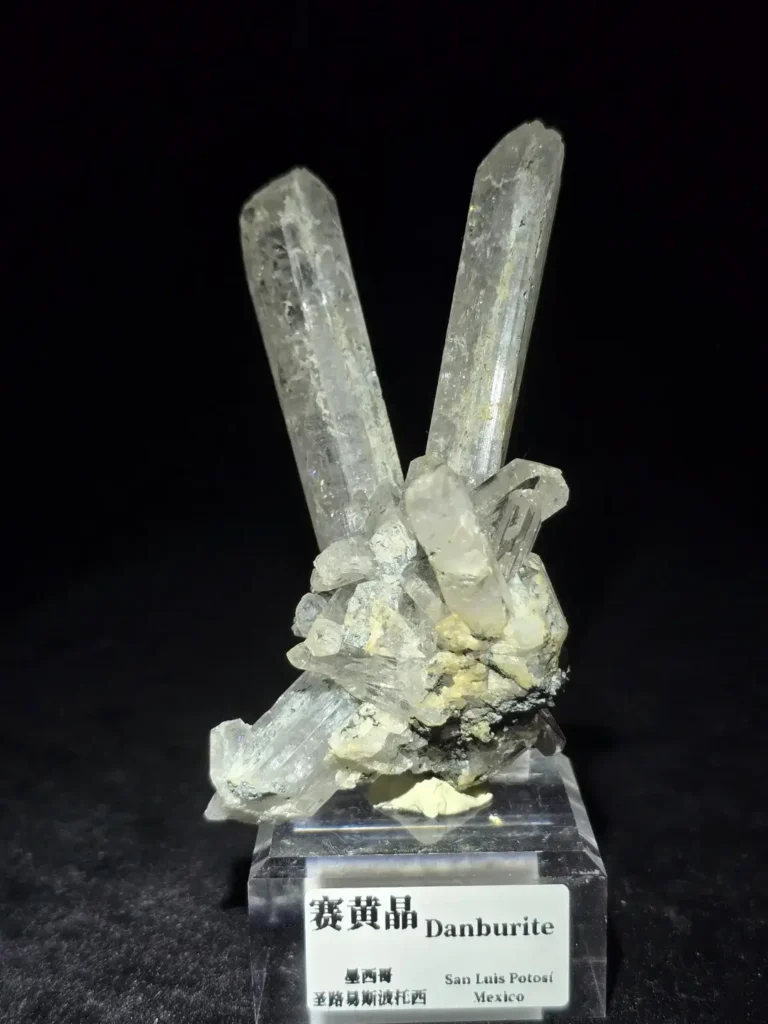
Today, most danburite on the market comes from Mexico, particularly Charcas in the state of San Luis Potosí. The mineral also occurs in Madagascar, Myanmar, Japan, Russia, and other locations. Depending on the locality, danburite can vary in color, transparency, and crystal characteristics.
Danburite Mineral Properties
Danburite is a calcium borosilicate mineral with the chemical formula CaB₂Si₂O₈. It belongs to the orthorhombic crystal system and has a Mohs hardness of 7–7.5.
Its crystal structure consists of interconnected silicon-oxygen and boron-oxygen tetrahedra that form a three-dimensional framework, with calcium ions occupying positions within that structure. Danburite crystals typically form elongated prisms. Their faces often show lengthwise striations, while the crystal terminations sometimes develop distinctive wedge-shaped faces.
Danburite occurs in several colors, including colorless to white, pale yellow, honey yellow, pink, and brown. Well-cut crystals with good transparency and clarity display a bright vitreous luster.
For many years, high-quality colorless danburite was regarded as an affordable alternative to diamond. Its dispersion, however, is relatively low at approximately 0.017. This means it generally lacks the strong rainbow-like flashes associated with diamond. Even so, a well-cut danburite can still deliver impressive brightness and clarity.
Although danburite remains a relatively niche gemstone, high-quality rough suitable for cutting into large, high-clarity faceted gems is comparatively limited. This scarcity helps explain why fine, large-carat danburite attracts interest from some gemstone collectors.
Danburite vs. Topaz: What’s the Difference?
Danburite can easily be mistaken for topaz when both stones are colorless or pale yellow. Once cut into faceted gems, they can also look similar. Both belong to the orthorhombic crystal system and have relatively close refractive indices, and display good transparency and a vitreous luster. Some crystals also share a similar prismatic shape.
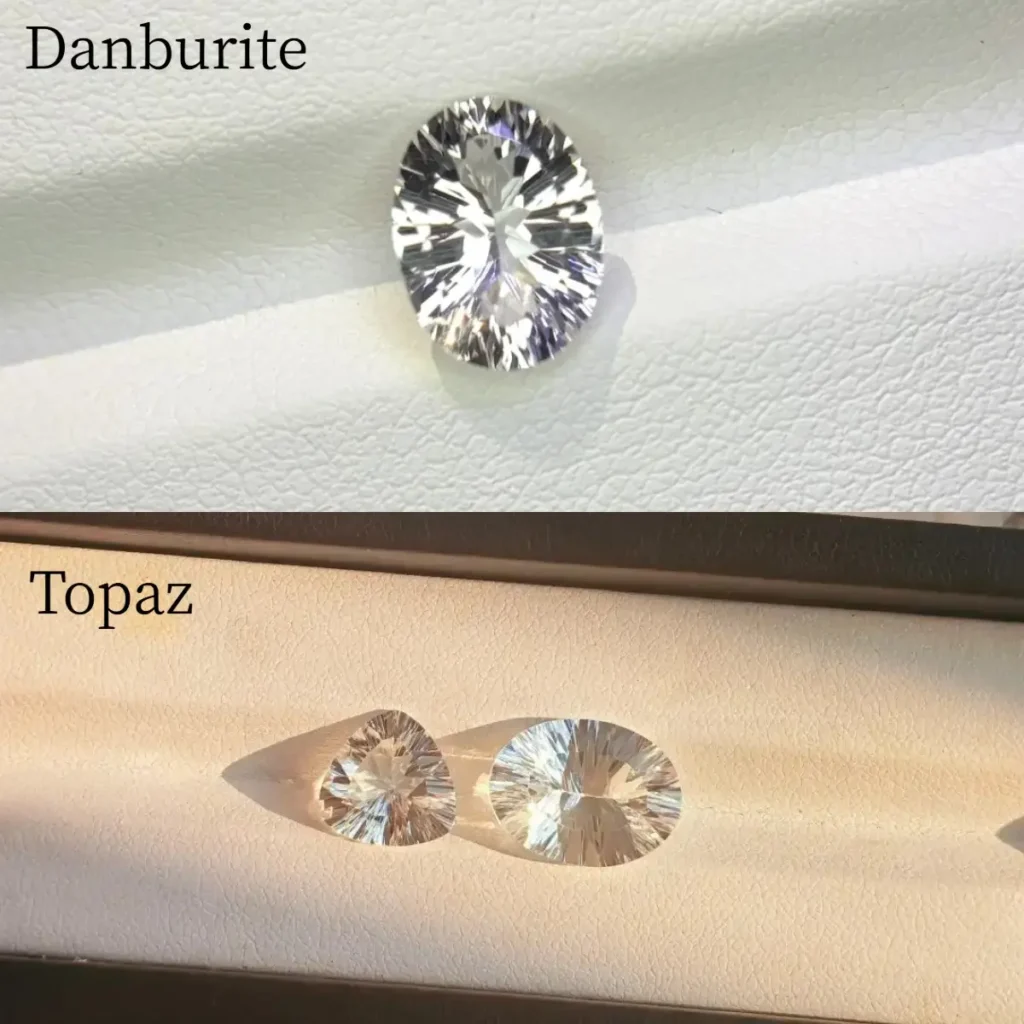
Despite these similarities, the two minerals differ in their chemical composition, physical properties, and identifying characteristics.
Key Differences
- Chemical composition: Danburite is a calcium borosilicate with the chemical formula CaB₂Si₂O₈. Topaz is a fluorine-bearing aluminum silicate, with the chemical formula Al₂SiO₄(F,OH)₂. Their distinct chemical compositions give them different mineral structures and physical properties.
- Hardness and cleavage: Topaz has a Mohs hardness of 8, making it harder than danburite and more resistant to scratches in everyday jewelry. However, topaz has perfect basal cleavage, which means a sharp impact from the right direction can split it along a specific crystal plane. Danburite has less pronounced cleavage and typically shows an uneven to subconchoidal fracture. Both gemstones need suitable settings and protection from impacts.
- Specific gravity (density): Danburite has a specific gravity of approximately 3.0, while topaz ranges from about 3.5 to 3.6. For stones of the same volume, topaz generally feels heavier. This difference can help with identification, although it is only one of several factors to consider.
- Ultraviolet fluorescence: Some danburite specimens fluoresce blue to blue-green under long-wave ultraviolet light. Topaz often shows little or no fluorescence, although its reaction varies. For example, some yellow topaz specimens fluoresce orange-yellow under long-wave UV light. Fluorescence can provide a useful clue, but it cannot identify either gemstone on its own.
- Birefringence: Danburite has a relatively low birefringence of approximately 0.006, compared with about 0.008–0.010 for topaz. Under certain viewing conditions, a loupe may reveal doubling of facet edges in a faceted gemstone. However, this effect is not a reliable way to distinguish danburite from topaz by eye.
No single characteristic can conclusively distinguish danburite from topaz in every case. If a gemstone has significant value, a large carat weight, or an uncertain identity, I recommend having it examined by a qualified gemological laboratory. When purchasing a gemstone, ask for a gemological report that corresponds to the specific stone.
Jewea’s Perspective
Danburite remains a relatively niche gemstone, and fewer consumers may recognize it than topaz. In our design work, however, we see its appeal in more than its resemblance to other transparent gemstones. Its clarity, vitreous luster, and potential for faceting make it worth exploring in its own right.
Beyond faceted gemstones for jewelry, well-preserved danburite crystals with clearly defined crystal forms also make interesting additions to mineral collections. They can serve as educational display specimens or decorative pieces for the home.
At Jewea, we believe that understanding a gemstone means more than knowing its name and physical properties. It also means exploring how we can appreciate it through jewelry design, everyday wear, and mineral collecting.