Sugilite Stone: A Deep Dive into Its Color, Texture, and Geological Beauty
OnlinOnline, people often compare Sugilite Stone to Charoite. You might even hear some call it a “budget alternative.” But look closer. From mineralogy and visual structure to high-end jewelry aesthetics, these two are completely different materials.
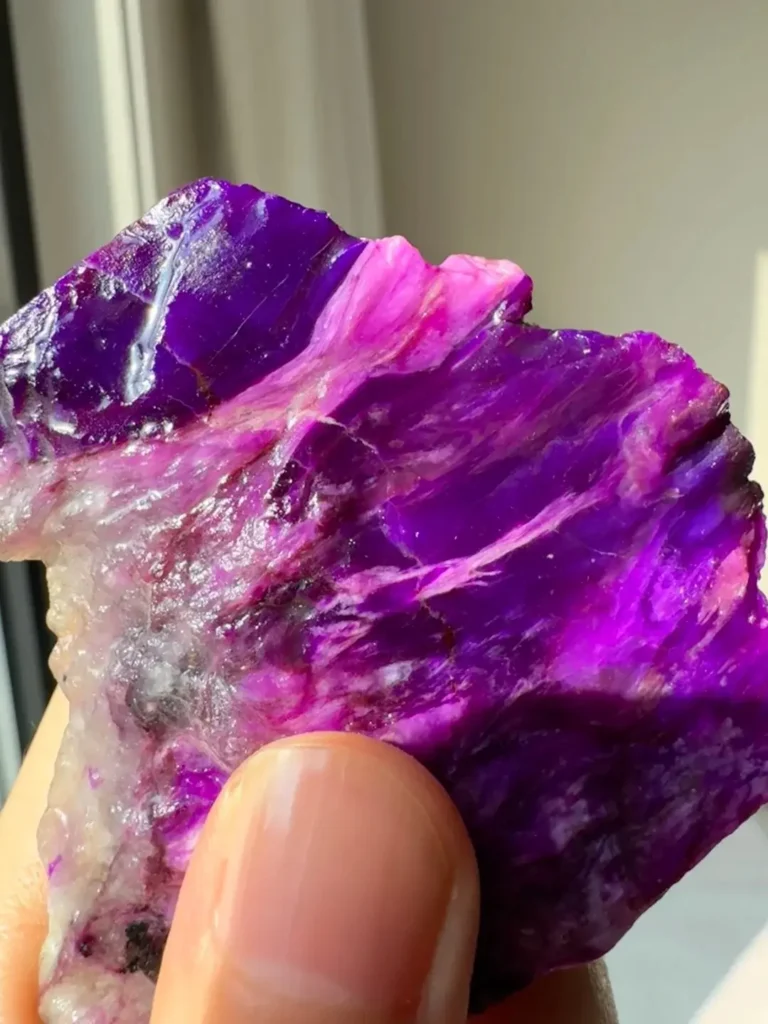
Advanced collectors and independent designers love Sugilite for a reason. Its appeal comes less from sparkle and more from how color exists within the material itself. The surface feels layered rather than reflective—deep violet moving into lavender haze, or blue-purple gathering around darker mineral structures. This structural gradient gives Sugilite its own permanent, distinct place in the world of colored gemstones.
In this article, we will objectively break down this material through its mineral properties, market quality variations, and expert buying tips.
What Is Sugilite Stone?
Sugilite stone first came to light in the 1940s when Japanese petrologist Ken-ichi Sugi discovered the mineral. However, the stone truly entered the international jewelry market in the 1970s, following the discovery of gem-quality sugilite in South African manganese deposits.
From a mineralogical perspective, this stone belongs to the cyclosilicate mineral group. It features a complex blend of potassium, sodium, lithium, iron, and manganese, reflected in its intricate chemical formula:
KNa2(Fe,Mn,Al)2Li3Si12O30
On the Mohs hardness scale, this purple gemstone scores between 5.5 and 6.5. This rating means it is neither fragile nor crystalline transparent. Instead, it has a dense, tightly compacted structure. While suitable for jewelry, its character comes more from density, texture, and its unique surface response to polishing.
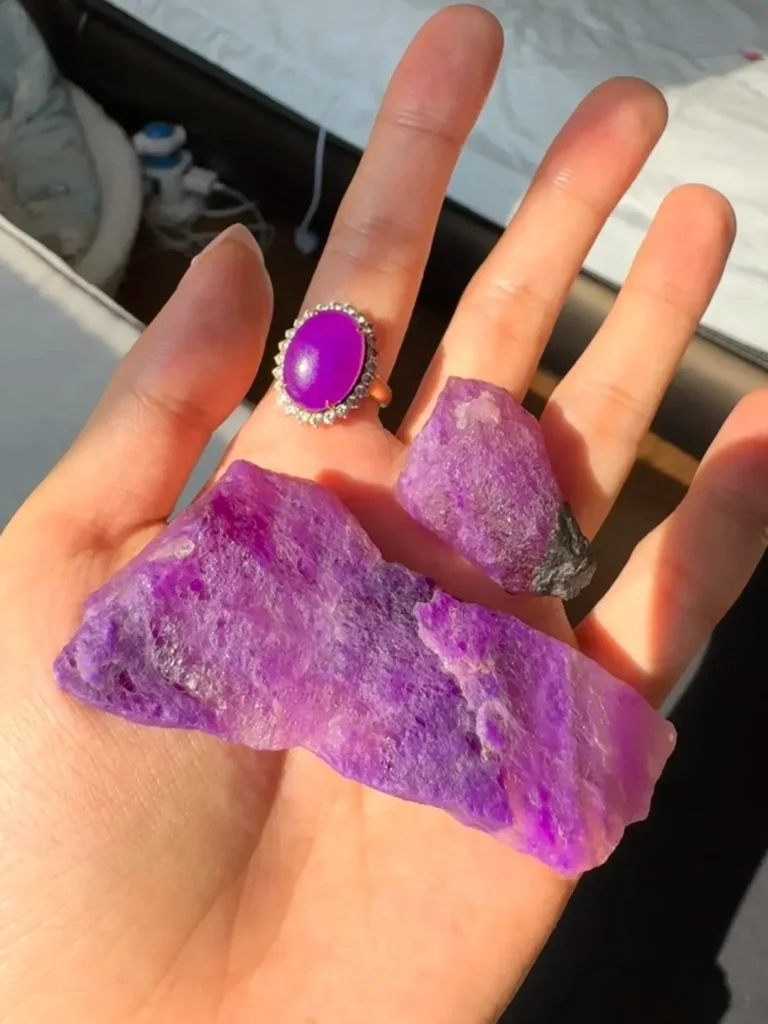
Manganese gives the stone its iconic purple hue. At the same time, different associated minerals and element ratios shift its colors and create unique natural patterns that feel almost geological in rhythm. Today, South Africa remains the premier source for this material. While Japan, Canada, and the US have noted mineral deposits, the stable supply of gem-quality sugilite from these regions remains highly limited.
The Color Palette of Sugilite
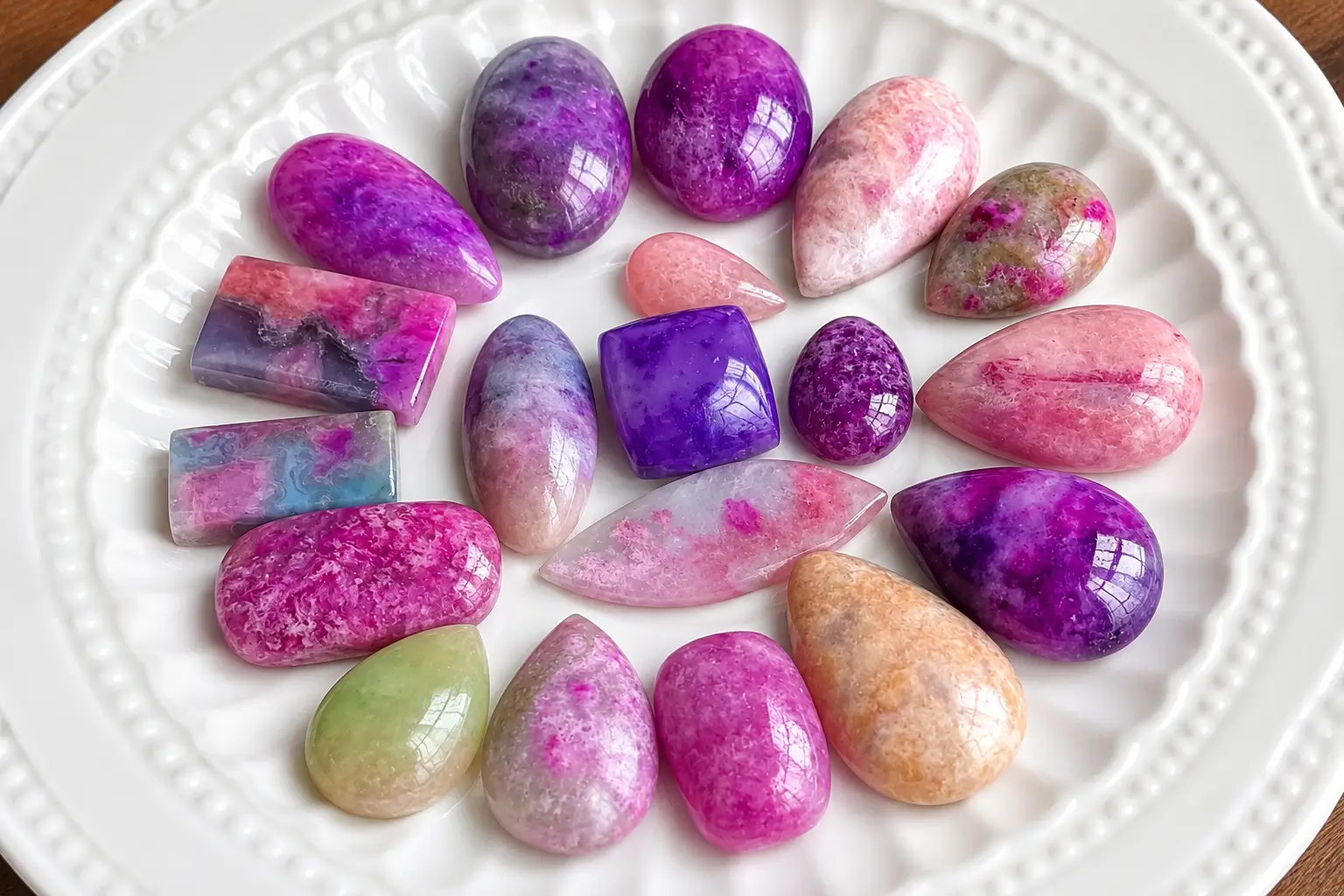
One of the reasons Sugilite continues to fascinate designers is that its color rarely behaves in a uniform way. Purple moves through the material in gradients, clouds, patches, and interruptions, appearing almost suspended beneath the surface.
Royal Purple and Deep Violet
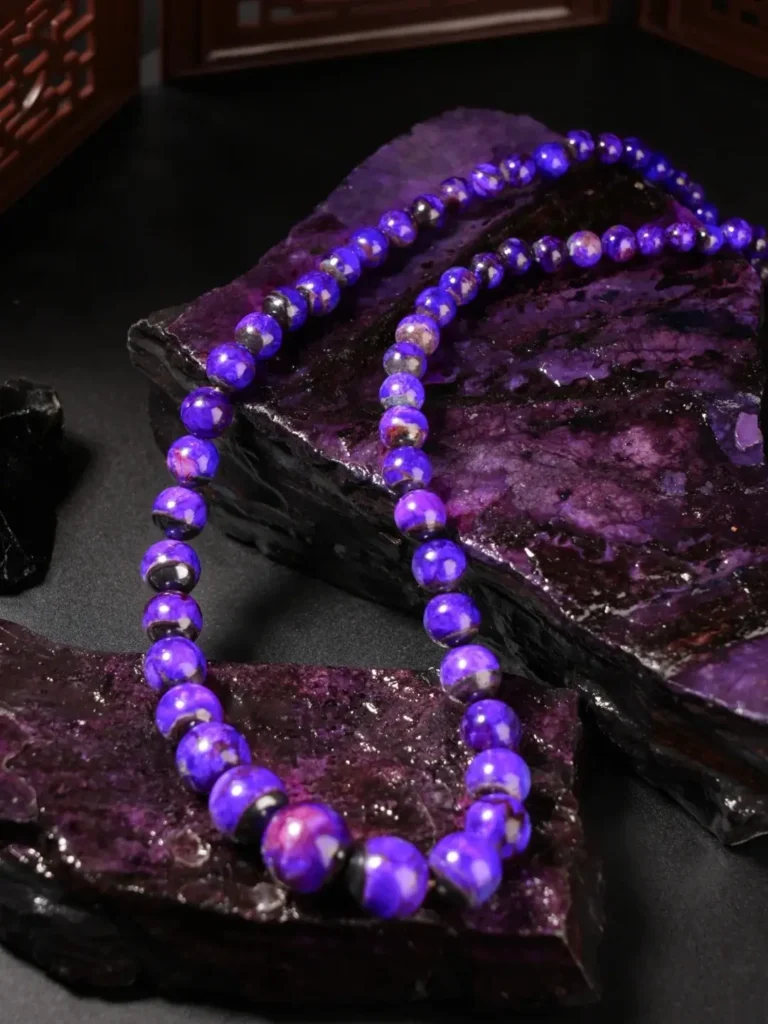
This is the most classic and iconic color range for Sugilite. High-quality purple stones typically feature:
- High color purity and strong depth of color
- Stable, consistent tones with uniform saturation
- Minimal dark inclusions or black matrix
What makes these pieces compelling is their restraint. Instead of producing sharp flashes of light, the finest specimens diffuse light softly, creating a rich, velvety visual effect.
Lavender and Pastel Pink-Purple
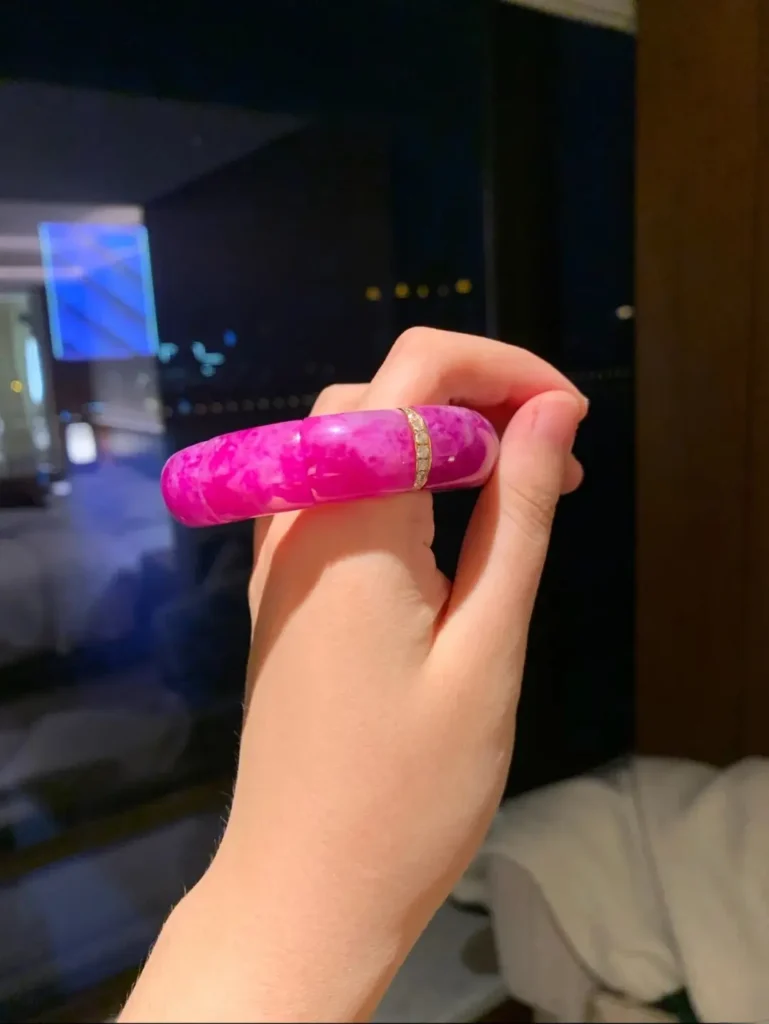
Some Sugilite forms in softer lavender, dusty lilac, or gentle pastel pink-purple tones. These lighter varieties carry a softer, more delicate aesthetic. They are highly versatile in modern jewelry design, blending perfectly with organic themes, open atmospheric moods, or light vintage styles.
Blue-Purple and Complex Mixed Variations
The market also features Sugilite with blue-purple zones, grayish hues, or intricate patterned matrices. Because of the high percentage of associated minerals, these stones sparked debates regarding their official naming in the early days.
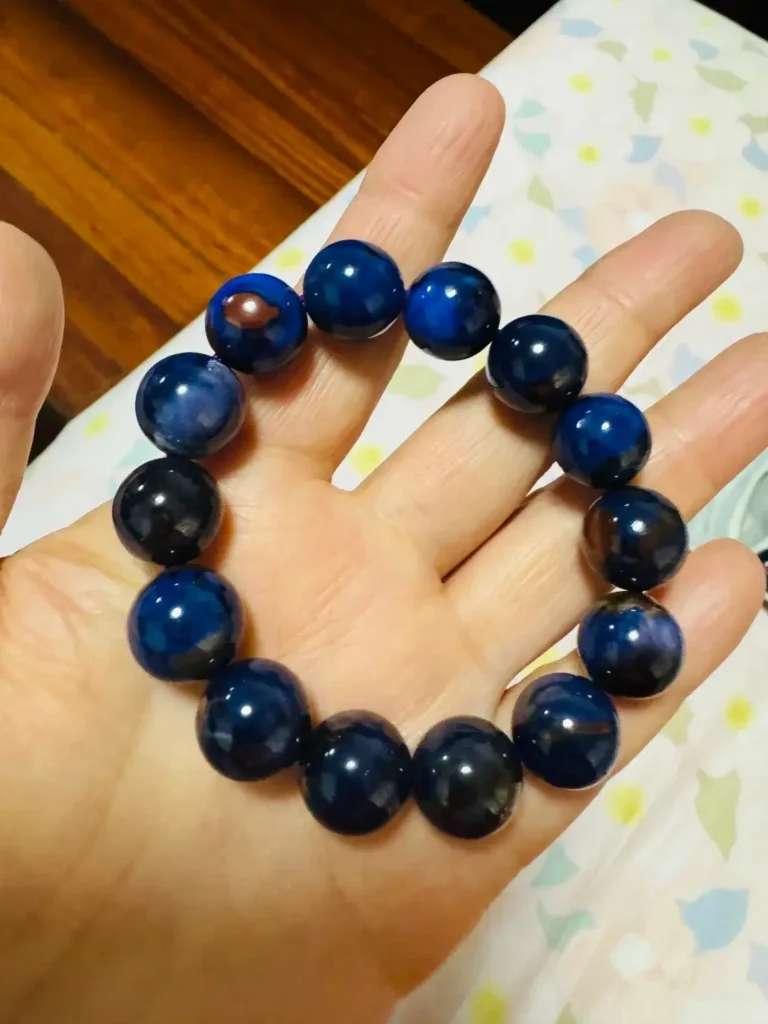
Traditionally, collectors favored cleaner material. Today, however, contemporary designers welcome these striking, mixed-mineral structures precisely because they preserve the feeling of untouched, natural mineral formation over visual perfection.
Evaluating Quality: Texture Over Color
Unlike many colored gemstones priced solely on color, Sugilite depends heavily on its overall “texture.” To seasoned jewelers and collectors, color matters, but the fineness of the grain, structural uniformity, and a lasting, lustrous finish after polishing are often far more critical.
Premium Sugilite typically exhibits these characteristics:
- A highly refined, fine-grained mineral structure
- A soft, stable surface luster that diffuses light instead of sharply reflecting it
- A waxy, gel-like appearance after polishing
- Smooth, naturally flowing transitions between color zones without coarse graining
In the trade, professionals categorize the material into three common structural profiles:
- Fine-Grained / Waxy Texture: This material features an exceptionally uniform structure and a delicate visual appeal, yielding a soft, rich luster when polished. It feels fully “settled,” as though the color and structure have completely fused together.
- Translucent Sectors: Certain specimens show mild translucency under strong, focused light. However, high transparency is not the core value driver for Sugilite.
- Earthy / Rock-like Texture: This material shows a noticeable grainy texture, rough structure, and a dry appearance. It typically belongs to lower commercial grades where dark matrix dominates.
Note: Popular Asian market descriptors like “icy” or “jadeized” are purely poetic and regional. They do not represent official, international gemological grading terminology.
Sugilite vs. Charoite: Key Differences
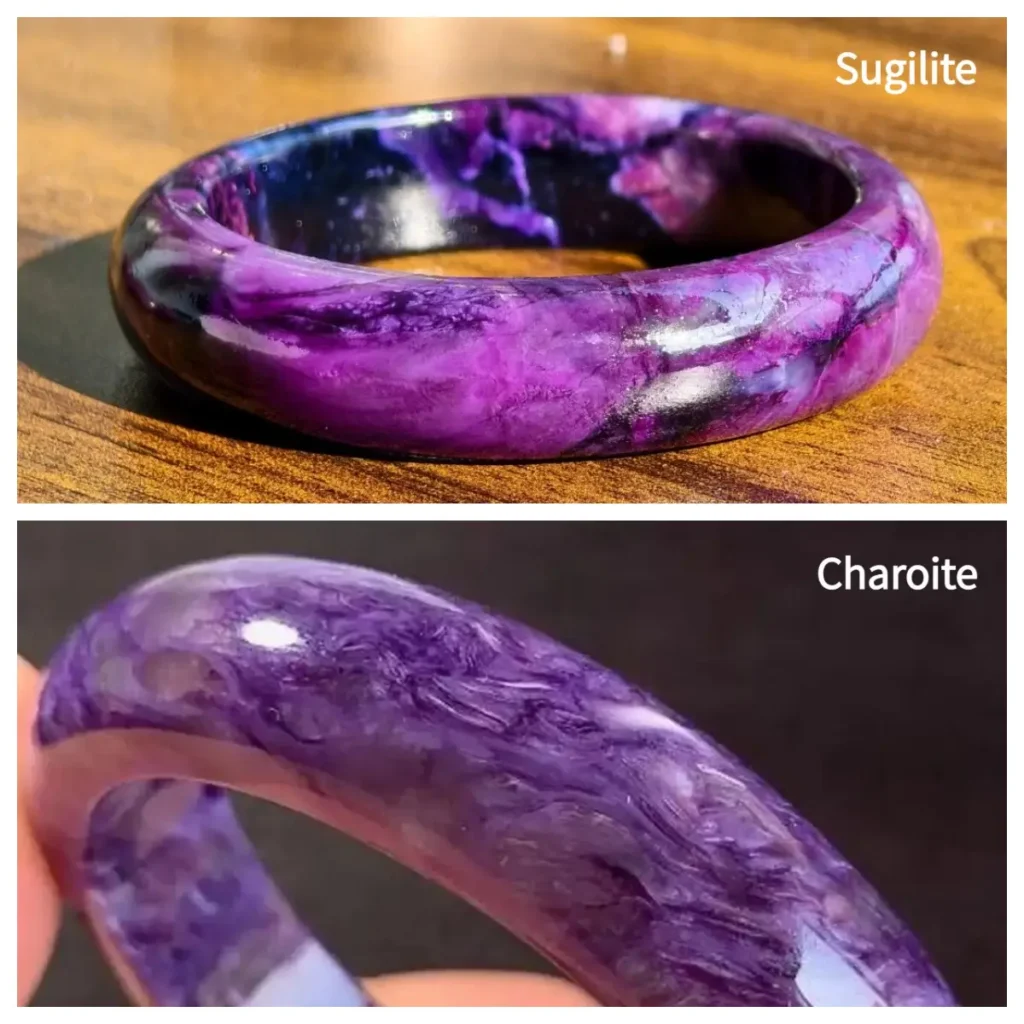
Although Sugilite and Charoite occupy the same purple spectrum, they represent two entirely distinct directions in mineral aesthetics. They speak different visual languages.
Sugilite
- Color Distribution: Colors appear in diffuse, cloud-like blocks, misty patches, or smooth gradients.
- Texture: Displays a distinctly compact, waxy, and gel-like mineral texture.
- Aesthetic Impression: Absorbs light rather than reflecting it. It offers a quieter, deeper, and more grounded visual presence.
Charoite
- Color Distribution: Displays prominent fibrous, swirling, or needle-like directional structures.
- Texture: Exhibits dynamic, high-fluidity pattern movements running through the stone.
- Aesthetic Impression: Features active light reflection, frequently showcasing a striking, silky chatoyancy (shimmer effect) for a more dramatic, kinetic expression.
Ultimately, these two materials share no simple “replacement” relationship. Where Charoite moves, Sugilite absorbs.
Market Identification and Treatments
Navigating the Sugilite market requires a careful eye, as artificial treatments do exist to mask low-grade materials.
Dyed Material
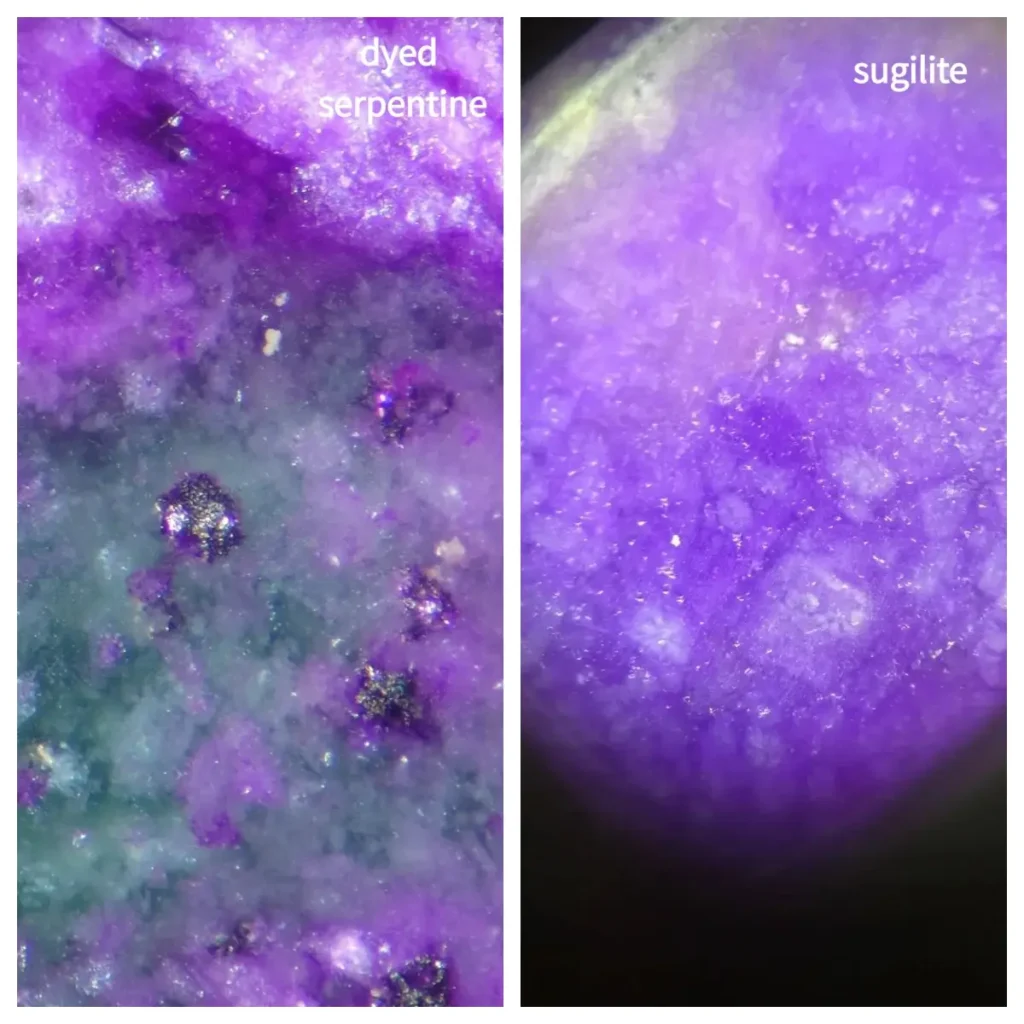
Artificially dyed stones usually reveal specific warning signs:
- An unnaturally uniform color distribution lacking organic depth and subtle layering
- Overly vivid, neon tones that feel visually disconnected from natural minerals
- Visible dye concentration or bleeding within surface fractures and veins
Resin-Filling and Clarity Enhancement
Suppliers often treat highly fractured material with resin infilling to mask surface cavities and improve the stone’s structural integrity. Heavily treated stones typically show an unnatural, excessively glossy surface luster, a distinct plastic-like feel upon close inspection, and reduced long-term durability.
In the gemstone world, treatment itself is not unusual. What matters is full disclosure. When Sugilite becomes too artificially uniform, it loses the very irregularities that make it interesting.
Beyond “Energy Stone” Narratives
The jewelry market frequently associates Sugilite with symbolic meanings like “healing” and “metaphysical energy.” From the standpoint of modern mineralogy and gemology, however, Sugilite remains fundamentally a natural mineral. It possesses no medical or pharmacological properties.
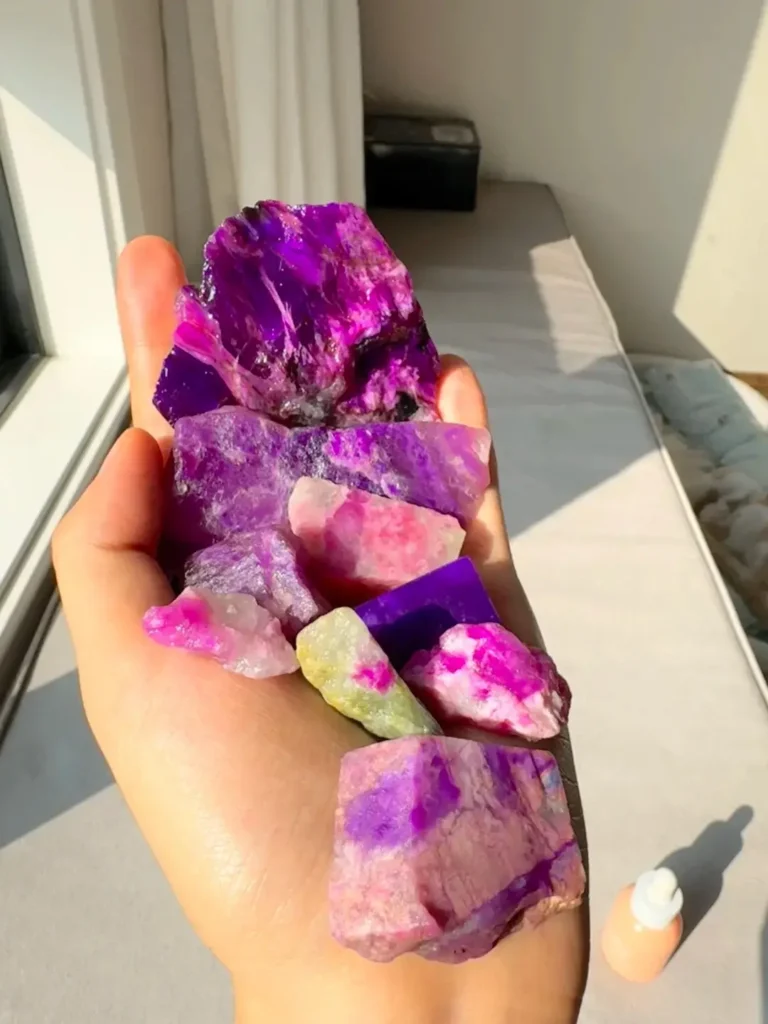
The true, lasting value of Sugilite lies entirely in its tangible physical presence: its remarkably unique color palette, its intricate, entirely irreplaceable mineral patterns, and the unpredictability of its internal structure. We appreciate Sugilite not for marketing myths, but for its geological individuality.
Jewea’s Notes
Sugilite is not a stone that can be understood through color alone.
Over time, what becomes interesting is usually the relationship between the color and the material itself — the density of the structure, the softness of the polish, the way darker mineral areas interrupt otherwise saturated purple.
Some stones impress immediately with brilliance. Sugilite takes a little longer, but its presence becomes clearer over time.