How to Use a UV Light for Gemstone Testing: Fluorescence, Wavelengths, and Common Mistakes
For most jewelry and jade enthusiasts, a UV light is a familiar and useful auxiliary tool for gemstone testing. It mainly helps us observe how gemstones react to ultraviolet light. Different gemstones can show different fluorescence patterns. Treatment and even geographic origin can also affect their reaction under UV light.
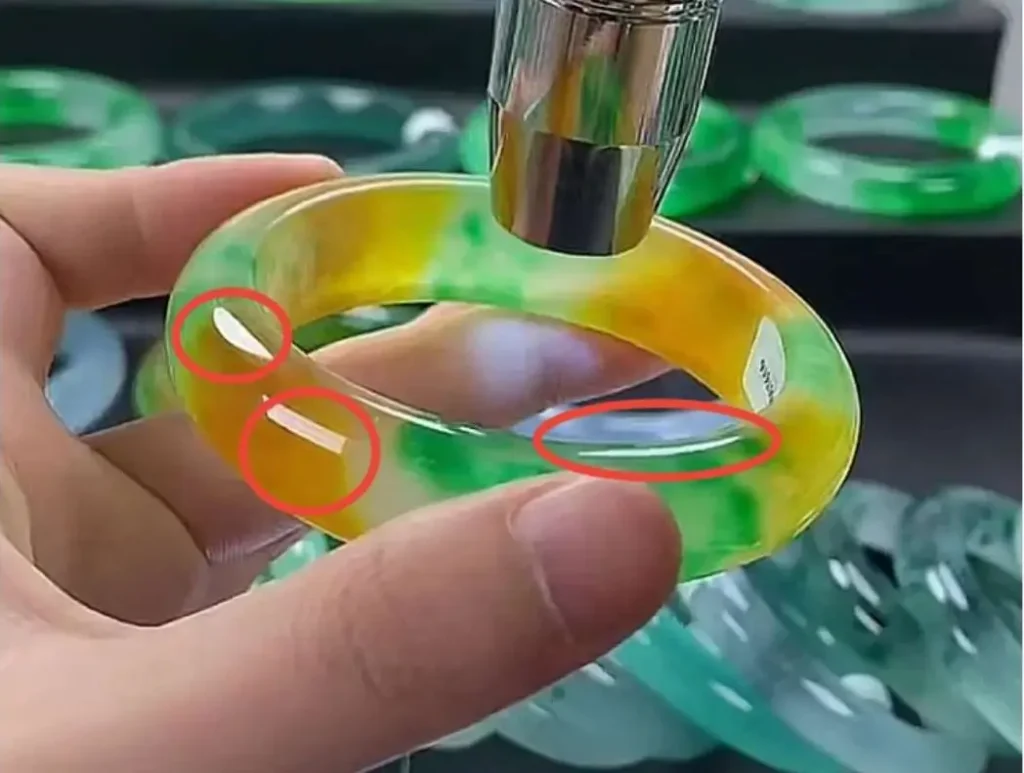
Recently, a friend showed me some photos they had seen online and asked:
“Why can’t a UV light detect a fake gemstone every time?”
That question leads to three important things we need to understand:
- Which gemstones can you examine with a UV light?
- What type of UV light is suitable for gemstone testing?
- How should you use a portable UV flashlight for more accurate observation?
Let’s go through these questions one by one.
UV Light: A Small Tool with Many Uses
Many jade enthusiasts use a UV light to check for signs of glue filling or to help determine whether jadeite has undergone the treatment commonly known as B-jade. But UV light has many other uses in gemstone testing.
It is important to remember that a UV light is an auxiliary testing tool, not a standalone instrument for identifying gemstones.
A fluorescence reaction only becomes meaningful when considered alongside other gemological properties, such as color, refractive index, specific gravity, inclusions, spectral features, and other test results.
1. Helping Distinguish Gemstone Types
Some gemstones look very similar to the naked eye and can be difficult to tell apart. Under UV light, however, they may show noticeably different fluorescence. This difference can help us distinguish between them.
For example:
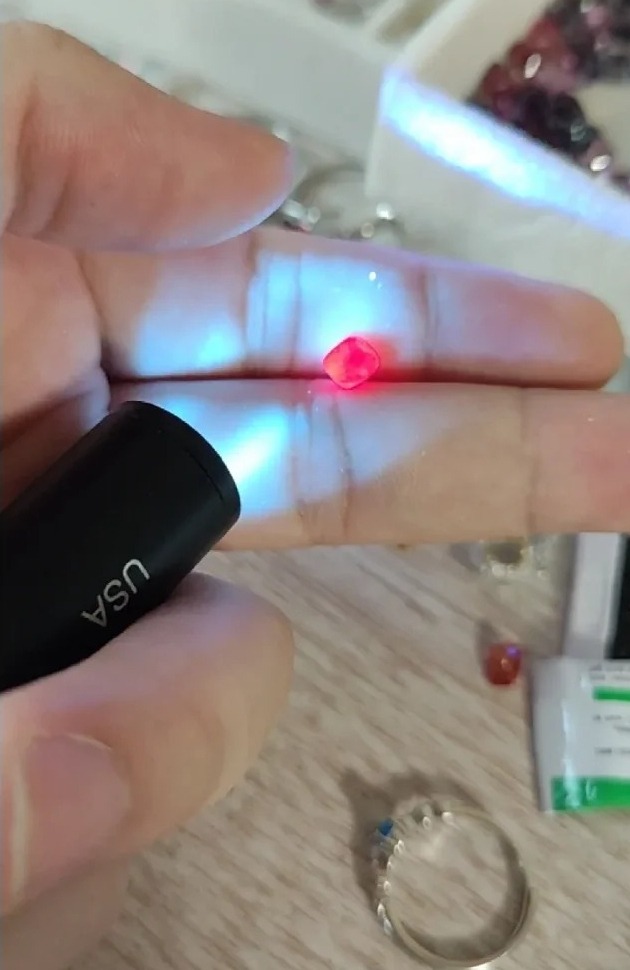
- Ruby and red garnet
- Red spinel and red tourmaline
- Sapphire and benitoite
2. Helping Distinguish Natural and Synthetic Gemstones
As synthetic gemstone technology advances, the visual differences between natural and synthetic stones can become increasingly difficult to spot. Under UV light, however, the two may still show different fluorescence patterns. These subtle differences can provide useful supporting evidence when distinguishing certain natural gemstones from their synthetic counterparts.
For example:
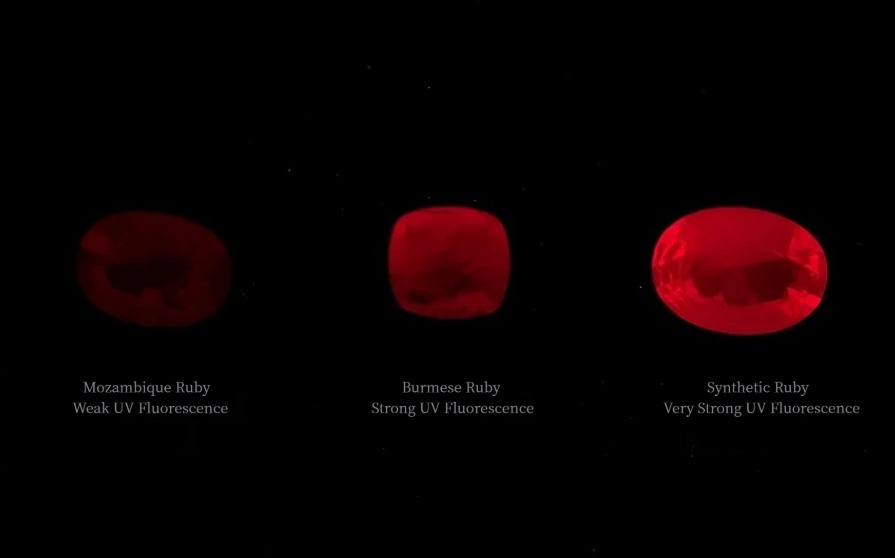
- Flame-fusion synthetic blue sapphire may show pale blue-white or green fluorescence, while most natural blue sapphires are usually inert, meaning they show little or no noticeable fluorescence.
- Natural ruby often contains trace amounts of iron (Fe), so its fluorescence under UV light may appear less vivid or intense than that of some synthetic rubies.
- Natural emerald may also show weaker fluorescence than some synthetic emeralds.
Gemstone fluorescence depends on many factors, including chemical composition, trace elements, geographic origin, growth conditions, and treatment. For this reason, fluorescence patterns can provide supporting evidence, but they do not by themselves establish whether a gemstone is natural or synthetic.
3. Helping Assess Diamonds and Their Simulants
In our previous article, Should You Buy a Diamond Ring With or Without Fluorescence?, we explained that diamond fluorescence can vary widely. Some diamonds show no fluorescence, while others show strong fluorescence. The fluorescence can also appear in different colors. These characteristics can help assess a diamond and, in some cases, may also affect its market value.
A UV light can do more than show the fluorescence intensity of a natural diamond. It can also provide useful clues when you need to assess a piece of jewelry set with many small diamonds and cannot easily determine whether they are natural.
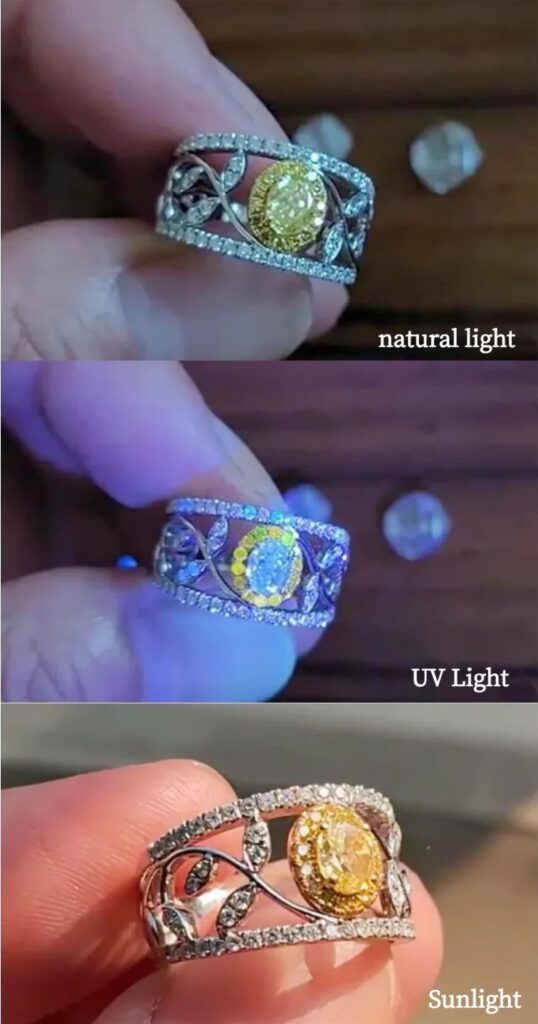
For example, in a natural yellow diamond ring with multiple small diamonds, the fluorescence color and intensity of the small diamonds will usually vary under UV light.
Some diamond simulants, such as Cubic Zirconia (CZ) and yttrium aluminum garnet (YAG), may show more consistent fluorescence.
In addition:
- Natural diamonds with strong blue fluorescence may also show yellow phosphorescence.
- Cubic Zirconia (CZ) may remain inert or show pale yellow fluorescence under long-wave UV.
- Yttrium aluminum garnet (YAG) may show yellow fluorescence.
4. Helping Assess Gemstone Treatments
Some treatments can leave materials that react to UV light. Common examples include:
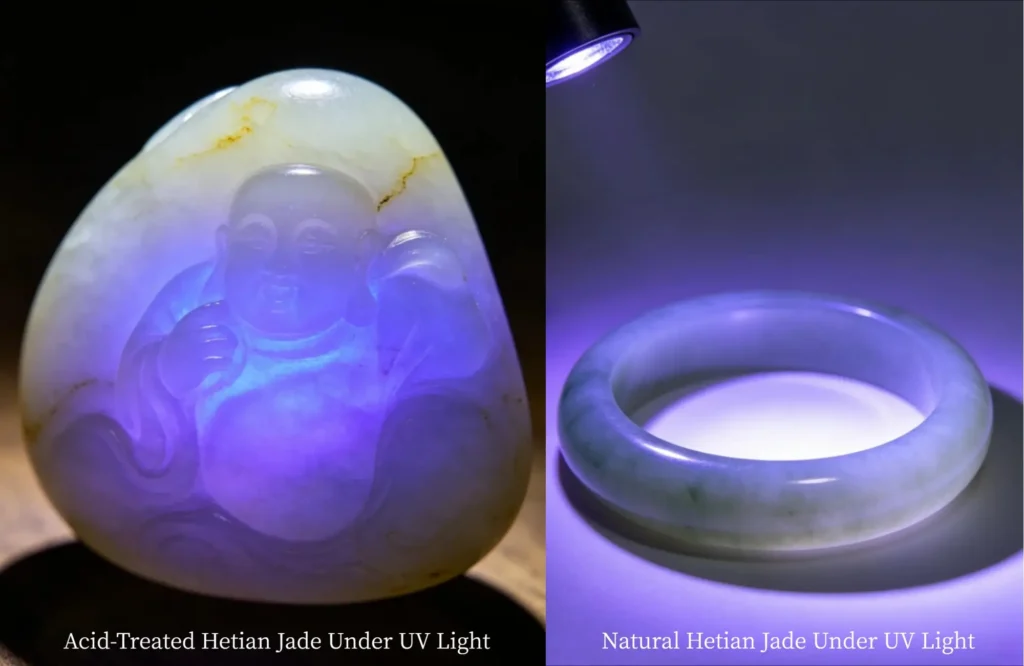
- Some acid-treated Hetian jade may show an intense blue-white or bluish-purple fluorescence under a UV flashlight, with the strongest fluorescence often appearing along fractures.
- Filling materials in some fracture-filled or oil-treated gemstones may fluoresce.
- Filling materials in some glass-filled gemstones may also fluoresce.
- The glue layers in some composite gemstones may produce fluorescence.
If a gemstone shows unusual fluorescence only in certain areas, you can examine those areas more closely. Check whether they correspond to fractures, cavities, glue layers, or other treated areas.
Keep one point in mind:
Fluorescence does not prove that a gemstone has been treated, and the absence of fluorescence does not prove that it is natural. Different materials and treatments can produce very different fluorescence patterns. You still need to consider other test results before reaching a conclusion.
5. Helping Assess Geographic Origin
For some gemstones, fluorescence can also provide clues about their geographic origin.
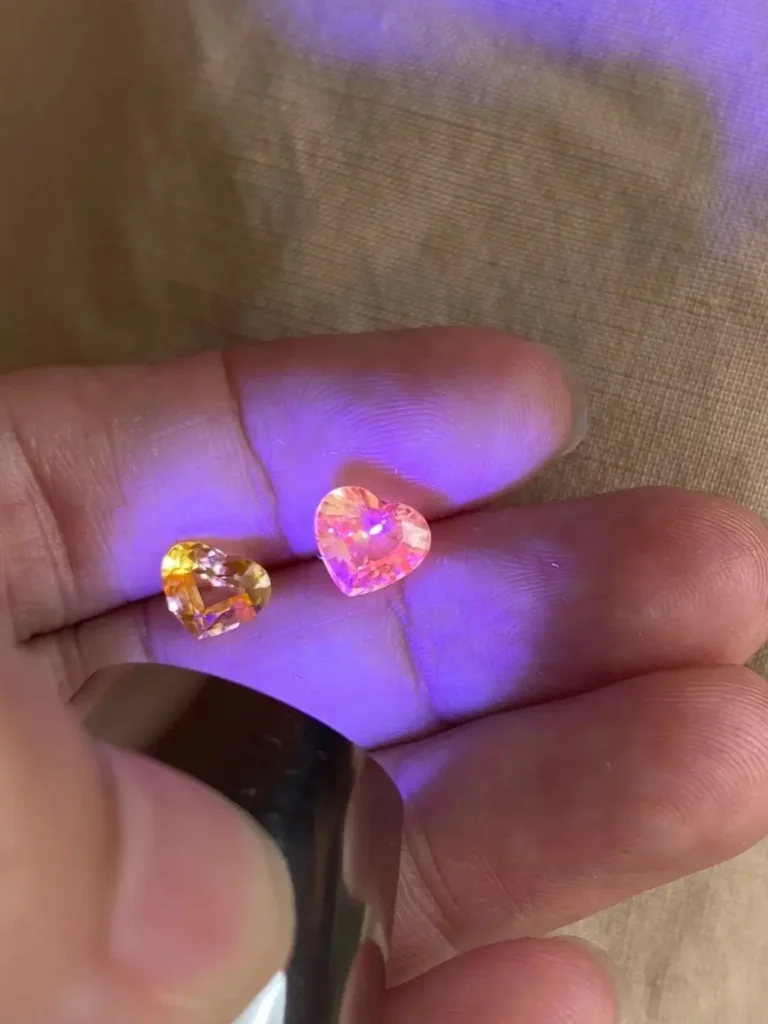
For example, some yellow sapphires from Sri Lanka may show orange-red fluorescence under UV light. while some yellow sapphires from Australia may remain inert.
Important: UV Fluorescence Is Not the Same as Color-Change Effect
This distinction is important.
Some dishonest sellers describe the fluorescence a gemstone shows under UV light as a color-change effect. For example, they may take chrysoberyl or another gemstone that shows a bright color under UV light and market it as the famous Alexandrite.
What Is Gemstone Fluorescence?
Fluorescence is a light-emitting phenomenon that occurs when a gemstone material absorbs high-energy radiation.
When certain gemstone materials absorb UV light, X-rays, or other high-energy radiation, their electrons move to higher energy levels. As the electrons return to lower energy levels, they release energy. Some of that energy appears as visible light.
Once the excitation source is turned off, the visible glow disappears. We call this fluorescence.
In simple terms:
UV light on → the gemstone absorbs UV radiation → the gemstone glows → UV light off → the fluorescence disappears.
What Is the Color-Change Effect?
The color-change effect is a special optical phenomenon in gemstones.
In gemology, it generally refers to a change in a gemstone’s apparent color as the spectral distribution or wavelength of the incoming light changes.
The simplest way to understand it is:
The same gemstone appears in different colors under different light sources.
For example, Alexandrite with a genuine color-change effect may show noticeably different colors under daylight and incandescent light.
Therefore:
Fluorescence under UV light does not mean that a gemstone has a color-change effect.
In our previous article about Alexandrite, we also explained that color-change phenomena include the common photochromic effect as well as the much rarer thermochromic effect.
Not Every UV Light Works for Gemstone Testing
This is an important point that many jewelry enthusiasts overlook. A regular UV flashlight used for checking banknotes is not the same as a UV light designed for gemstone testing.
Ultraviolet light (UV) is electromagnetic radiation with wavelengths of about 10–400 nm. It falls between visible light and X-rays on the electromagnetic spectrum.
UV light has a shorter wavelength than visible light, so the human eye cannot see it directly.
In practical gemstone testing, the most relevant range is generally 200–400 nm.
For practical use and study, this range is usually divided into three bands:
- Short-wave UV (SWUV): 200–280 nm, with 254 nm as the main wavelength.
- Mid-wave UV: 280–315 nm.
- Long-wave UV (LWUV): 315–400 nm, with 365 nm as the main wavelength.
Among these, long-wave UV (LWUV) and short-wave UV (SWUV) are the two wavelengths most commonly used in gemstone testing.
Professional gemstone fluorescence equipment typically uses a UV viewing cabinet or dark chamber. It allows the user to observe fluorescence under both long-wave and short-wave UV.
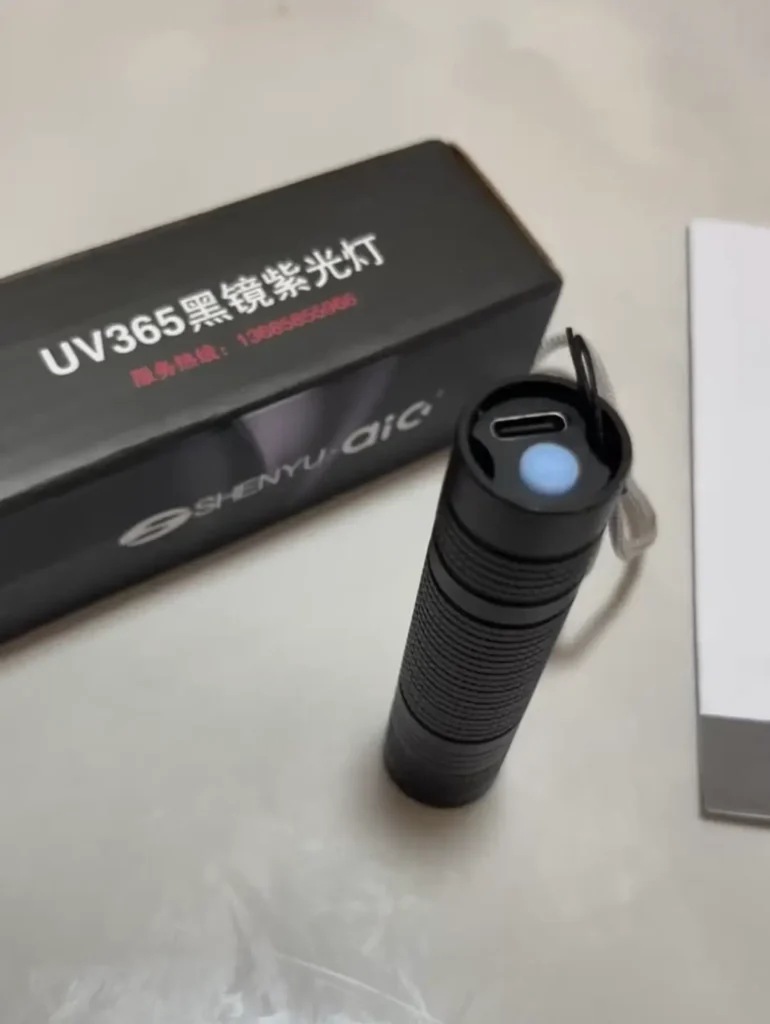
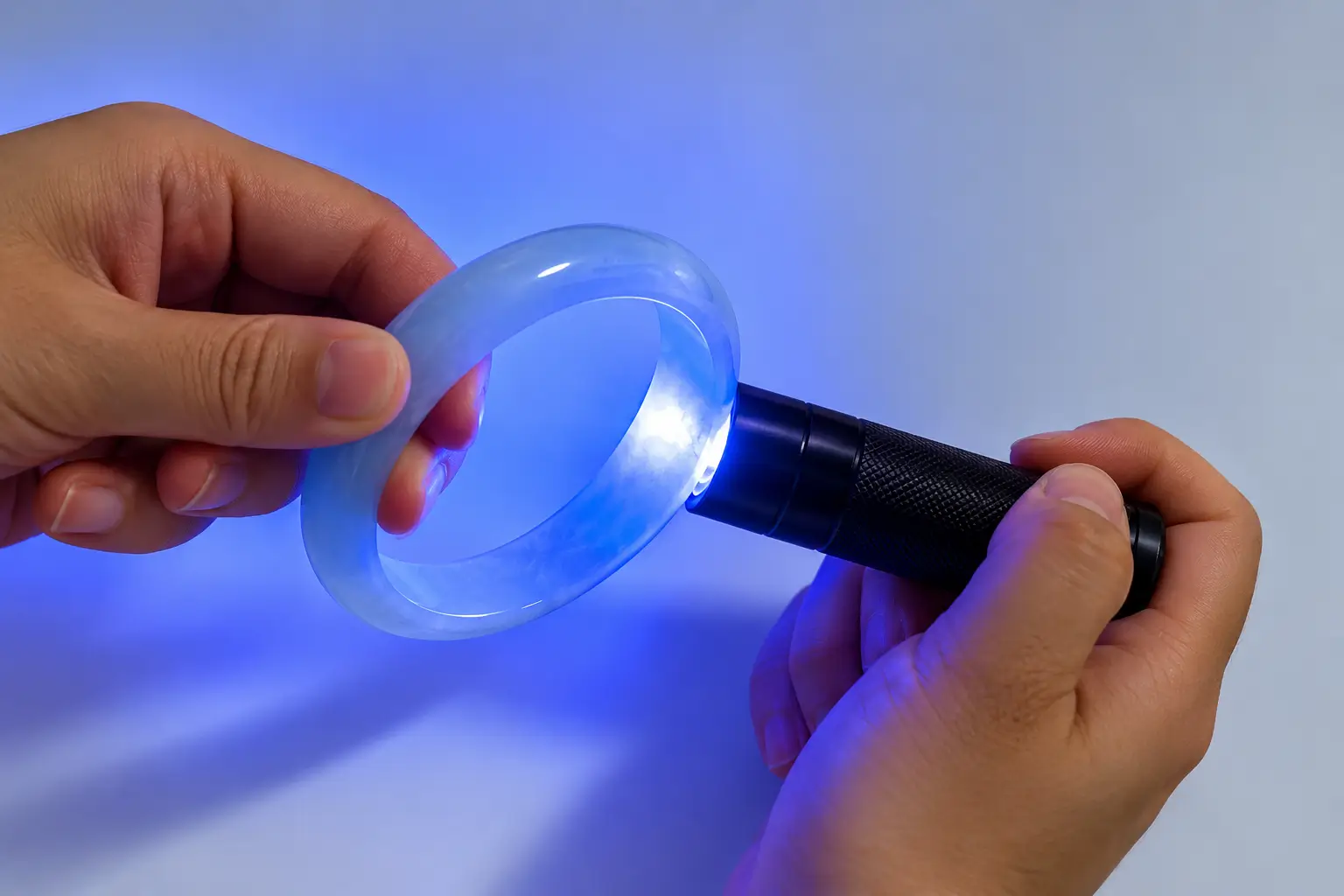
For jewelry enthusiasts, a professional 365 nm long-wave UV flashlight is a practical choice when buying a UV light for gemstone testing.
How to Use a UV Flashlight Correctly
Choosing a UV light with the right wavelength is only the first step.
The viewing environment, background material, working distance, and lighting angle can all affect what you see.
When using a portable UV flashlight, three common issues deserve special attention.
1. Observe in a Dark Environment
You may wonder:
Why do some livestream sellers shine a UV flashlight on a gemstone but fail to show the fluorescence or treatment signs they claim to see?
An inaccurate wavelength can cause problems. But another common reason is much simpler:
The environment is too bright, with too much surrounding light.
Gemstone fluorescence may not appear very strong. Bright ambient light can easily overpower a weak glow, making it difficult for the eye to see even when the gemstone does fluoresce.
This matters even more when a gemstone has only a small amount of localized glue filling or other filling from processing. The resulting fluorescence may be very weak and only become visible in a darker environment.
When using a portable UV flashlight, try to work in one of these conditions:
- A room with the lights turned off.
- A dark area away from direct light.
- Any other setting that minimizes ambient light.
If you do not have a professional viewing cabinet, you can also use your hand to create a small shaded area over the jewelry you want to examine. Then shine the UV light into that area.
This simple method can significantly reduce interference from ambient light.
2. Avoid Strongly Fluorescent Background Materials
Do not place the gemstone directly on materials that fluoresce strongly, such as:
- White fabric
- A4 paper
- White tissue or napkins
These background materials may produce a strong glow under UV light. They can interfere with the gemstone’s fluorescence and may even overpower it.
Some livestream sellers may show this kind of setup: For example, a seller may place suspected B-jadeite on white velvet and shine a UV flashlight on it in a brightly lit livestreaming environment. The seller may then claim that the jadeite is natural simply because they see no obvious fluorescence.
For beginners who do not know how to use a UV flashlight correctly, this setup can easily lead to a misleading result.
3. Keep the UV Light Close to the Test Object
If you hold the flashlight too far from the gemstone or use a beam that is too wide, less UV light may reach the gemstone’s surface effectively.
For example, when testing a jadeite bangle, the flashlight must actually point at the bangle. If the beam falls beside it instead, you may not see the fluorescence even if the bangle does fluoresce.
You do not need to press the flashlight against the gemstone. Keep it at a reasonable distance and make sure the UV beam covers the area you want to examine.
JEWEA Conclusion
A UV light is a useful tool for gemstone testing, but it is not a magic flashlight that can tell you whether a gemstone is real with a single beam.
Effective Gemstone UV Light Testing depends on at least three things:
The right wavelength + the right viewing environment + the right technique.
Most importantly:
UV fluorescence should only serve as supporting evidence in gemstone testing.