Coral Jade: Understanding Fossil Coral and Silicified Coral
In our previous article, Deciphering the Big Three: The World of Aka Red Coral, Momo, and Sardinia, we introduced coral and some of its well-known varieties.
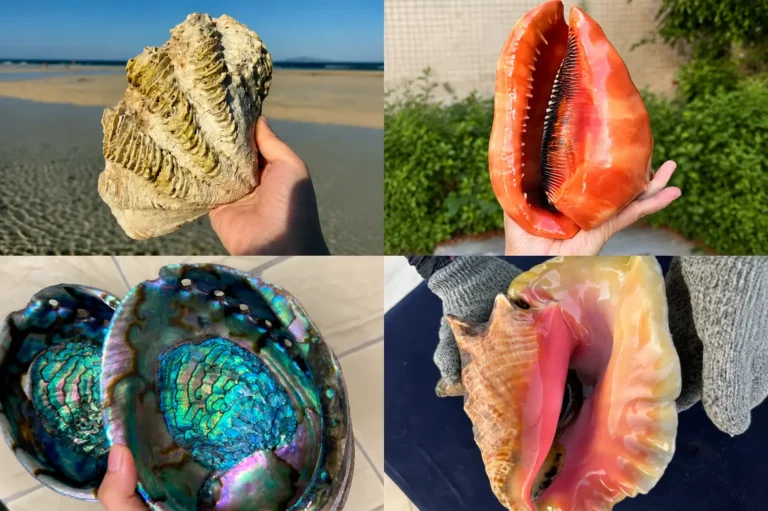
Coral is an organic gemstone used in jewelry and decorative pieces. But under geological conditions, its skeletal structure can also give rise to another type of natural material.
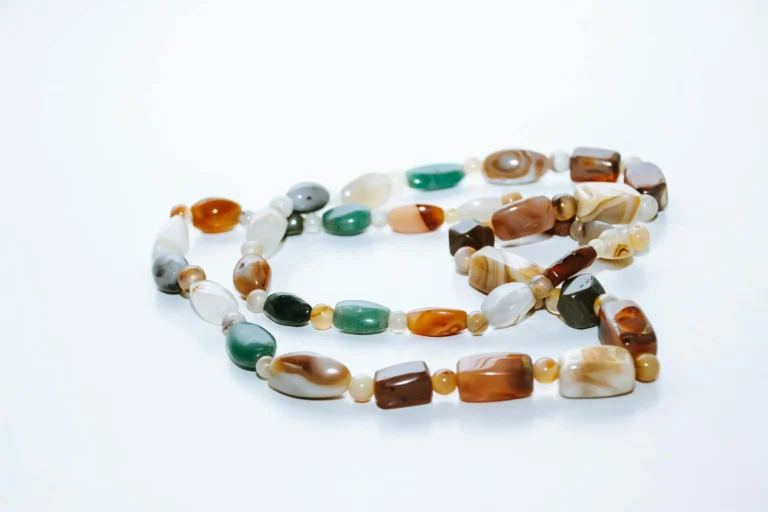
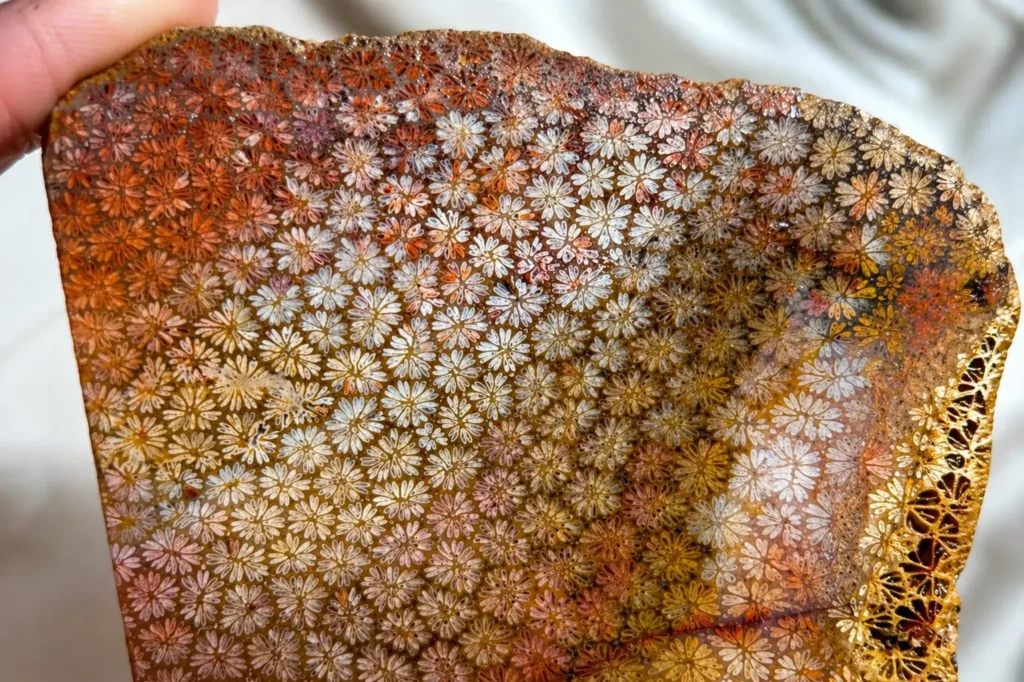
Over long periods of burial and geological change, the calcareous skeletons of ancient corals can undergo fossilization, mineral replacement, or mineral infilling. These processes can preserve the original coral structure while altering its mineral composition, resulting in fossil coral. In the market, people sometimes call these coral-structured materials “Coral Jade.”
So, what geological changes turn coral skeletons into Coral Jade? How does Coral Jade relate to coral? And how do different mineral compositions affect the gemological properties of fossil coral materials? Let’s take a closer look.
What Is the Relationship Between Coral Jade and Coral?
Coral Jade is not jadeite or nephrite. The market also uses names such as Chrysanthemum Jade and Silicified Coral. These trade names do not follow a single, consistent naming system. Similar materials occur in Indonesia, Taiwan, and parts of mainland China, including Guangyuan in Sichuan, Ningqiang in Shaanxi, and Xinjiang.
Geologically, Coral Jade has a direct connection to coral.
The original material comes from the calcareous skeletons of ancient corals. Over long periods of burial and geological change, the coral skeleton can undergo mineral replacement, recrystallization, or mineral infilling. These processes can preserve the original coral structure and turn it into fossilized material.
In simple terms:
The original coral skeleton provides the structural framework, while geological processes alter and preserve that framework over time.
However, the “Coral Jade” sold in today’s jewelry market is not the same material as coral itself.
Natural coral is an organic gemstone. Its skeleton consists mainly of calcium carbonate and other components, and it retains a structure produced by living organisms. During fossilization, however, coral can undergo significant mineral changes. Mineral replacement and other geological processes can alter the final composition, sometimes making it quite different from the original coral.
So, Coral Jade comes from coral, but it is not an organic gemstone. It can preserve the structure of the original coral without necessarily retaining its original chemical composition.
Not All Coral Jade Has the Same Mineral Composition
“Coral Jade” is not a single mineral species.
During fossilization, coral can undergo different degrees of mineral replacement, recrystallization, and infilling. As a result, the material that forms can have very different mineral compositions.
Some fossil coral materials are dominated by silica-based minerals and may be described as silicified coral. Others may retain a significant amount of carbonate minerals.
For this reason, the trade name “Coral Jade” alone cannot tell you the exact mineral composition of a material.
This distinction can also affect its hardness, density, durability, and suitability for different uses.
Silicified Coral
Silicified coral forms when silica-rich minerals replace or fill the original coral skeleton during fossilization.
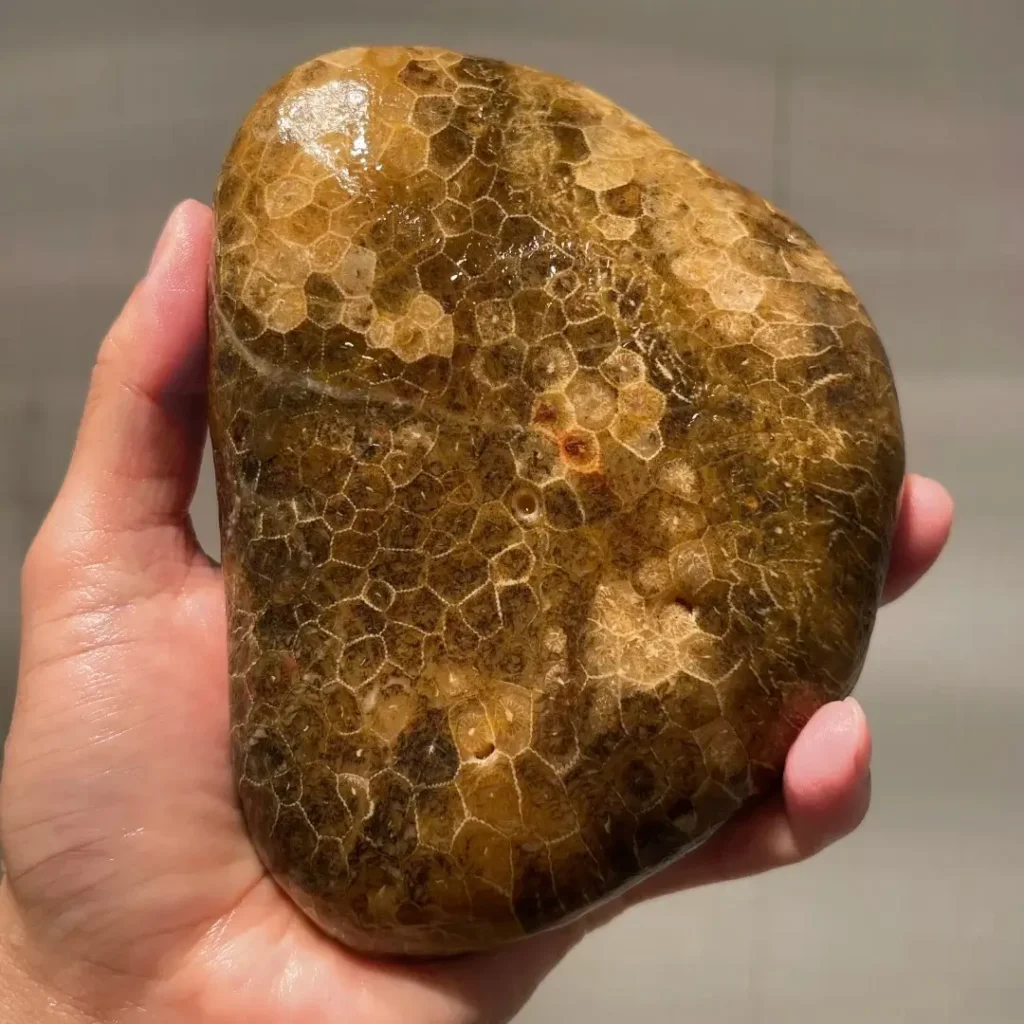
It typically consists mainly of quartz and microcrystalline or cryptocrystalline silica, which may occur as fine-grained aggregates.
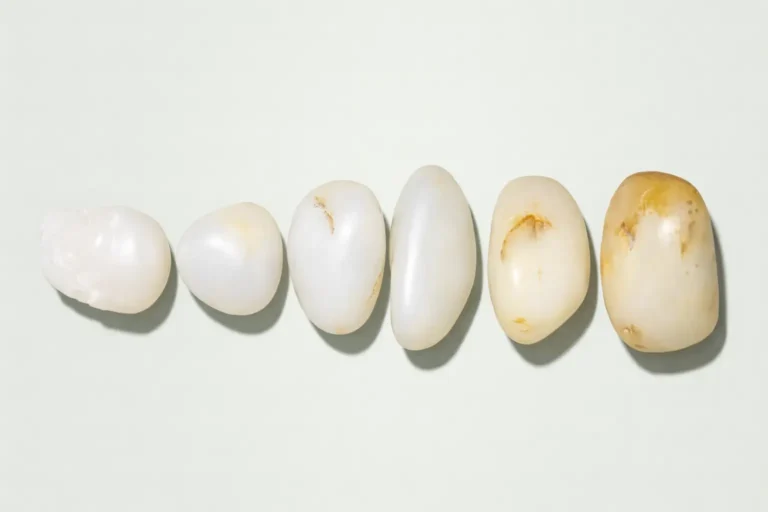
Silicified coral can show a wide range of colors. Common shades include white, yellowish white, grayish white, reddish brown, and brown. The final color may vary with the original coral structure, later mineral replacement, and trace elements.
In China, silicified coral is recognized within the quartzose jade classification under GB/T 34098-2017, Quartzose Jade—Classification and Nomenclature.
Typical silicified coral dominated by silica-based minerals generally shows gemological properties similar to those of other quartz-rich materials. However, the hardness, density, and refractive index of individual specimens can vary with their mineral composition, porosity, preservation of the original structure, and the presence of other infilling materials. These variations mean that no single set of values should be treated as fixed parameters for all Coral Jade.
A typical silicified coral specimen may have a refractive index of about 1.53–1.54. Its hardness is generally higher than that of natural coral.
Because silicified coral is generally harder and more resistant to wear than natural coral, specimens that retain a clear coral structure are commonly used to make jewelry and decorative pieces.
Keep in mind that individual specimens can vary significantly in both structure and mineral composition. Recrystallization does not necessarily change the mineral composition, whereas mineral replacement can alter the original composition. For a specific piece, testing remains the most reliable way to determine its actual properties and composition.
Carbonate-Rich Fossil Coral Materials
Unlike silicified coral, some fossil coral materials remain dominated by carbonate minerals after fossilization. In some cases, the original carbonate minerals may also undergo recrystallization.
Some specimens consist mainly of calcite.
These materials can retain a clear coral structure. However, calcite is significantly softer than quartz, so these materials generally have lower wear resistance than silica-rich materials.
For this reason, you cannot determine whether a material sold as “Coral Jade” belongs to the quartzose jade category based on its trade name alone. You also cannot judge its hardness or durability simply by looking at its coral patterns.
The material’s actual mineral composition is an important factor in determining its physical properties.
If durability or material properties matter when you buy Coral Jade jewelry, it is best to check the specific material or gemological testing information rather than rely on the trade name alone.
What Structures and Patterns Are Typical of Coral Jade?
Quartzose jade includes a range of different materials. In some cases, color and overall appearance alone are not enough to distinguish one variety from another.
Fossil coral materials have one feature that sets them apart:
They can preserve the original growth structure of the coral skeleton.
For this reason, coral structures and patterns can provide useful clues when identifying these materials, rather than relying on color and overall appearance alone.
Different corals grow in different ways. After fossilization, they can also develop different patterns as geological processes alter the original structure.
Common patterns include:
- Radial structures
- Concentric radial structures
- Peacock-tail patterns
- Other textures that preserve features of the original coral skeleton
These patterns reflect the coral’s original growth form, as well as the later processes of mineral replacement, recrystallization, and infilling.
Because these patterns can vary so widely, the jewelry market has developed many descriptive names for them over time.
Keep in mind that appearance and surface patterns provide clues, but they cannot by themselves determine mineral composition or establish whether a material is natural. Identifying a specific specimen requires a combination of microscopic examination, physical property testing, and, when necessary, laboratory analysis.
Common Coral Jade Patterns
The names below are mainly trade descriptions and informal terms used by consumers. They are not standardized gemological classifications. When buying Coral Jade, focus on the actual material and available testing information rather than using a pattern name to judge its mineral composition or value.
Chrysanthemum Pattern (Daisy Pattern)
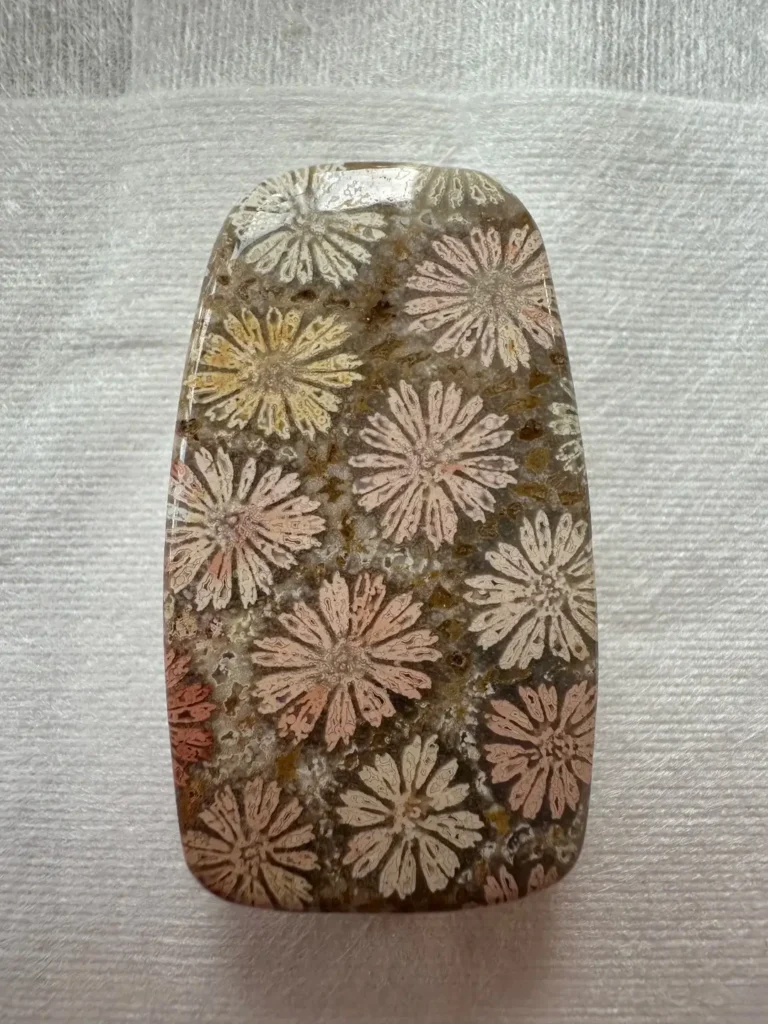
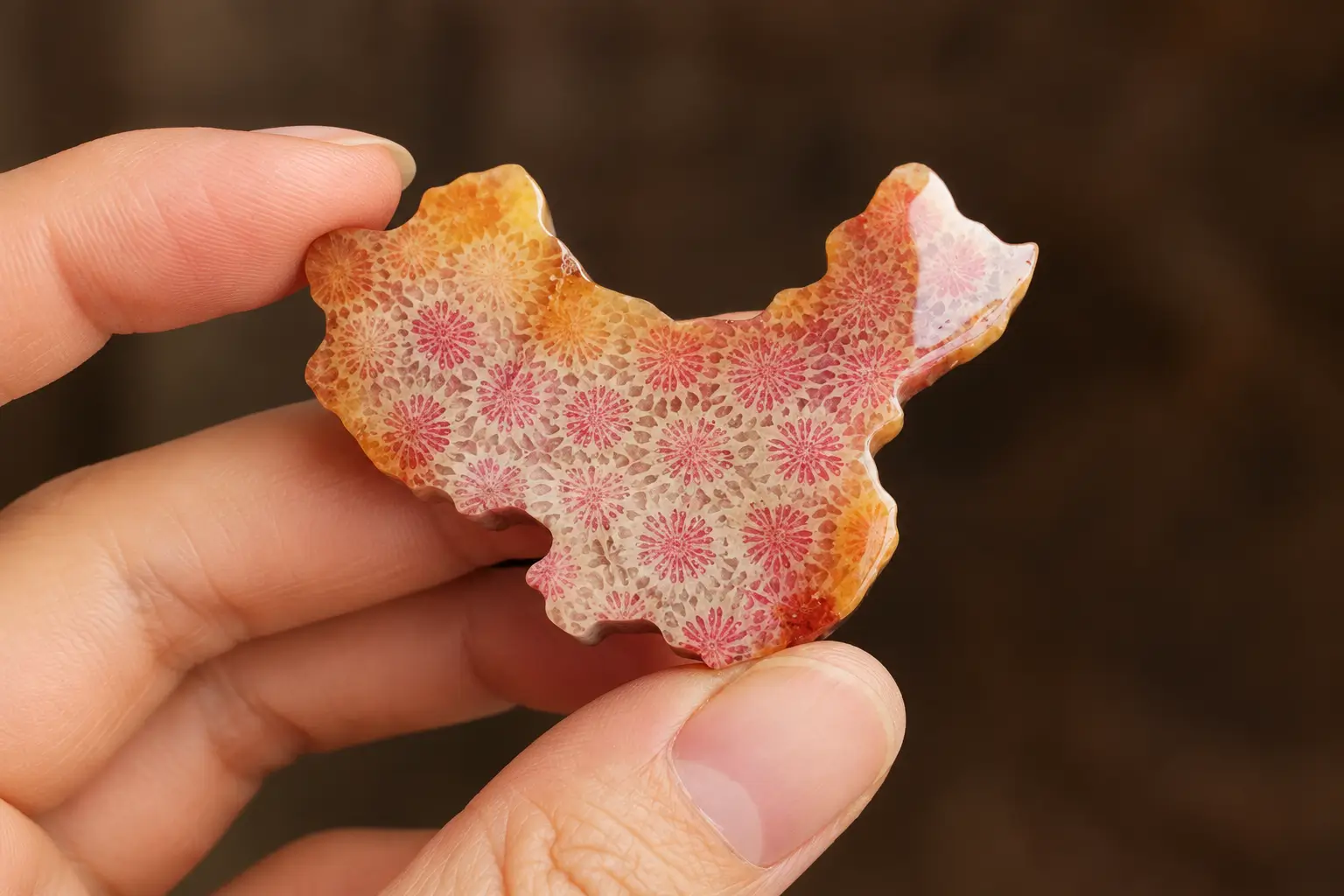
The pattern radiates outward from a central point. It can resemble a blooming chrysanthemum or daisy.
This is also one of the more recognizable fossil coral patterns among consumers.
Lemon-Slice Pattern
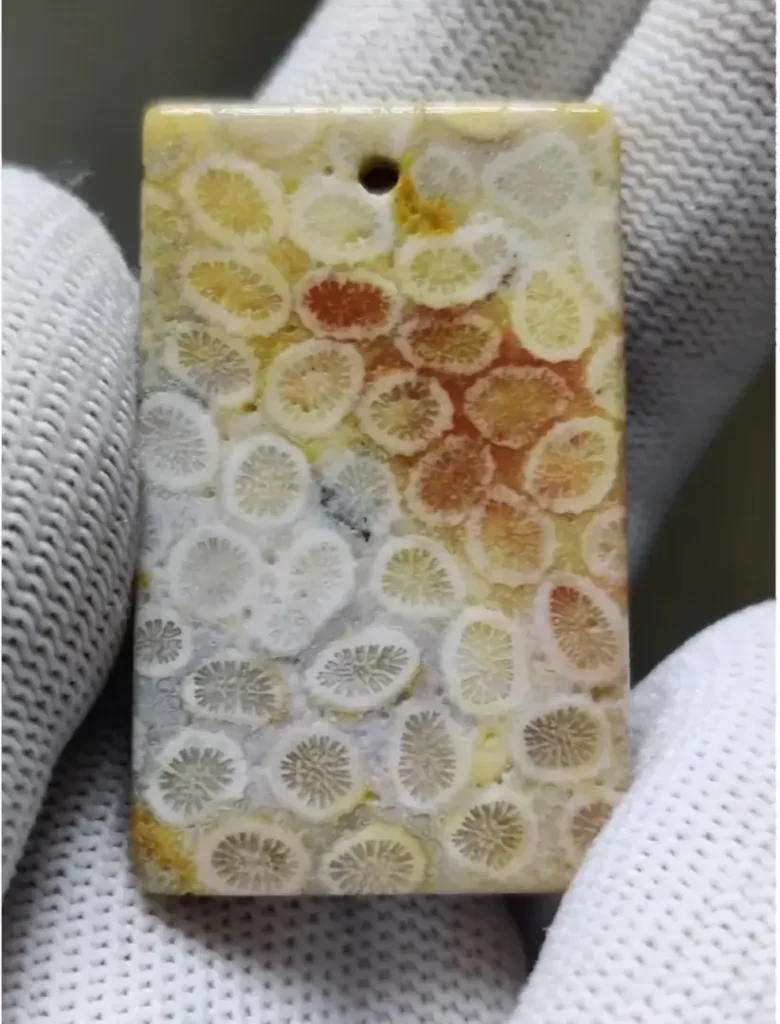
The pattern creates a visual effect similar to a sliced lemon or a round cross-section. The internal structure is often clearly visible.
Insect-Like Pattern
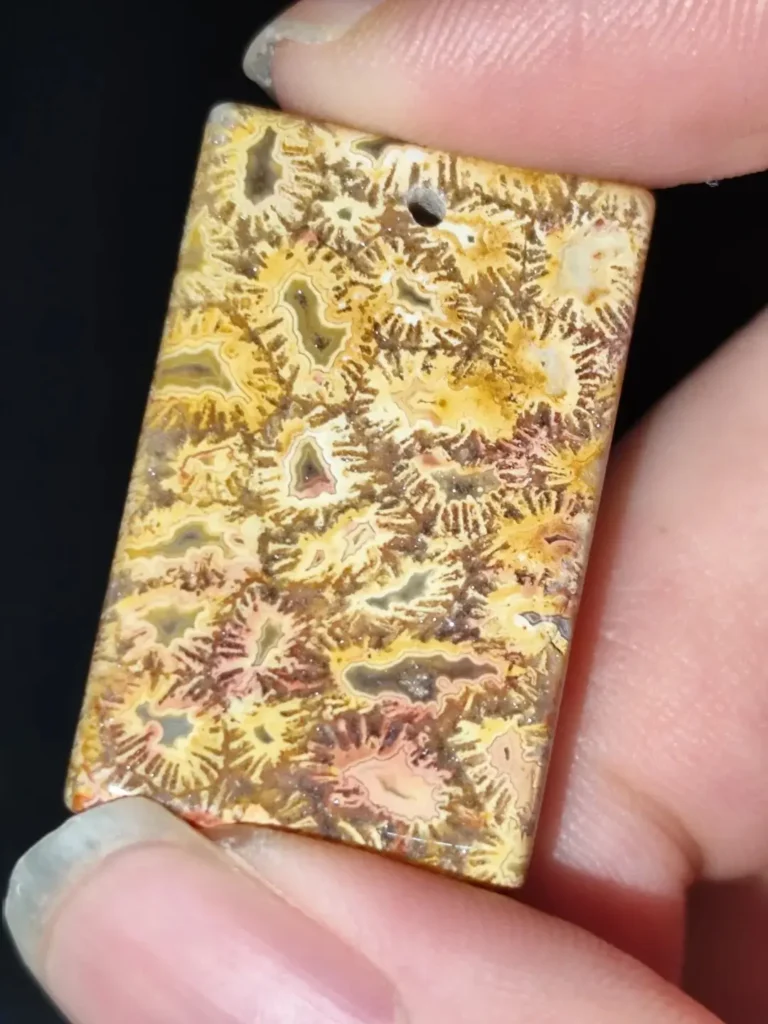
The pattern can resemble small insects or other tiny creatures. Some forms are elongated and worm-like, while others appear shorter, rounded, or irregular.
The name is purely descriptive and refers to the appearance of the pattern, not to its geological origin.
Phoenix-Feather Pattern
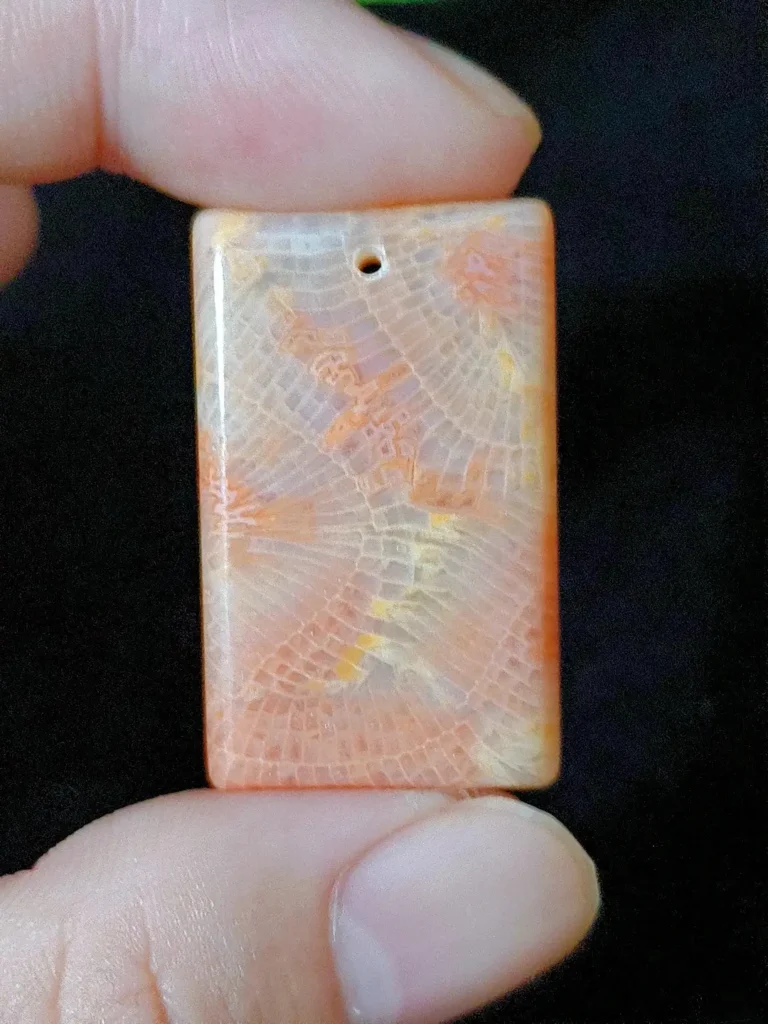
The pattern features fine, flowing lines that resemble the feathers of a phoenix.
It can form an intricate, layered texture, with noticeable variations from one specimen to another.
Colorful Pattern
In some Chinese markets, names such as “Colorful Zambi” are used for certain combinations of color and pattern. These names are commercial or descriptive terms rather than standardized gemological classifications.
Is Coral Jade Jewelry Suitable for Everyday Wear?
If the material consists mainly of silica-based minerals, as in silicified coral, it is generally much harder and more resistant to wear than natural coral. It is therefore usually better suited to everyday wear than natural coral.
That does not mean it requires no care.
Fossil coral remains a natural geological material. Its durability also depends on its internal structure, fractures, cavities, how it has been cut and finished, and the design of the setting.
For everyday wear, avoid:
- Strong impacts
- Prolonged contact with strong acids or alkalis
- Unnecessary exposure to chemicals
- Long-term rubbing against significantly harder gemstones
Take extra care with materials that have fragile structures or natural fractures.
So rather than saying that “Coral Jade needs no care,” it is more accurate to say:
Silicified coral is generally more resistant to everyday wear than natural coral, but it still needs basic jewelry care.
Jewea Summary
Coral Jade is a fascinating natural material.
It has a direct geological connection to coral, but it is no longer coral itself.
Its appeal lies in its natural structures, varied patterns, and distinctive geological story.
For people who appreciate natural materials and unusual patterns, Coral Jade offers another way to look at jewelry:
We see more than color and pattern. We see a biological structure preserved in stone through geological time.