Sunstone Jewelry: Material Honesty in Light, Structure, and Design
In the crowded world of fine jewelry, Sunstone does not belong to the category of “power gemstones.”
It does not carry the structured hierarchy of diamonds defined by carat and clarity. It also lacks the long-standing symbolic weight of rubies and sapphires, which have been tied to royalty and religion for centuries. Instead, sunstone feels more like a de-institutionalized mineral expression. It does not rely on myth or legacy. It lets light do the storytelling.
In Jewea’s design language, we describe this quality as:
Material Honesty
Sunstone does not hide how it forms. Its beauty is not constructed or refined into perfection. It is activated by light.
Sunstone Is Not Quartz: A Feldspar That Captures Light
In handcrafted jewelry, sunstone jewelry is often mistaken for something more familiar at first glance. Many people assume it is a type of glitter-infused crystal.
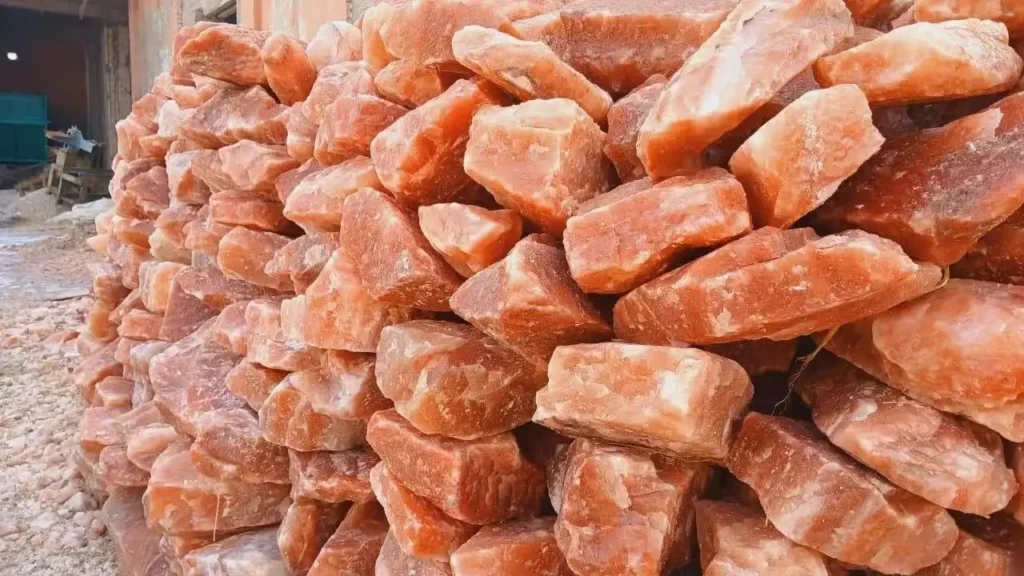
But in mineralogical terms, its identity is very precise:
- Mineral family: Feldspar group
- Crystal system: A variety within the plagioclase feldspar series
- Core composition: A framework silicate made of sodium, calcium, and aluminum silicates
It is not “clear crystal with added shimmer.” Instead, it is a mineral system where the crystal structure itself takes part in the optical effect.
The sparkle you see is not decoration. It is part of how the stone is built.
The True Origin of Aventurescence in Sunstone Jewelry
Aventurescence is the most distinctive optical effect found in sunstone jewelry.
This effect does not come from surface reflection. It comes from inside the crystal structure itself.
Tiny inclusions create this phenomenon, mainly:
- Fine hematite particles
- Or goethite
- Sometimes thin plate-like mica minerals
These plate-like inclusions align within the feldspar crystal. When light enters the stone, it reflects selectively at different angles. This creates a shimmering effect that looks like flowing metallic sand.
From a visual standpoint, it behaves less like decoration and more like a structured optical system frozen inside the crystal.
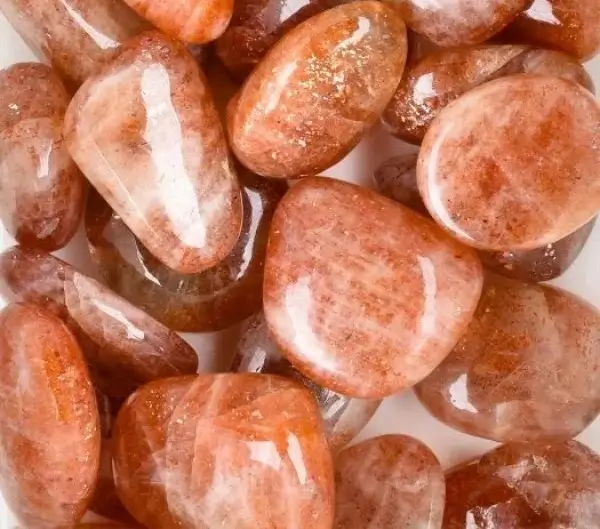
It is not glitter. It is not surface sparkle.
Instead, it forms a directional light pattern locked inside the mineral itself.
Five Visual Types of Sunstone Jewelry (Not a Single Gemstone)
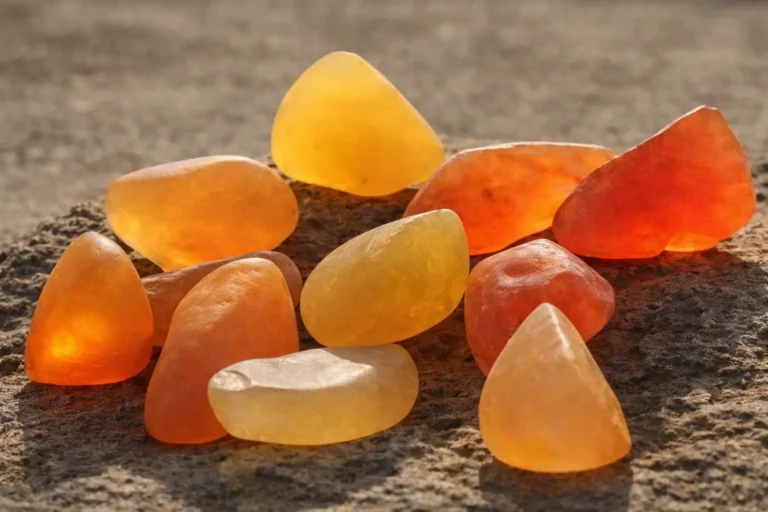
In commercial use and design practice, sunstone jewelry is not a single category. It works more like a spectrum of optical expressions.
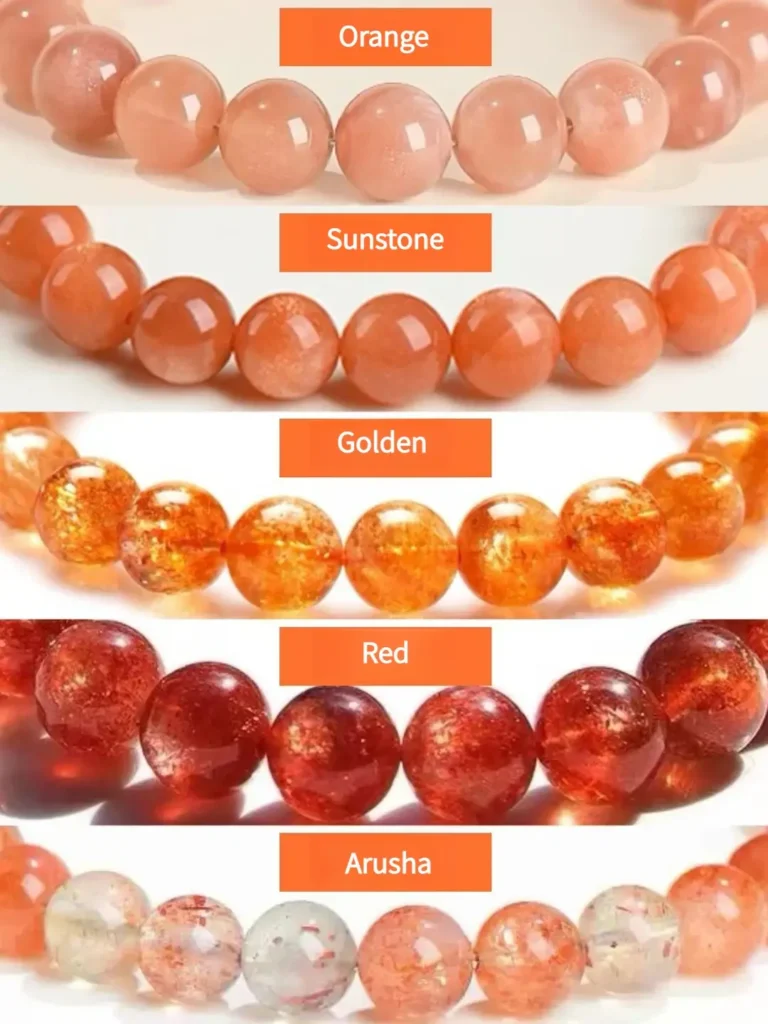
At Jewea, we treat it as five distinct visual types:
1|Orange Moonstone
Light orange or soft apricot tones.
The aventurescence is subtle and less intense.
This type highlights the soft glow of feldspar itself. It feels like a low-saturation daylight filter.
2|Classic Sunstone
Orange to warm orange-yellow tones.
The aventurescence is clearly visible.
This is the most recognizable form. It shows a distinct “sparkle-in-motion” effect created by internal light points.
3|Golden Sunstone
Deeper tones ranging from golden orange to amber gold.
The internal plate-like inclusions are denser.
The light effect appears more dynamic. It often flashes in a flame-like pattern when the stone moves.
4|Red Sunstone
A red-orange color family.
Some high-grade stones show deeper tones close to spinel red.
This type carries stronger visual intensity and more saturated light response.
5|Arusha Sunstone
A composite mineral from the Arusha region of Tanzania.
It is not just “sunstone.” It is a multi-mineral system:
- Feldspar base (sunstone / strawberry feldspar)
- Beryl inclusions in some formations
- Mixed color expression of orange, red, and green
Its uniqueness comes from one key fact:
It is not a single mineral. It is the frozen result of a multi-phase geological process.
The Source of Light: Geological Origins of Sunstone Jewelry
The value differences in sunstone jewelry come directly from differences in geological formation systems.
Beyond the major signature sources described below, high-quality sunstone also occurs in India, Canada, and parts of China, where deposits continue to produce material suitable for fine jewelry use.
1|Tvedestrand, Norway
A classic high-grade source.
This region produces stones with extremely fine hematite plate inclusions. The aventurescence appears strong, consistent, and evenly distributed.
The color usually ranges from reddish-orange to deep amber tones.
2|Kola Peninsula, Russia
These stones form within alkaline igneous rock.
The crystal structure is denser, and the color tends to be darker.
They show a clear contrast between low transparency and strong sparkling points.
3|Oregon, USA (Oregon Sunstone)
One of the most design-relevant sources, and also the official state gemstone.
Its uniqueness comes from several factors:
- It contains natural copper inclusions
- It shows a wide color range (colorless → pink → green → red)
- It has high transparency, allowing internal structures to remain visible
From a design perspective, it behaves more like:
A naturally tunable optical material
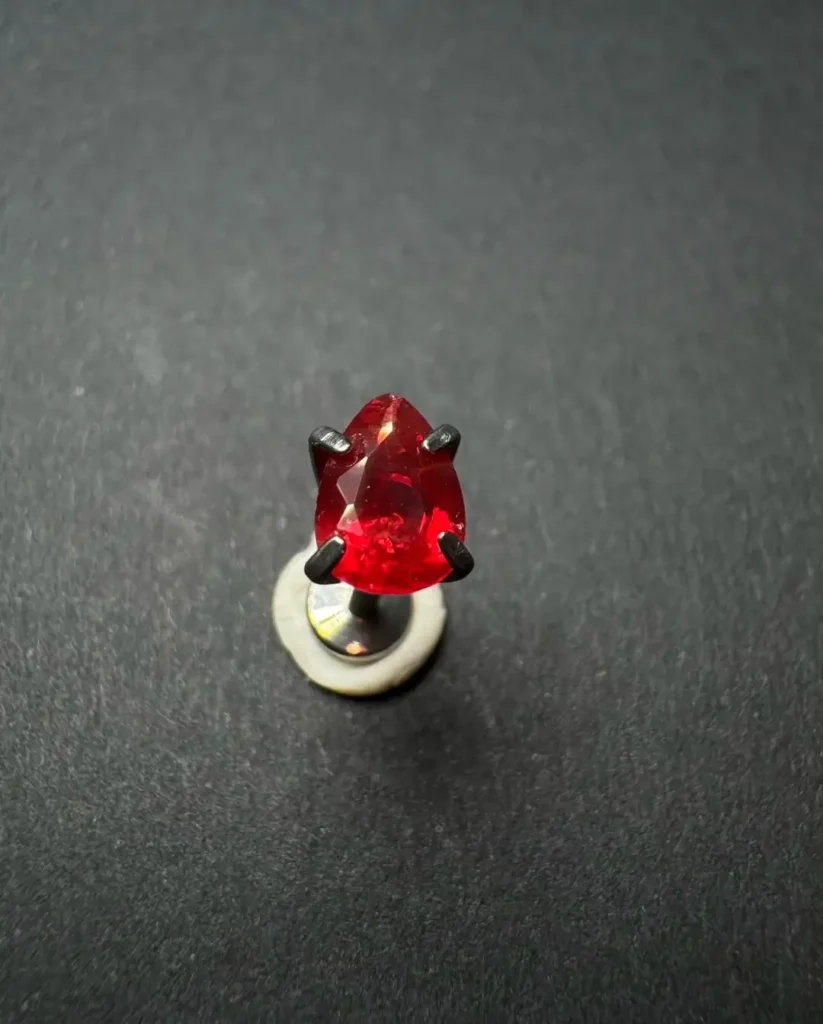
Red Oregon Sunstone can also show a rich, ruby-like red, making it an interesting alternative to ruby. For a closer look at how it compares with ruby, see 3 Lesser-Known Alternatives to Ruby.
Jewea Design Context: How Sunstone Becomes a Necklace
In this Jewea piece, sunstone does not stand alone as a central object. We treat it as a structural light source within the design.
We understand it as:
A mineral unit that carries emotional brightness.
✦ Main Structure: Sunstone × Feldspar Light Chain
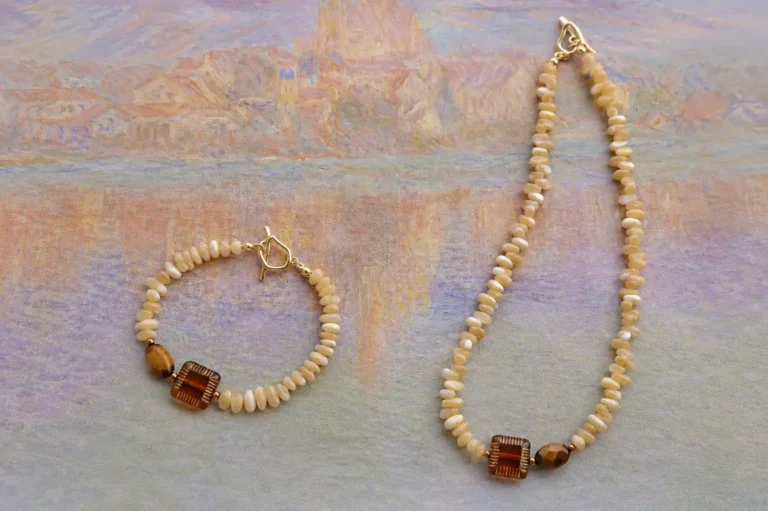
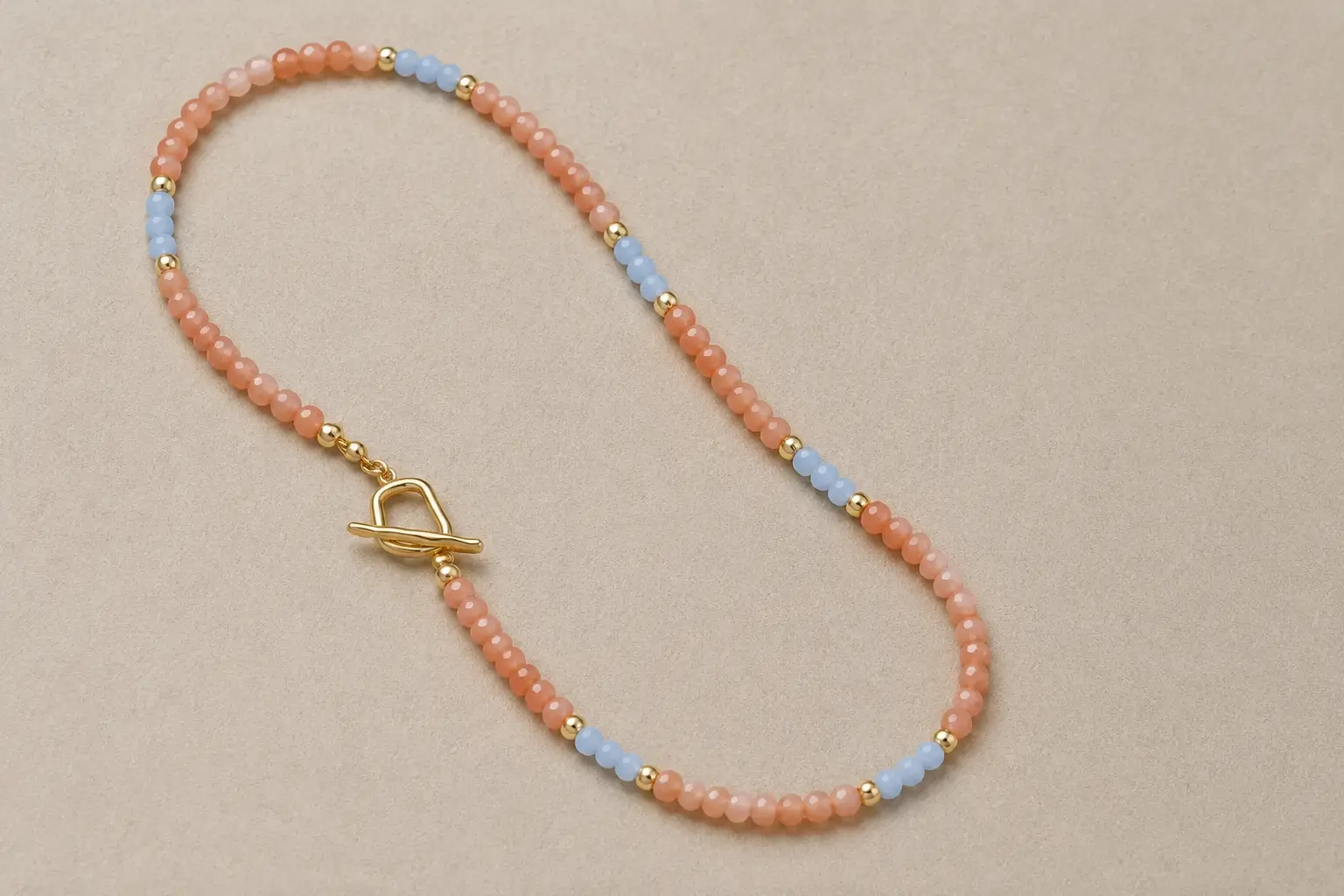
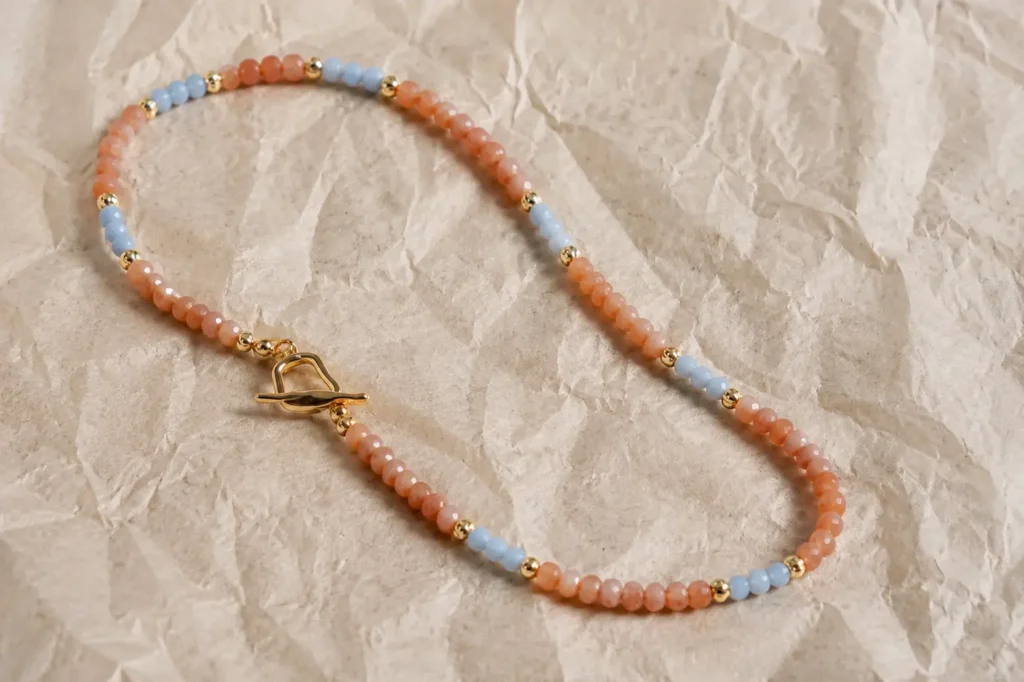
We build our sunstone necklace around a fine chain of warm orange sunstone beads.
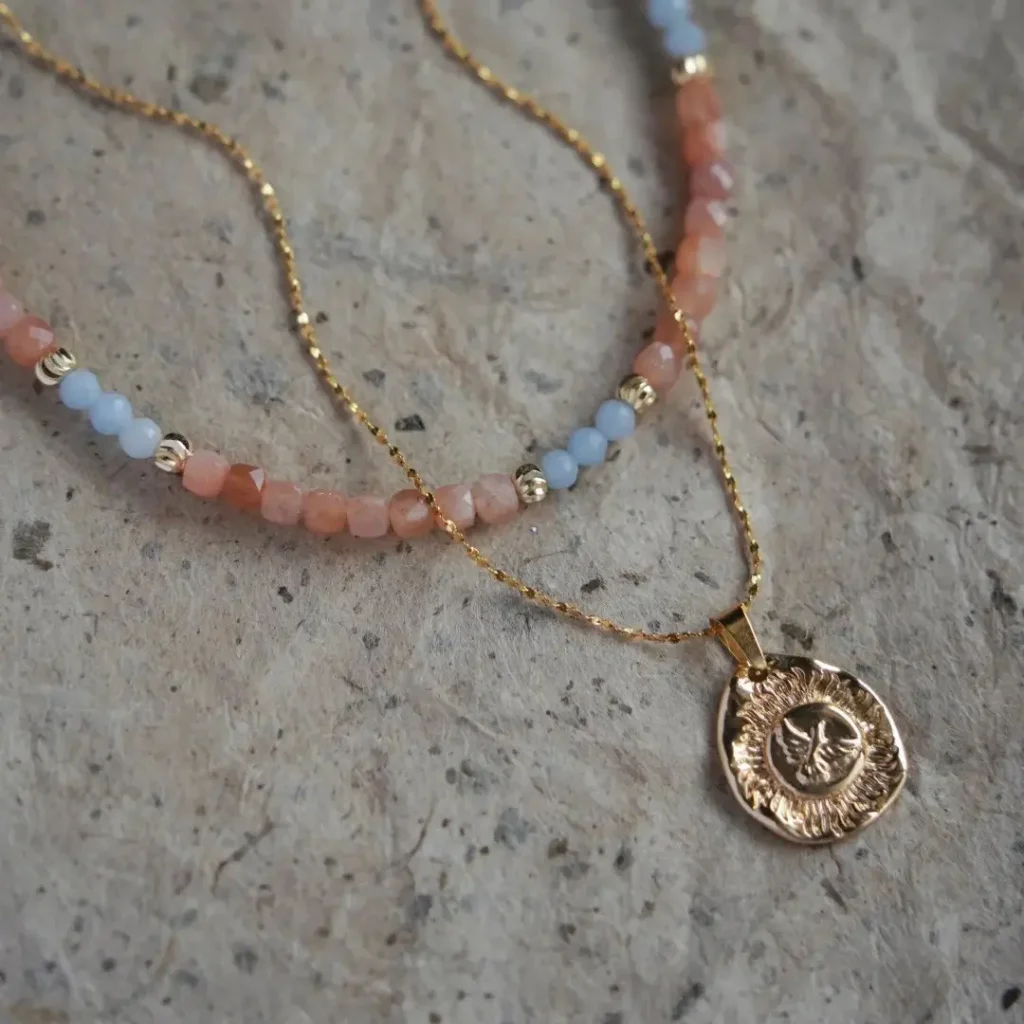
Its role is not to add volume. It creates a continuous rhythm of micro-light.
These light points do not follow a strict pattern. They stay slightly irregular. That randomness comes from the natural structure of feldspar. It is also what makes the material visually alive.
✦ Introducing Contrast: Angel Blue Chalcedony
If sunstone releases light, angel blue chalcedony slows it down.
We avoid strong color clashes. Instead, we work with controlled contrast:
- Small accents of soft blue placed at intervals
- Embedded between warm orange beads
- Visual spacing that keeps the composition breathable
This creates a balanced color rhythm rather than tension or conflict.
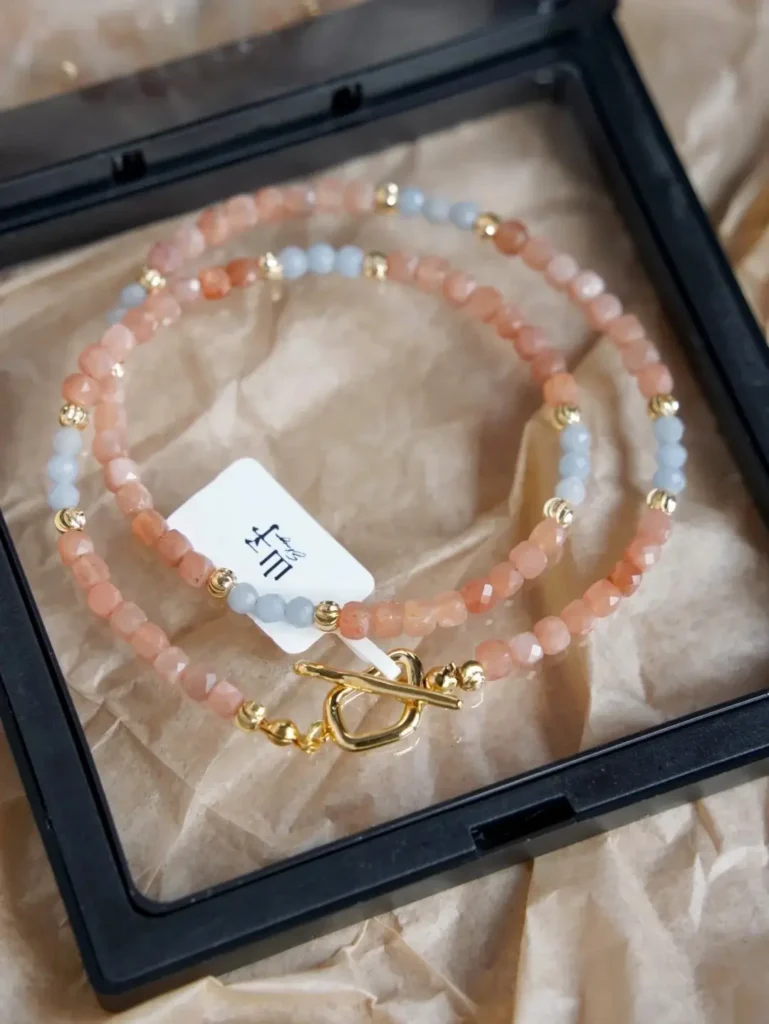
In color terms, it reads as:
Orange (heat energy) + Blue (cooling system)
A controlled complement, not a collision.
✦ Secondary Layer: Vintage Metal Pendant
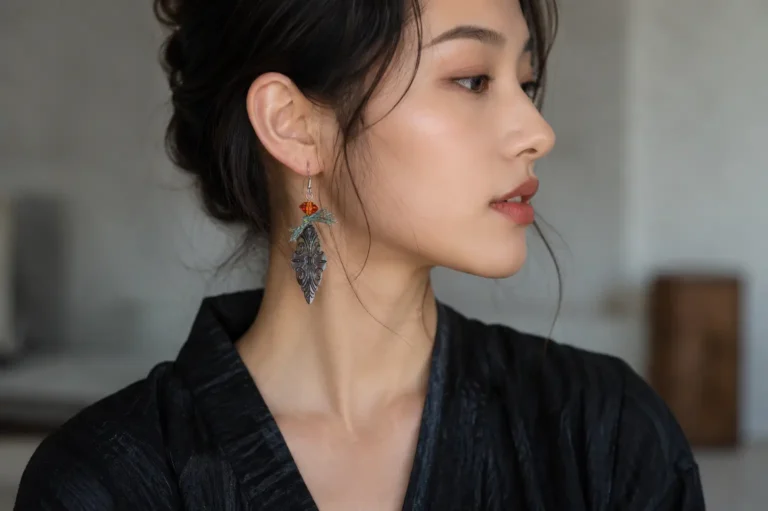
We add a fine gold-toned titanium steel chain below the main strand, finished with a hand-cast bird relief coin pendant.
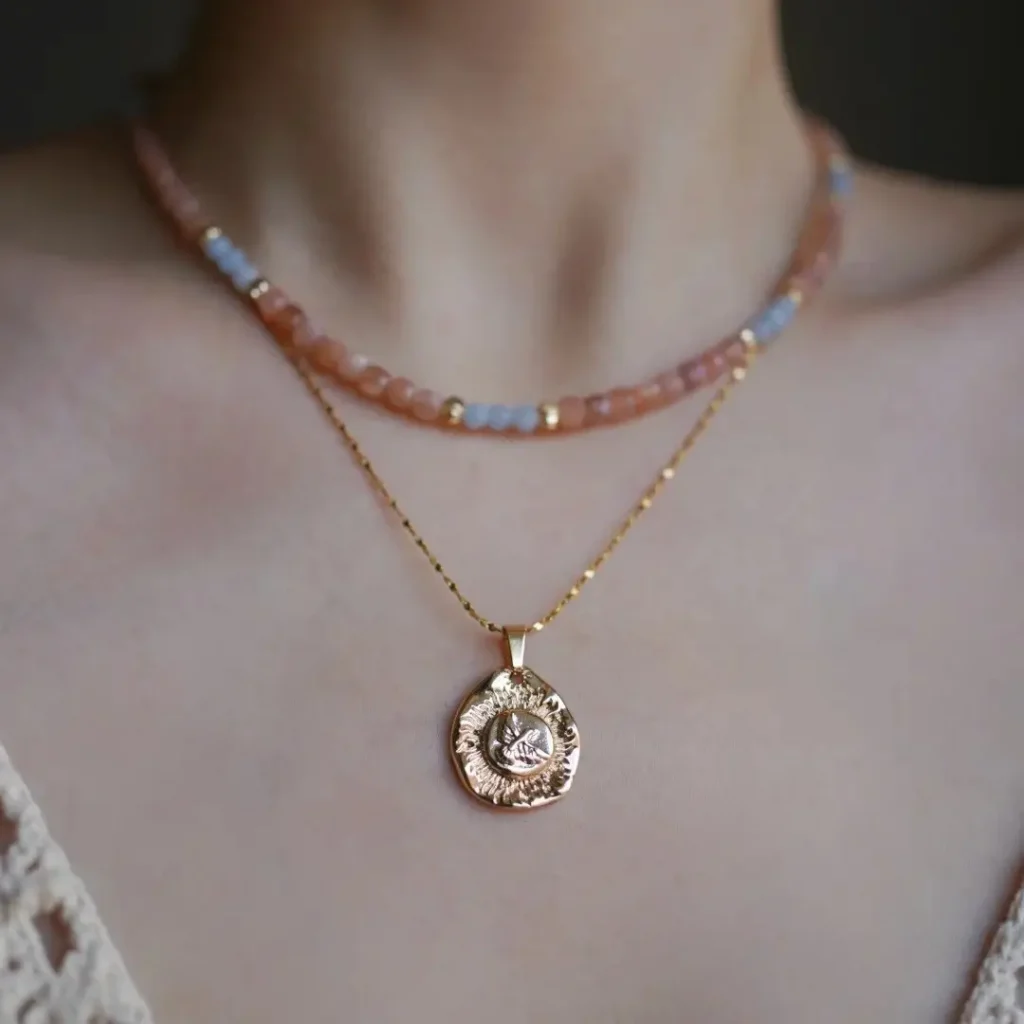
Here, decoration is not the point. We focus on material repetition.
- The coin carries a granular metal texture
- It echoes the hematite-like sparkle inside sunstone
- It builds a dual system of mineral light and metal light
In other words:
Light from geology and light from human craft meet on the same visual plane.
How to Identify Genuine Sunstone Jewelry
Although sunstone is a niche semi-precious gemstone, the market still contains many imitations made from low-grade glass or synthetic aventurescence materials. Below are two practical ways to evaluate authenticity in everyday use.
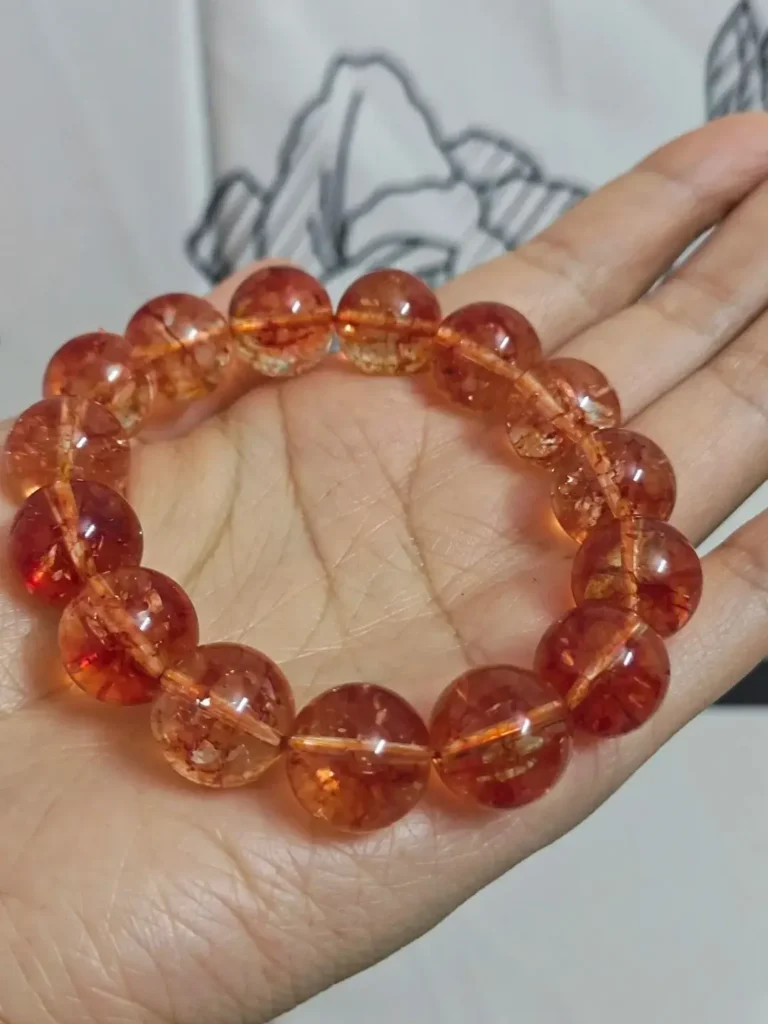
1. Check Internal Structure and Inclusions
- Genuine sunstone jewelry:
Under magnification, real sunstone shows a layered feldspar structure with natural cleavage planes. The hematite or goethite inclusions vary in size and sit in irregular positions. Nothing looks uniform or manufactured. - Imitation sunstone:
Glass-based imitations often contain dense air bubbles. To mimic sparkle, manufacturers may add metallic flakes. These flakes usually appear too regular, often triangular or overly uniform in shape.
2. Observe Color and Light Behavior
- Genuine sunstone jewelry:
The color looks vivid but not flat. It has depth and movement. When you rotate the stone under light, the golden shimmer emerges from within the crystal. The effect feels layered and slightly unpredictable, with natural optical variation. - Imitation sunstone:
Glass substitutes often look overly even or slightly dull in depth. They may still flash on the surface, but the light stays flat. The material lacks the internal metallic movement and optical complexity that real sunstone naturally shows.
Jewea Closing Note
Sunstone jewelry is not designed to be the most expensive gemstone piece. It works more like a recorder of light.
It traps light inside feldspar crystals and releases it at specific angles. The effect is not constant. It appears in moments, then disappears again.
In Jewea’s view, this is the most powerful quality of the stone:
It does not create perfect light. It preserves the trace of light as it passes through.
When sunstone and angel blue chalcedony come together in one necklace, the result is not a simple style combination. It forms a more natural visual structure.