Tiger’s Eye Bracelet: Is Yours Natural?
“I’m obsessed with the ‘Cat’s Eye’ effect, but I can’t justify the price of a Chrysoberyl. Are there any high-quality options under $100?” To this Jewea reader, my immediate recommendation is the Tiger’s Eye bracelet.

With its signature silky band of moving light, Tiger’s Eye captures the essence of chatoyancy, offering not just a single “eye,” but an entire strand of luminous motion at a fraction of the cost. It allows you to own an entire strand of “eyes” at a fraction of the cost.
Following our guide, “Chrysoberyl Cat’s Eye: The Only True “Cat’s Eye” Guide“ today we explore the mesmerizing world of Tiger’s Eye chatoyancy. But as its popularity grows, so does the market for “bleached” and synthetic fakes. Before you invest in a Tiger’s Eye bracelet, there are three things you must know:
- What exactly is Tiger’s Eye? (Understanding the silk of the stone).
- Tiger’s Eye vs. Hawk’s Eye: What is the real difference?
- The Authenticity Check: Is my Tiger’s Eye natural or treated?
What Exactly is Tiger’s Eye? (Understanding the “Silk” of the Stone)
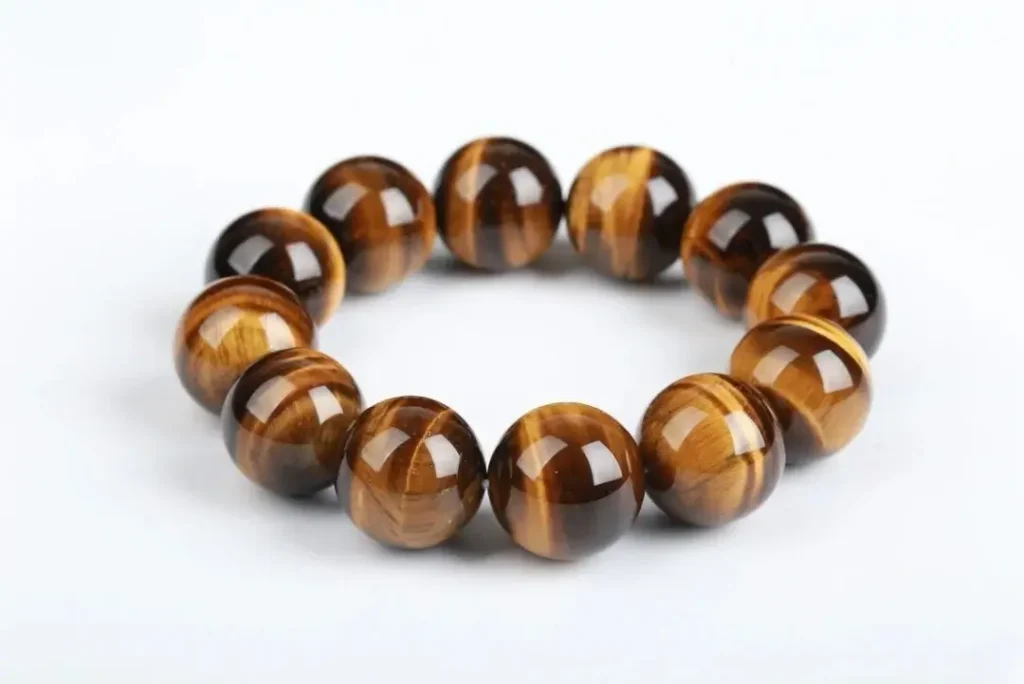
To understand a Tiger’s Eye bracelet, we need to look at what it really is: a variety of chatoyant quartz formed through a process called silicification.
In simple terms, Tiger’s Eye began as fibrous blue asbestos (crocidolite). Over time, this material was gradually replaced by silica (quartz), while preserving its original fibrous structure. This rare geological process gives Tiger’s Eye both its durability and its signature optical effect.
- Mohs Hardness: 5–7
- Relative Density: 2.48–2.85
- Refractive Index: 1.544–1.553 (Spot test: 1.53–1.54)
The Secret of “Silky Luster”
Among the many varieties of quartz, Tiger’s Eye is instantly recognizable for its distinctive silky, moving band of light—often described as a “cat’s eye” effect.
This visual phenomenon comes directly from its internal structure. Even after being replaced by quartz, the stone retains extremely fine, hair-like fibers arranged in parallel layers. When light hits these aligned fibers, it reflects in a concentrated band that appears to glide across the surface as the stone moves.
The result is a soft, fabric-like glow—what gemologists refer to as chatoyancy.
Tiger’s Eye vs. Hawk’s Eye: What Is the Real Difference?
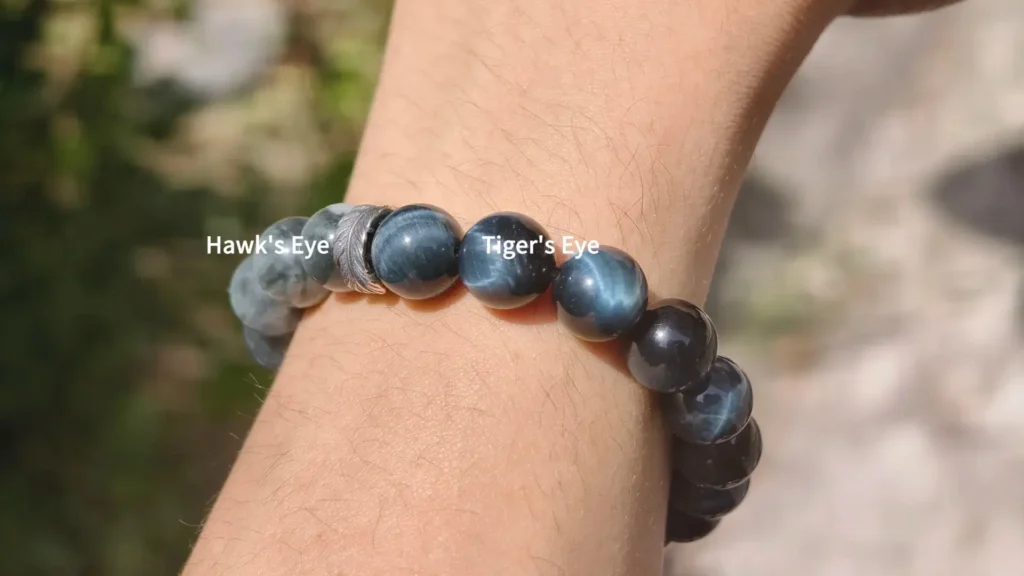
While Tiger’s Eye is the most well-known variety, it is often confused with its close “sibling,” Hawk’s Eye (also known as Falcon’s Eye). They share the same fibrous structure and silky luster, but differ primarily in color and stage of formation—making this a common point of confusion for new collectors.
The secret to telling these two “eye” siblings apart with the naked eye is simple: look at the color.
Tiger’s Eye: The Golden Glow
We reserve the commercial name Tiger’s Eye for stones ranging from golden-yellow and brown to reddish-brown. The presence of iron oxides (such as limonite), which form during the stone’s transformation, primarily creates this warm, earthy palette.
When cut into cabochons or polished into beads, Tiger’s Eye displays a flowing, silky shimmer—sometimes forming a distinct “cat’s eye” effect.
You might wonder: if both Tiger’s Eye and Chrysoberyl Cat’s Eye show this effect, why does the market prize one so highly while keeping the other affordable?
The difference comes down to three key factors:
- Optical Precision: The “eye” in Tiger’s Eye is typically broader and softer, lacking the sharp, high-contrast line seen in Chrysoberyl.
- Rarity: Tiger’s Eye is widely available, while Chrysoberyl Cat’s Eye is rare and highly collectible.
- The “Wink” Effect: Unlike fine Chrysoberyl, Tiger’s Eye rarely displays the dramatic “opening and closing” (milk-and-honey) effect as light moves across the surface.
Note: A less common variety known as Zebra Tiger’s Eye features irregular, interwoven patches of golden-brown and blue, reflecting variations in the stone’s formation.
Hawk’s Eye: The Blue Stage of Transformation
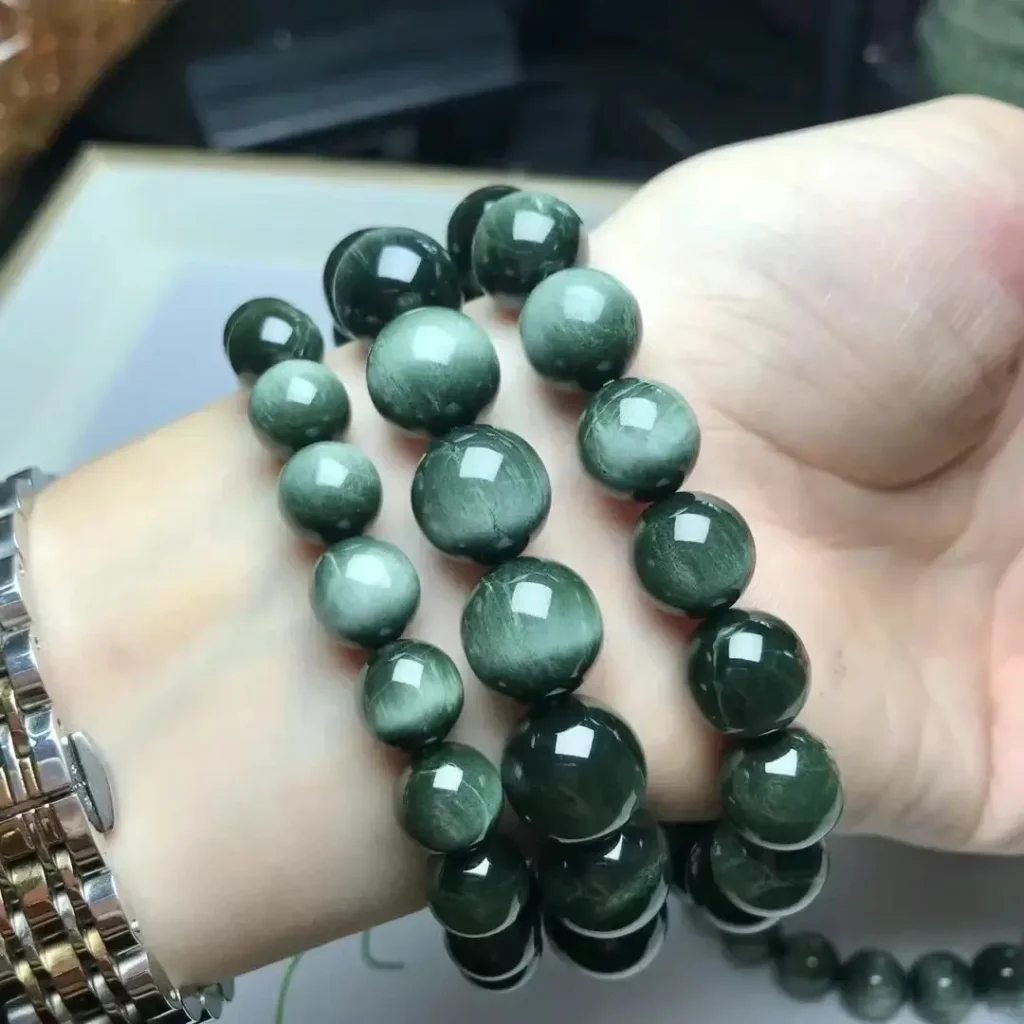
Hawk’s Eye (also called Falcon’s Eye) refers to the grayish-blue to blue-green varieties within the same family of chatoyant quartz.
Rather than having a completely different origin, Hawk’s Eye represents an earlier stage in the same transformation process. Its color comes from residual blue fibrous minerals (crocidolite) that have not yet fully altered. As oxidation progresses and iron content develops, this blue material gradually shifts into the golden tones seen in Tiger’s Eye.
When polished, Hawk’s Eye produces a cooler, steel-blue silky shimmer—more subdued, but equally captivating. Like Tiger’s Eye, it can also display a cat’s eye effect under the right lighting conditions.
Market Value & Form
Because the beauty of these stones lies in their silky luster and chatoyancy, lapidaries most commonly shape them into smooth cabochons, round beads, or polished inlays. Jewelers rarely produce faceted cuts or intricate carvings.
In terms of value, Tiger’s Eye offers strong visual appeal at an accessible price point due to its abundance. A natural Tiger’s Eye bracelet typically ranges from $20 to $100, depending on bead size, color, and the clarity of its chatoyant band.
Rather than rarity, its appeal lies in the balance between durability, visual movement, and everyday wearability.
The Authenticity Check: Is Your Tiger’s Eye Natural or Treated?

You might find yourself asking: at this price point, is there really any reason to alter Tiger’s Eye? The answer is yes. To meet demand for brighter, more visually striking material, many stones on the market have undergone various forms of enhancement.
Here is how to distinguish a natural stone from an artificially treated one.
1. eaching: Enhancing the “Golden” Look
Naturally, Tiger’s Eye varies widely in quality. Most rough material tends to appear relatively dark or muted, while the market favors brighter, more luminous golden tones.
To achieve this look, some manufacturers use acid treatment (bleaching) to lighten darker stones.
- What to look for: Bleached stones often display a noticeably bright brownish-yellow base with a somewhat exaggerated luster. The color may appear slightly “milky” or chalky within the golden bands. This high-contrast appearance is frequently mistaken for premium Golden Tiger’s Eye, when in fact the color has been artificially enhanced.
2. Dyeing: Expanding the Color Range
Natural Tiger’s Eye typically occurs in shades of yellow, brown, and reddish-brown, while Hawk’s Eye presents blue to gray-blue tones. In general, these colors are relatively subdued rather than highly saturated.
To create more vivid and commercially appealing colors, stones are often bleached first to remove natural pigmentation, and then dyed.
- The Red Flag: If you encounter Tiger’s Eye bracelet in vibrant magenta, bright green, or unusually intense blue, it is very likely dyed. While natural red Tiger’s Eye does exist, it typically appears as a deep, earthy brick-red—rather than bright or neon tones.
A Quick Science Note on Natural Color

The color of Tiger’s Eye primarily depends on the degree of silicification and the extent of iron-related mineral oxidation:
- Blue (Hawk’s Eye): The earliest stage, retaining more of the original blue fibrous crocidolite structure.
- Yellow / Gold (Tiger’s Eye): A transitional stage, where iron-related minerals such as limonite begin to influence the color.
- Brownish-Red: A more advanced stage, where stronger iron oxidation (often involving minerals like hematite) produces deeper red-brown tones.
The Bottom Line: If the color appears overly uniform, excessively bright, or simply too vivid for its price point, you are likely looking at an enhanced specimen rather than a fully natural stone.
Finding Your Perfect “Eye”
The true allure of Tiger’s Eye lies in its fluid, silky luster and unmistakable chatoyancy. While this stone does not share the extreme rarity of a Chrysoberyl, it remains a high-value daily essential for any jewelry lover.
We invite you to explore our curated selection of Tiger’s Eye bracelets to find a piece that resonates with your personal style and appreciation for genuine gemstones.