Madama, Hanadama, or Tokusen? The Ultimate Guide to Akoya Pearls
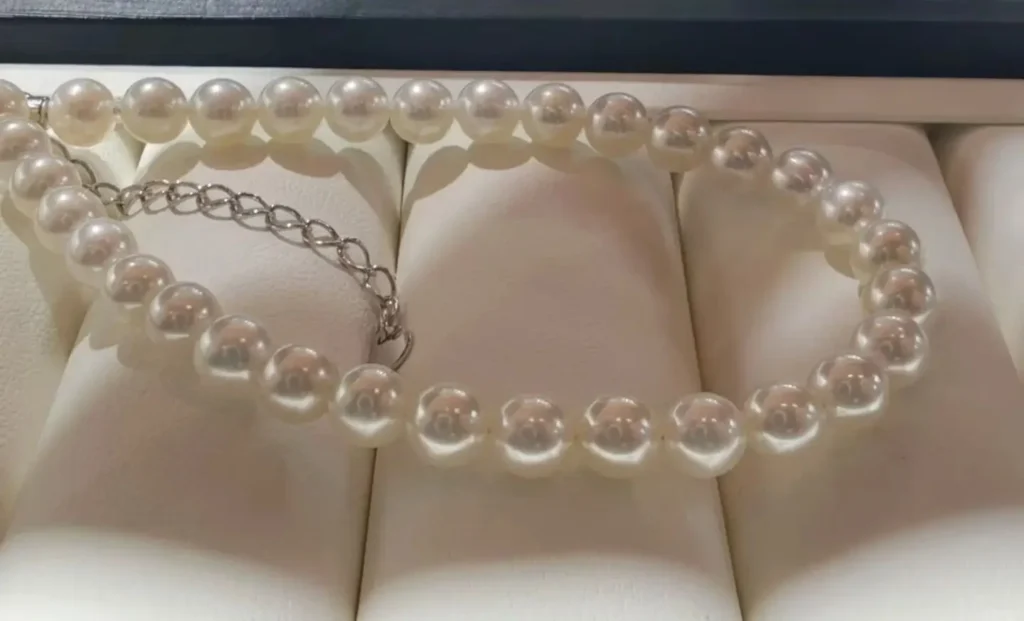
As the “petite and exquisite” icons of the pearl world, AKOYA pearls have become a must-have staple in every woman’s jewelry box. Their timeless elegance and effortless versatility make them the perfect accessory for any occasion.
However, in an era of information overload, consumers are often misled by pervasive myths. We frequently encounter questions such as:
- “Do you carry the ‘AKOYA brand’ of pearls?”
- “What exactly are ‘Tennyo’ and ‘Hanadama’, and how do they relate to AKOYA?”
- “Is it true that AKOYA pearls are exclusively found in Japan?”
If you find yourself overwhelmed by these technical terms and conflicting claims, you’re not alone. Today, let’s clear the air and take a deep dive into the true world of AKOYA pearls!
Akoya: A Pearl Variety, Not a Brand Name
Akoya pearls—also known as “Agoya pearls”. But wait! The meaning behind this name might not be what you think.
Myth #1: It is NOT a location
Contrary to what some retailers might tell you, “AKOYA” is not a geographical place name. While “Akoya” sounds like it could be a Japanese town, the only historical connection to a place called “Akoya” is Agui-cho in Aichi Prefecture. However, the primary heartlands for Akoya pearl cultivation are actually located in the Seto Inland Sea region (spanning Nagasaki, Mie, Kumamoto, and Ehime). These world-class pearl farms have absolutely no connection to Aichi.
Myth #2: It is NOT a brand
Let’s set the record straight: AKOYA is not a brand name. You won’t find an “AKOYA Corporation” owning these pearls. It is a category of saltwater pearl, not a trademarked label belonging to any single company.
The Origin of the Name: Why Akoya is Not a Brand
So, where does the name actually come from? It all traces back to the Pinctada fucata, the mother-of-pearl oyster that creates these saltwater gems. In Japanese, this specific oyster is called “あこや” (pronounced: Ah-ko-ya).
Because Japanese innovators were the first to successfully master the cultivation of these high-quality saltwater pearls, the industry naturally adopted the Japanese name of the oyster itself. Thus, the “Akoya Pearl” was born.
What are Akoya Pearls?

Unlike many gemstones named after locations, Akoya pearls take their name directly from the oyster that creates them: the Pinctada fucata martensii. Typically, a single Akoya oyster nurtures only one pearl at a time, making each gem a singular labor of nature.
Size: Small but Exquisite
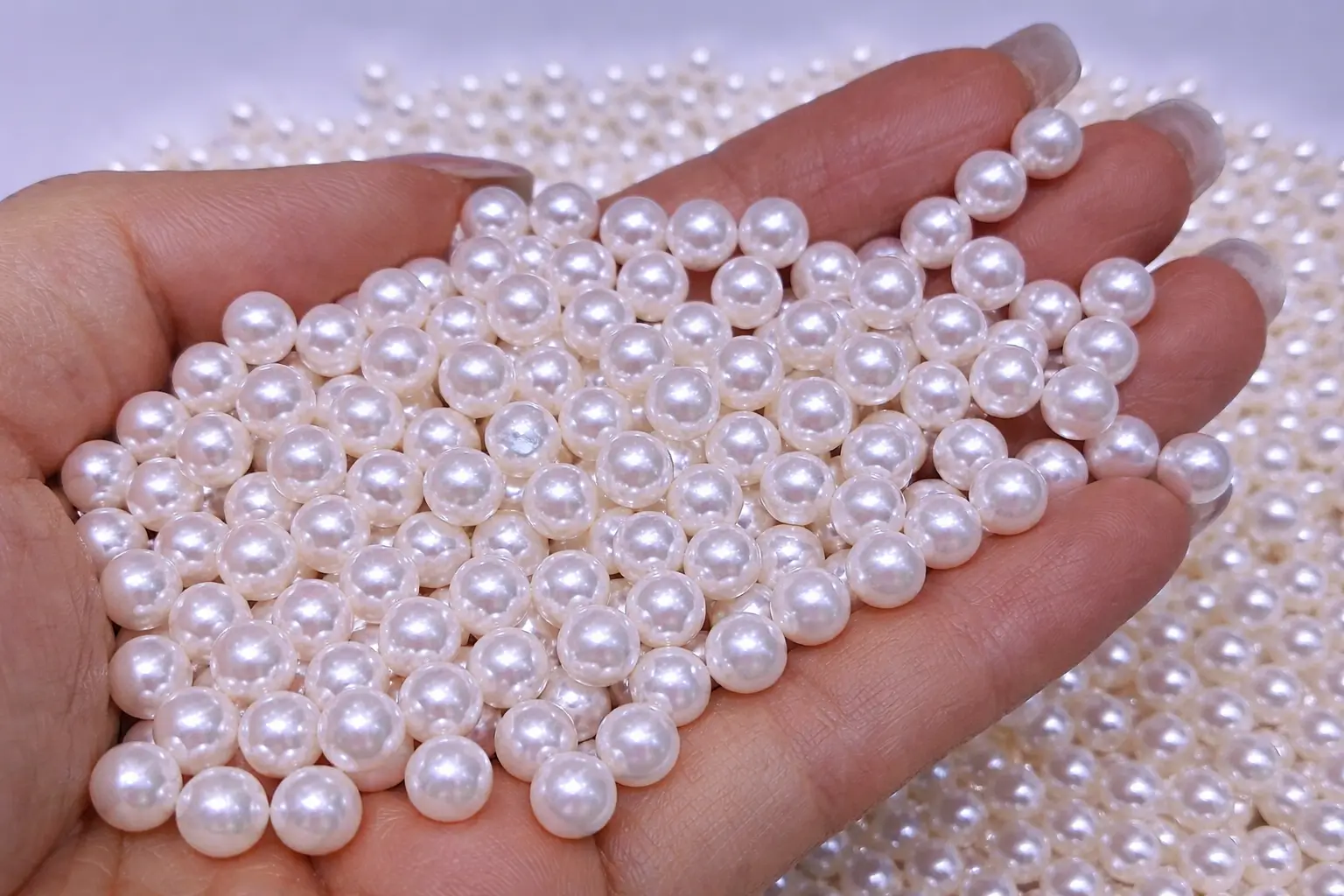
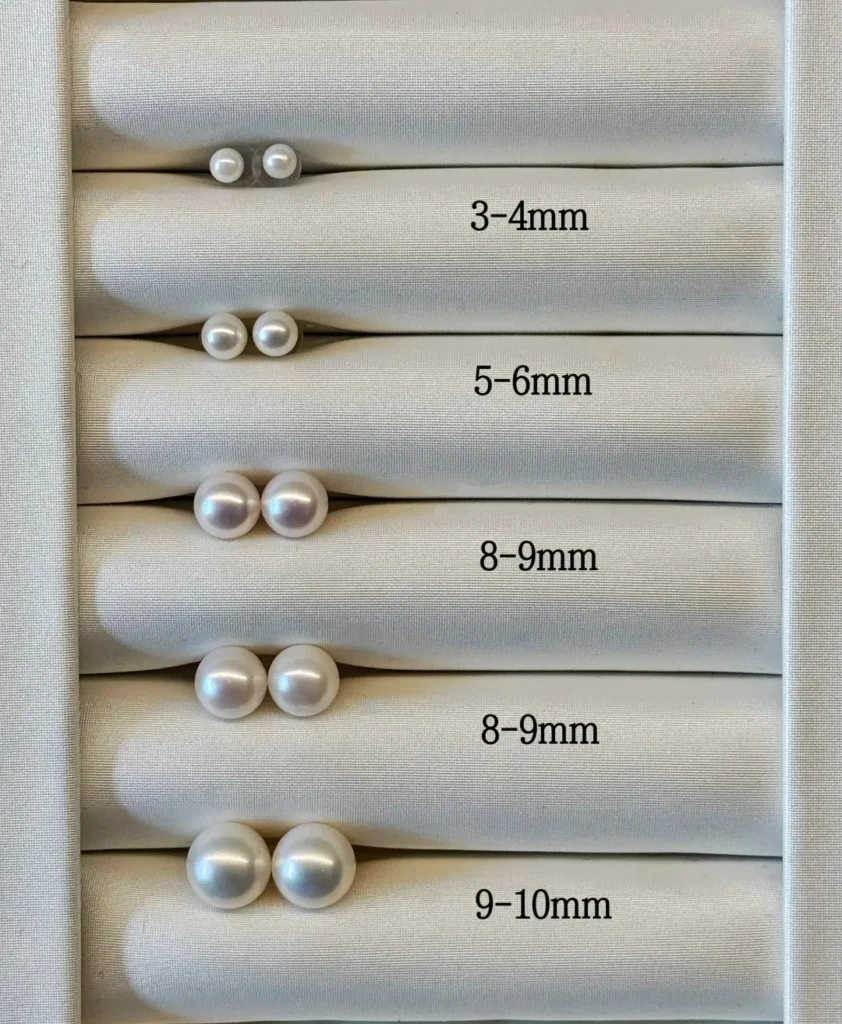
Most Akoya pearls measure between 5mm and 8.5mm in diameter. While harvests exceeding 9mm remain scarce, specialized Japanese cultivation can produce exceptional specimens reaching 10mm. However, these rare, large-scale pearls command a massive price premium that far exceeds the cost of standard sizes.
Shape: The Near-Perfect Sphere
Akoya pearls are celebrated for their classic silhouettes. While you can find unique oval and organic Baroque shapes, the market predominantly treasures them for their near-perfect spherical roundness.
Lustre: The “Little Lightbulb”
What truly sets the Akoya apart is its extraordinary brilliance. Influenced by their specific marine environment and the mother-of-pearl host, these gems possess a multi-dimensional glow that far surpasses most freshwater pearls. With a mirror-like metallic luster so sharp it can reflect your own image, they have earned the affectionate nickname: “The Little Lightbulbs” of the pearl world.
Color: A Symphony of Hues
The color of an Akoya pearl is a sophisticated blend of its body color, overtone, and orient. While the primary body color is typically white, the palette is incredibly diverse:
- Classic White & Pink: The most sought-after combination, often featuring soft rose overtones.
- Silver-Blue & Gold: Rare and striking natural shades.
- Nuanced Tones: Depending on the subtle play of light (orient), you may discover shades of silver, pale gold, champagne, creamy yellow, and elegant ivory.
Akoya Pearl Grading Explained: Decoding Hanadama vs. Tennyo Standards
If you’ve started exploring the world of Akoya pearls, you’ve likely encountered terms like Hanadama, Tennyo, or Madama. While these names may seem confusing at first, they aren’t just marketing buzzwords—they are prestigious titles awarded by Japanese gemological institutions to categorize the absolute “crème de la crème” of the Akoya harvest.
Think of these names as titles of excellence. Here is how the industry distinguishes its most prized gems:
Madama: The Silver-Grey Rarity
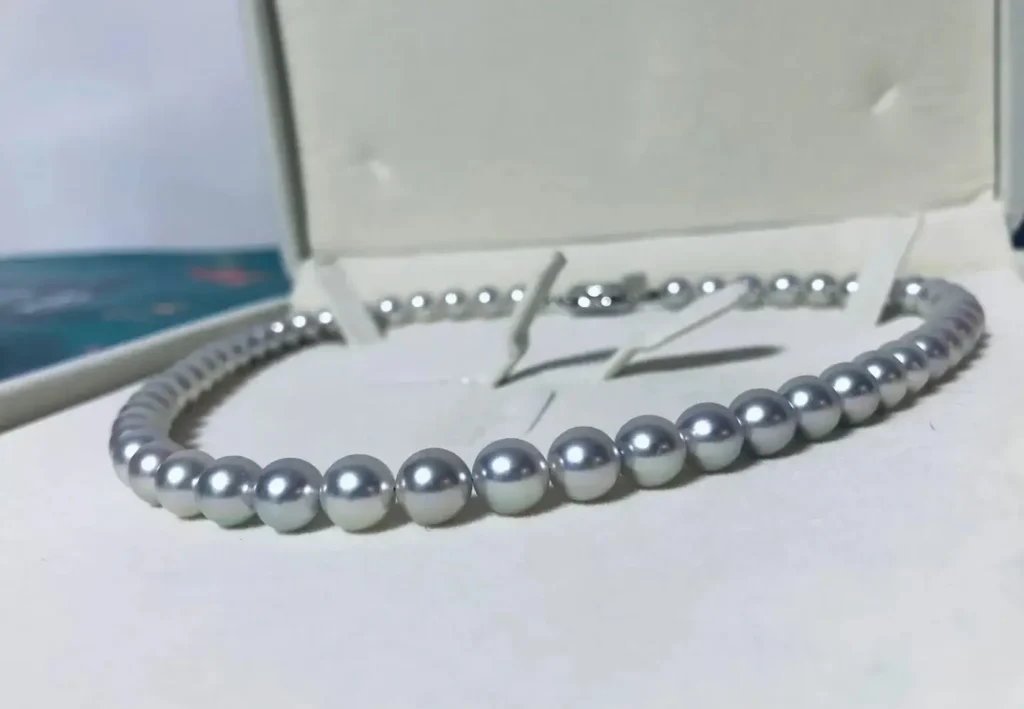
The Japan Pearl Science Laboratory (JPSL) reserves the name Madama exclusively for the highest-quality silver-grey Akoya pearls. Strictly speaking, a silver-grey pearl cannot bear the “Madama” title without an official certificate from the JPSL. Because they must exhibit an extraordinary metallic luster and a flawless surface, top-tier Aurora Madama pearls are the “Blue Diamonds” of the Akoya world—a rare, natural phenomenon that represents only a microscopic fraction of the global harvest.
Sairin: The “Miniature Hanadama”
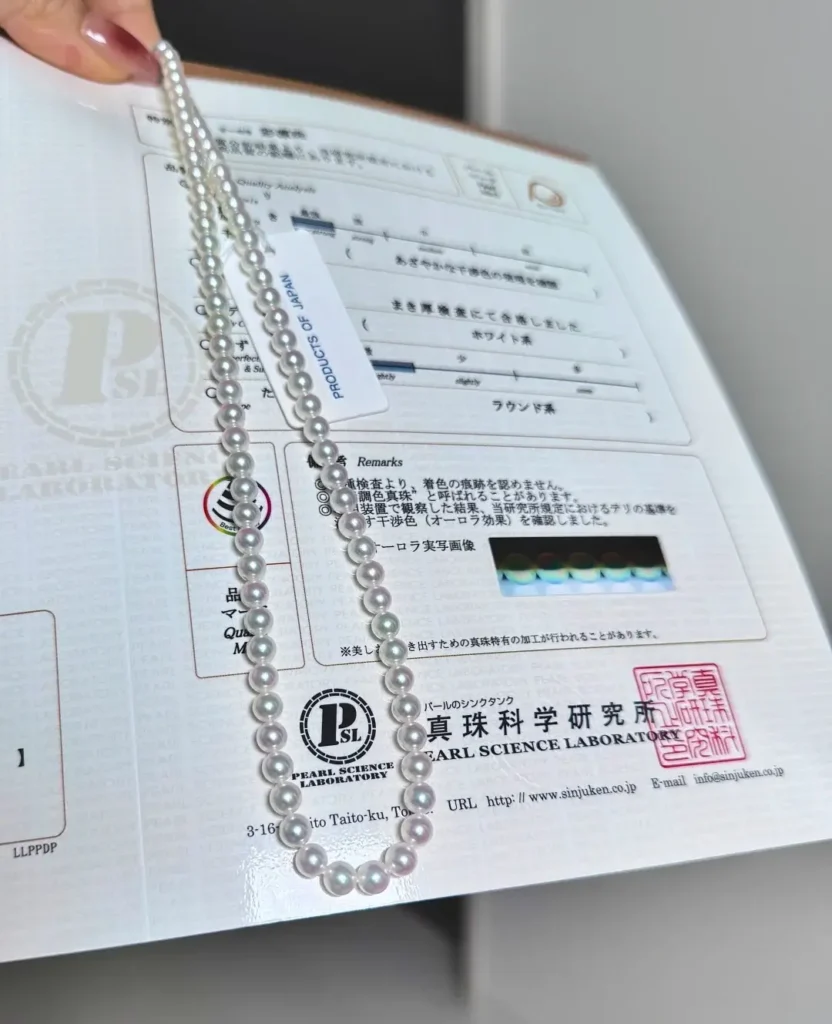
The Japan Pearl Science Laboratory (JPSL) reserves the name Sairin (meaning “Radiant Colors”) exclusively for high-quality Akoya pearls measuring under 6mm. Think of Sairin as the “Miniature Hanadama”—these petite gems mirror the elite luster and surface standards of their larger counterparts. Despite their small scale, Sairin pearls are the unrivaled champions of the small-size Akoya category, offering a concentrated brilliance that makes them a favorite for delicate, high-end jewelry designs.
Hanadama: The Pinnacle of White Akoya
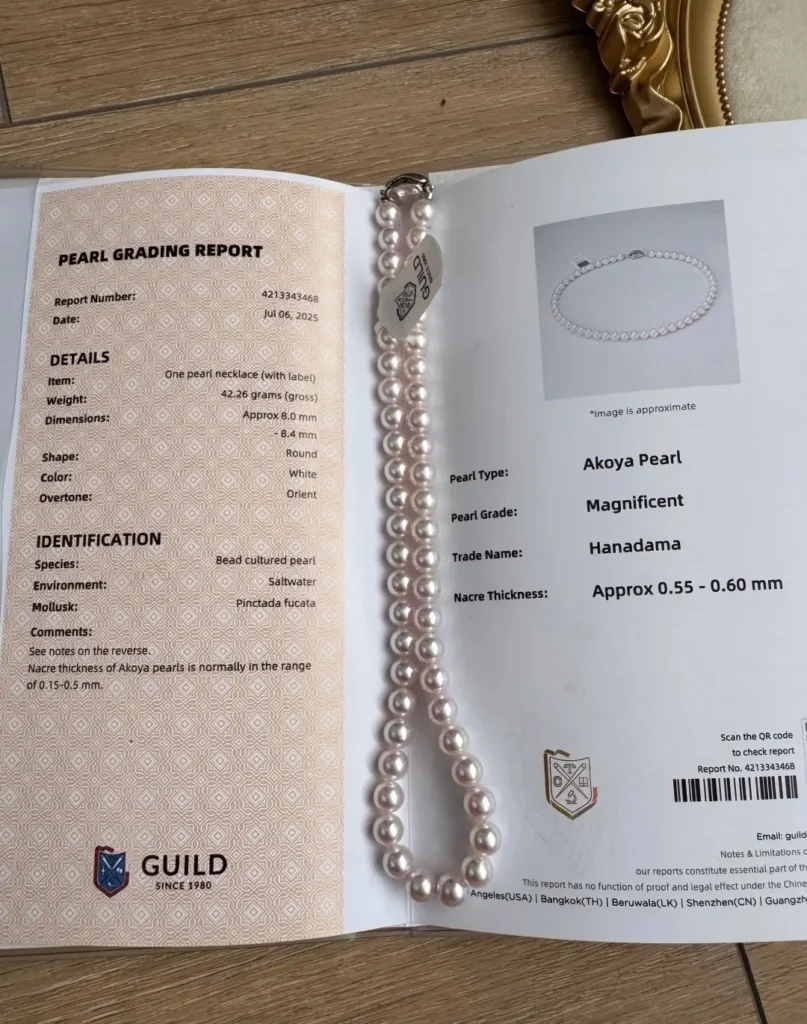
The Japan Pearl Science Laboratory (JPSL) reserves the name Hanadama exclusively for the highest-grade white Akoya pearls. To earn this designation, pearls must meet the JPSL’s most rigorous evaluation standards for luster, surface, and nacre. The term originates from the Japanese word Hana (meaning “tip” or “edge”), signifying that these pearls stand at the very pinnacle of production. In today’s market, Hanadama pearls represent a miniscule percentage of the total annual Akoya harvest. This extreme rarity, combined with their unrivaled mirror-like brilliance, makes them the most coveted treasures in the saltwater pearl industry.
Tennyo: The Goddess of Luster
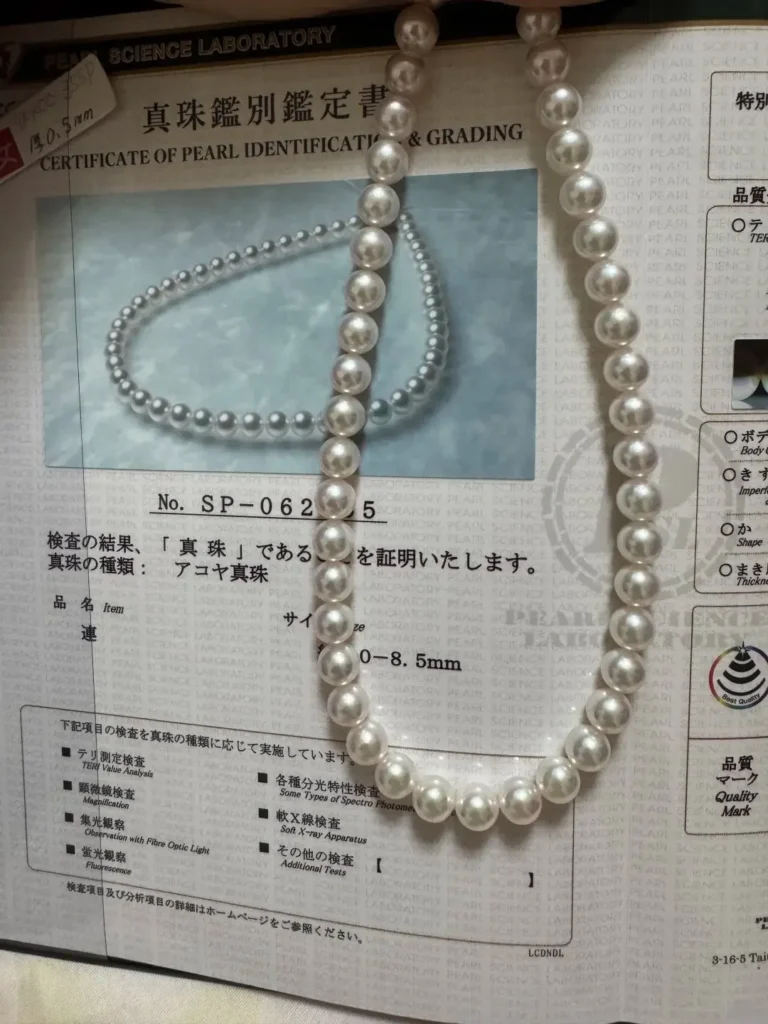
The Japan Pearl Science Laboratory (JPSL) reserves the name Tennyo (meaning “Goddess”) exclusively for the absolute elite of Hanadama pearls. This title represents a tier even higher than the standard Hanadama, specifically identifying pearls that exhibit powerful interference colors. To achieve Tennyo status, a pearl must simultaneously meet a series of grueling criteria: it must be a perfect sphere, possess a flawless or near-flawless surface, and feature a nacre thickness exceeding 0.5mm. Most importantly, the JPSL employs a proprietary, scientific testing system known as “TERI” to quantify this unparalleled radiance. Without this specialized JPSL certification, a pearl cannot be classified as a true Tennyo.
Tokusen: The Ultimate Selection
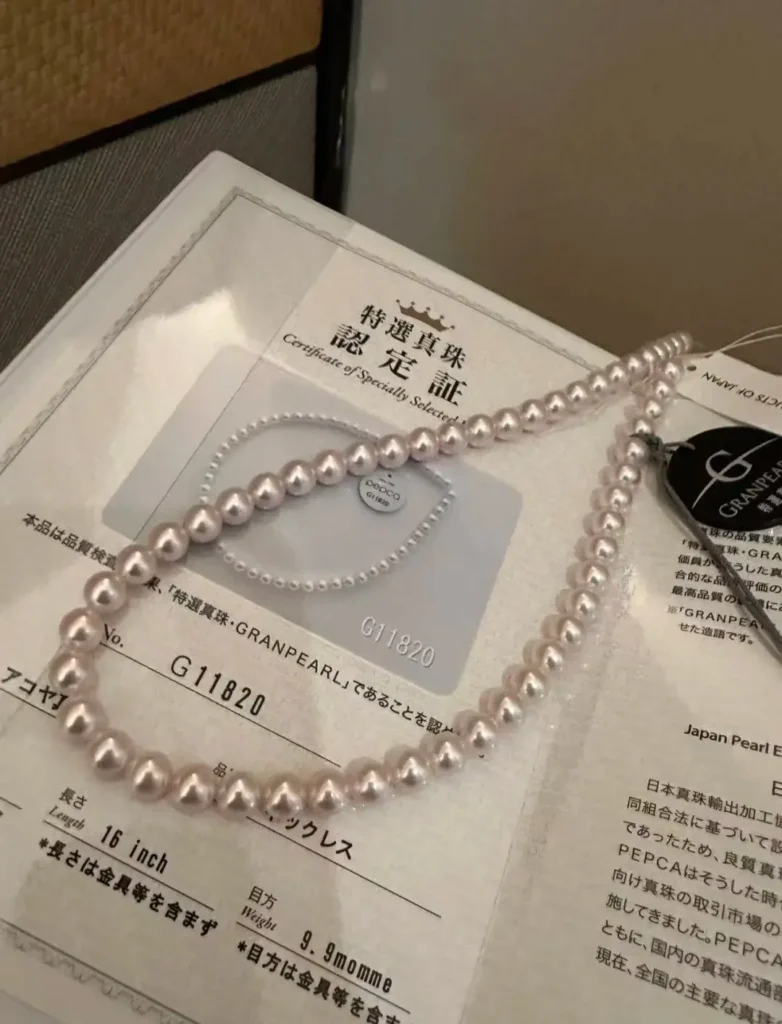
If any title surpasses the prestigious “Tennyo,” it is undoubtedly Tokusen. This exclusive designation appears on certificates issued by the Japan Pearl Exporters’ Association (JPEA) to describe the most extraordinary Akoya pearls ever harvested. Unlike standard laboratory grading, Tokusen (meaning “Specially Selected”) represents the absolute pinnacle of rarity and value. When a strand is graced with the “Tokusen” seal from the JPEA, its market value skyrockets, positioning it as a true collector’s masterpiece. In the hierarchy of Akoya pearls, Tokusen is the “Reserve Vintage”—a gem so rare that it defines the upper limit of pearl luxury.
Tennyo vs. Tokusen: The Ultimate Akoya pearls Showdown
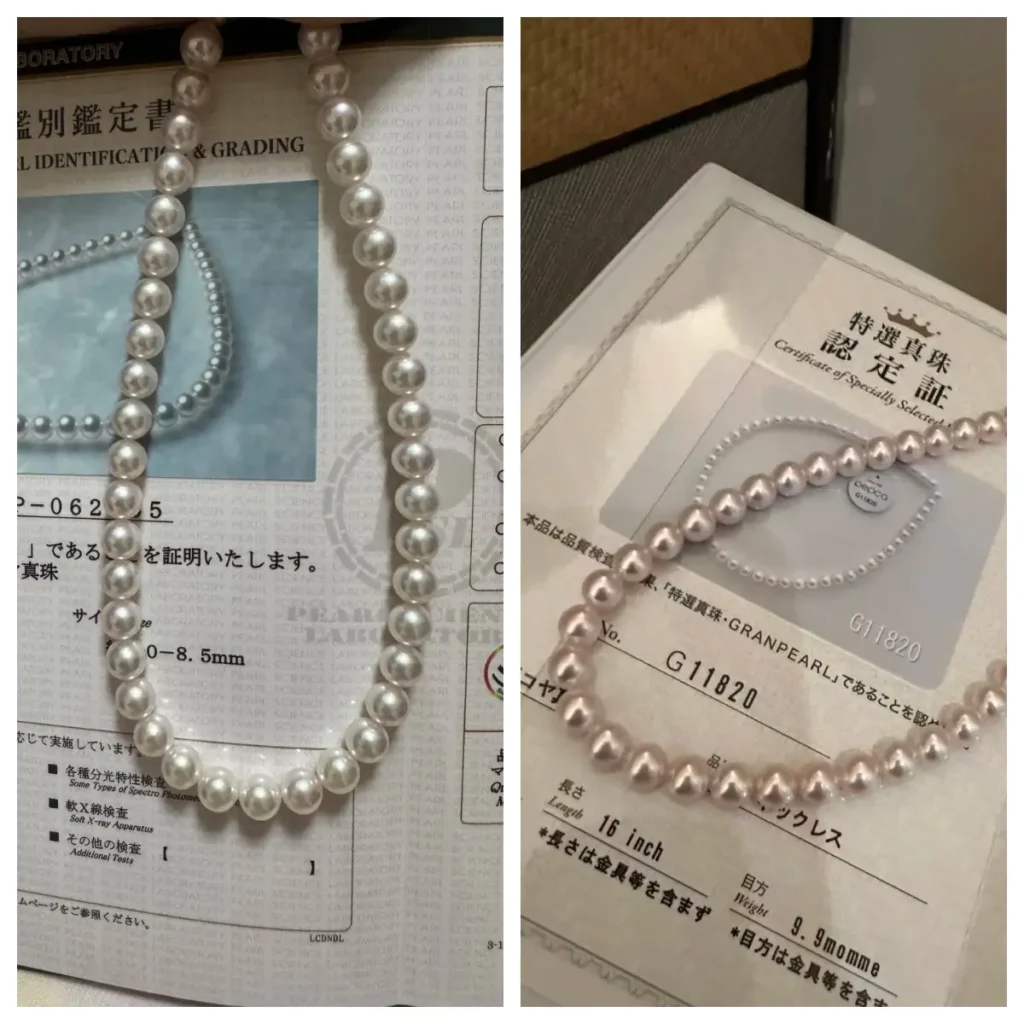
In the Japanese pearl industry, Tokusen is the undisputed gold standard. While every Tokusen-certified pearl meets or exceeds Tennyo requirements, the reverse is not true—only the elite few among Tennyo pearls possess the rarity to earn the Tokusen title.
When ranked by rarity and market value, the hierarchy is absolute: Tokusen > Tennyo > Hanadama > Sairin
In high-end pearl trading, these titles are not marketing adjectives—they are certified legal designations. A pearl cannot be labeled “Tennyo” or “Tokusen” based on a seller’s claim; it requires a rigorous, multi-point scientific inspection backed by a formal Certificate of Authenticity. A “Tokusen” seal from the JPEA doesn’t just guarantee beauty—it ensures the pearl’s status as a high-value investment.
Recognized Authorities
To buy with absolute confidence, only trust grading reports from these globally recognized institutions:
- Japan Pearl Exporters’ Association (JPEA)
- Japan Pearl Science Laboratory (JPSL)
- Japan Pearl General Laboratory
Without an official report from these authorities, any “top-grade” claim is merely speculation. Always demand the paperwork to ensure your investment is truly world-class.
Are Akoya Pearls Exclusive to Japan? The Global Production vs. Market Reality
While Japan remains the spiritual home of the Akoya pearl, the story of its origin is more nuanced than most realize. As we established, “Akoya” describes pearls harvested from the Pinctada fucata oyster—a species that naturally ignores international borders.
Today, Japan continues its reign as the primary producer of Akoya pearls, yet successful cultivation also thrives in the coastal regions of Guangdong and Guangxi, China. Specifically, the waters around Beihai now host extensive Akoya farms, contributing a massive volume to the global supply chain.
The Japanese Advantage: Mastery of Quality
If both countries grow these pearls, why does Japan still dominate the high-end market? The answer lies in their uncompromising quality control.
Japanese cultivators have spent over a century perfecting the technology and biological research behind pearl nucleation. Furthermore, Japanese gemological institutes enforce rigorous grading standards that bar low-quality or “sub-par” pearls from ever entering the premium market. This relentless pursuit of perfection cements the “Japanese Akoya” as the undisputed global benchmark for excellence.
Market Dynamics: A Collaborative Powerhouse
The relationship between these two regions is often more collaborative than competitive. Today, many Japanese wholesalers import high-quality raw pearls from China. They then apply sophisticated Japanese processing and grading techniques to these gems before exporting them alongside their domestic harvests.
By blending a global supply with local expertise, Japan maintains its undisputed leadership in the pearl industry. Whether a pearl begins its life in Beihai or Mie, the Japanese standard of finishing remains the definitive key to its prestige.
Akoya vs. Nanzhu: Two Names, One Queen

There is an ancient Chinese proverb that defines the hierarchy of pearls: “Freshwater pearls are fine, Eastern river pearls are rarer, but Nanzhu (Southern) pearls are supreme.” For centuries, Nanzhu pearls—harvested from the pristine waters of Beihai and Hepu—have been celebrated as the “Queen of Chinese Saltwater Pearls.” Since the Qin Dynasty, these gems were so prized they were reserved exclusively as imperial tributes for emperors.
Identical Lineage: The Pinctada Fucata
Many collectors are surprised to learn that Nanzhu and Akoya pearls are biological siblings. Both are born from the same mother: the Pinctada fucata (Akoya) oyster. While “Akoya” is the modern Japanese term that dominates the global market, “Nanzhu” is the historical legacy of the exact same saltwater species cultivated in Southern China.
A Tale of Two Standards
If they share the same DNA, why do their reputations differ? While Nanzhu carries the weight of 2,000 years of imperial history, the Akoya name has come to define the modern global standard. This is due to Japan’s 20th-century mastery of spherical nucleation and the implementation of industrial-grade certification. Today, the choice is between heritage and precision: whether you seek the ancient legacy of a Hepu Nanzhu or the certified perfection of a Japanese Akoya, you are investing in the same exquisite luster that has defined saltwater luxury for millennia.
A Note from Jewea
At Jewea, we believe in radical transparency. Many retailers market Akoya pearls as an “exclusive Japanese treasure,” but the reality is quite different: Akoya pearls exist in abundance throughout the Chinese market. The reason many sellers avoid discussing the true origin of their pearls ultimately comes down to a strategic game between provenance and market perception. The global success of any gemstone relies on a robust and standardized grading system. Much like the 4Cs revolutionized the diamond industry, Japanese gemological institutions have perfected a meticulous grading hierarchy for Akoyas. This precision is a primary driver behind the commercial triumph of Japanese Akoya pearls.
In the jewelry world, the “water” isn’t actually that deep—it is the human heart that hides the truth. We believe that the more transparent the information, the more vibrant the market becomes.